 Briefing
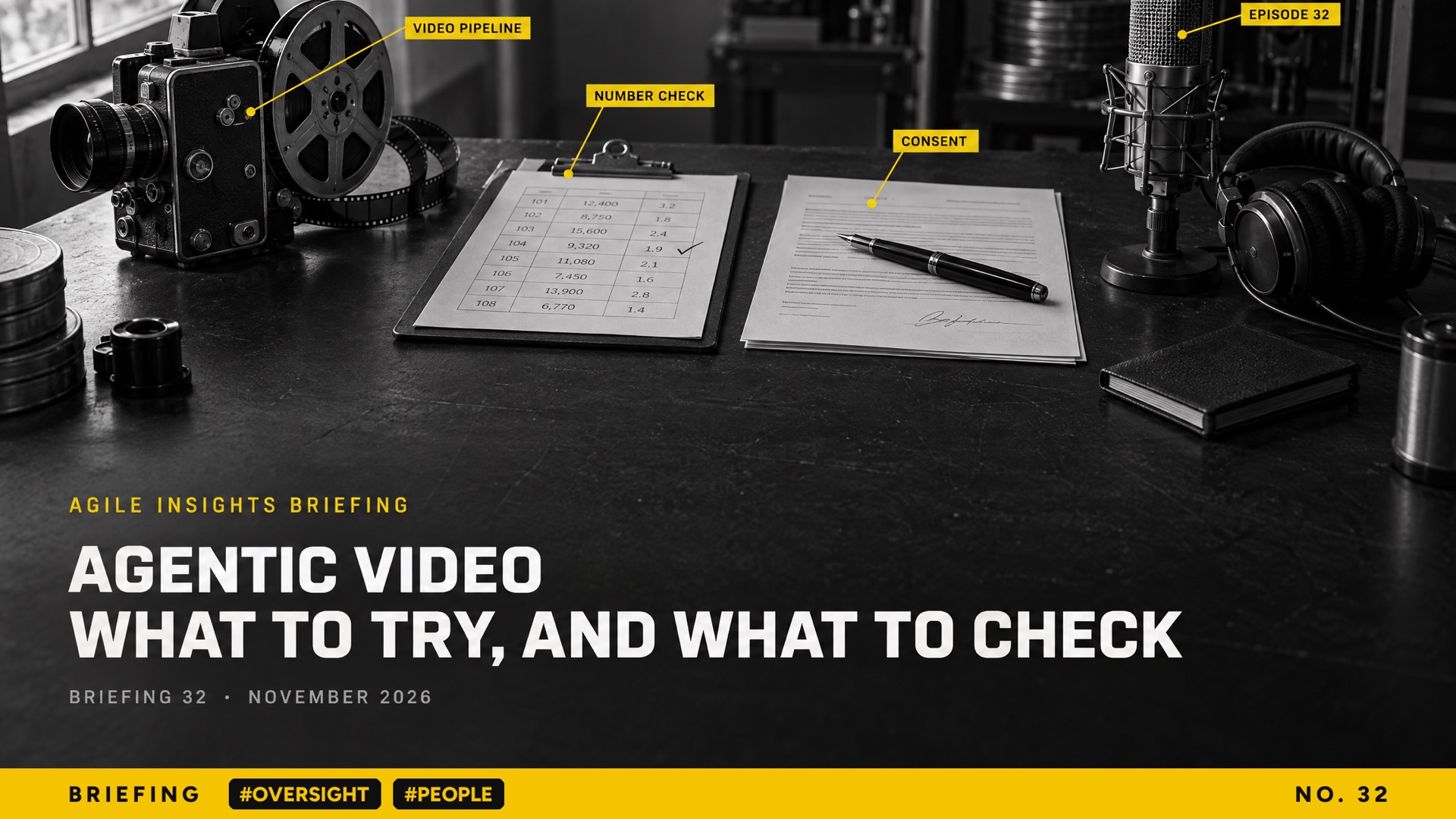
Episode 32 · Primer and discussion · About 13 minutes
Agentic video is real: what to try, and what to check
Part 1: Primer · About 6 minutes
Download the MP3 · Linda and Leonard, AI voices, read a script written from the sources below.
Part 2: Discussion · About 6 minutes
Download the MP3 · Linda and Leonard, AI voices, read a script written from the sources below.
In this episode
01Editing became a conversationCoding agents can now find good takes, trim pauses and assemble a first cut, watch long footage, and write animation as code that renders to a file.
02Assembled beats generatedThe cheap, reliable kind of AI video is real recordings, voices and data with the agent doing the edit. The host found animation worked better than generated footage.
03Six signs video beats the docShowing beats telling, the audience will not read it, you repeat the explanation, it needs several languages, recordings exist, or conviction must land. Otherwise, write the document.
04A pipeline is an applicationOnce a video publishes on a schedule it is software: it needs a named owner, a number check that stops the run, a data date on every frame and a record of versions.
05What to do firstStart with how-to, explainer and handoff videos on material that is not confidential. Hold personalised sales videos and staff avatars until there is consent, a number check and an owner.
Sources and links (4)
The AI Daily Brief, 8 November 2026 · Episode page
The episode this briefing is built on: eight changes, six signs and three levels for agentic video.
The episode this briefing is built on: eight changes, six signs and three levels for agentic video.
Introducing agentic video understanding with Gemini · Google blog
Google's announcement, 1 September 2026, with its own figures on token use and accuracy for long video.
Google's announcement, 1 September 2026, with its own figures on token use and accuracy for long video.
What is custom text to speech avatar? · Microsoft Learn
Microsoft's documentation, including the recorded consent statement it requires before building a custom avatar.
Microsoft's documentation, including the recorded consent statement it requires before building a custom avatar.
New EU guidance on AI transparency · Baker McKenzie
Baker McKenzie on Article 50 of the EU AI Act and the deepfake disclosure duties that apply from 2 August 2026.
Baker McKenzie on Article 50 of the EU AI Act and the deepfake disclosure duties that apply from 2 August 2026.
Written from the episode and public sources, checked on 10 November 2026. The use cases are the host's suggestions, not case studies, and the Google figures are Google's own. Check the originals before quoting.
Our fact check · 14 claims: 5 confirmed, 7 reported, 1 unverified, 1 not yet known
Before we record, every claim the hosts make is checked against the sources (this table was last updated 10 November 2026). Confirmed means a primary source or two independent reports; Reported means one party says so; Partly right, Disputed, Unverified and Not yet known mean what they say, and the hosts say so on air. This is the table as we left it.
- ReportedOpus 5.5 is to video what Opus 4.5 was to codeOpinion: The host's view, not a measured result
- ReportedEditing by conversation is available in video tools and natively in Claude Code and CodexThe host's account; the named tools were not tested for this episode
- ConfirmedGoogle's agentic video understanding cuts tokens by up to 88% and lifts quality by up to 7%As published; Google's own post, 1 Sep 2026, for Gemini 3.7 Flash; "up to" figures, largest on long video; no independent test found
- ConfirmedThe model decides what to watch, at what speed, across frames, audio and transcriptGoogle, 1 Sep 2026
- ConfirmedClaude Code can build animated video in React and render it with RemotionRemotion publishes agent skills and a Claude Code plugin (Tella guide, Aug 2026, citing Remotion's own repository)
- ReportedAgents can record their own product demos with computer useThe host calls it "nascent but real"
- ReportedGenerated B-roll has improved, but animation works better for explainingThe host's experience on his own project
- ReportedAvatars and dubbing already deliver value inside companiesOpinion: The host's view; no data given
- ReportedSix signs that video beats the documentOpinion: The host's framework
- ReportedOne base video can become 20 to 30 personalised sales versionsThe host's example; no case named
- ConfirmedA custom avatar on Microsoft's platform needs a recorded consent statement from the personMicrosoft Learn, custom text-to-speech avatar, checked 9 Nov 2026
- ConfirmedIn the EU, deepfake disclosure duties under Article 50 of the AI Act apply from 2 August 2026Baker McKenzie, 2 Jul 2026; the test is audience-based and needs no intent to mislead; minor technical edits generally fall outside it
- Not yet knownWhether a lifelike avatar of a real staff member counts as a deepfake under the EU testDepends on realism and how it is presented; no guidance found on internal work video
- UnverifiedSelf-updating videos stay accurateThe host says the pipeline can be set up now; no one has shown how often they go wrong
Want to know more?
Sign up for our podcast at agile-insights.com.au.
Read the transcript · Part 1: Primer
Linda Here is the idea for today. Making a short, edited video at work has become cheap enough to be worth doing, because the same AI agents that write code can now edit footage and build animation. That changes who makes video, and it means a video pipeline should be governed like any other piece of software. By the end of this primer you will know what has changed, when a video beats a document, and the few controls that keep a cheap video honest.
Leonard So this comes from an episode of The AI Daily Brief on the eighth of November. The host, Nathaniel Whittemore, makes a comparison that a lot of people in technology will recognise. About a year ago, a coding model got good enough that people who could not code started building working software. He thinks the newest models are doing the same thing for video. What actually changed, though? Video editing has had clever tools for years.
Linda He lists eight changes, and three of them do most of the work. The first is that editing became a conversation. You can ask an agent to find the best takes, trim the pauses, place some supporting footage and assemble a first cut, inside the coding tools people already use. The second is that a model can now watch footage. Google published a feature in September where the model decides which parts of a long video to look at, and at what speed. Google says it uses up to eighty eight per cent fewer tokens and is up to seven per cent more accurate, with the biggest gains on recordings that run for hours. Those are Google's own figures, and nobody has tested them independently yet.
Leonard And the third?
Linda The third is animation. A coding agent can now write an animated video as code, using a library called Remotion, and render it to a file. That matters because animation explains dense information well, and because code can be re-run. The host says that on his own projects, animation has worked much better than video generated from a text prompt, which can still look slightly wrong. So the cheap, reliable kind of AI video is not a model inventing footage. It is real recordings, real voices and real data, with the agent doing the editing and the graphics.
Leonard That is a useful line to draw. But cheap does not mean wanted. Nobody needs more video in their week. How does he decide when a video is actually the right format?
Linda He gives six signs, and they make a good test. Video beats a document when showing beats telling, like a new screen or a number changing between quarters. When the audience will not read the document. When you keep giving the same explanation. When it has to work in several languages. When the recordings already exist. And when you need conviction to land without being in the room yourself. His sharpest point is about the audience. Busy executives, frontline teams and customers will not read a wall of text, and that is a fair reading of their week, not a judgement about them. If none of the six signs apply, write the document.
Leonard Fair enough.
Leonard Then here is where it gets interesting for anyone who looks after AI in an organisation. He describes three levels. At level one, the agent edits footage you already have, like a highlight reel from a long meeting. At level two, it makes something new, like last quarter's results as an animated chart. At level three, it runs a pipeline, say a two minute update every Friday built from metrics and tickets. And he puts it neatly himself: a video is a video, but a pipeline is an application that makes videos. That is the governance moment, isn't it?
Linda It is. Once something publishes on a schedule without a person pressing the button, it is software, and it needs what software needs. A named owner. A check on what it says, especially the numbers, because a video is believed faster and checked less than a document. People skim a report twice, but almost nobody re-watches a video to check a figure. So the numbers should come from a fixed set of data, and the run should stop if the script says something different. Every frame should carry the date the data was taken. And there should be a record of which version said what, so that if the figures are restated, you can find the old videos and pull them.
Leonard Mm. That is the bit that matters.
Leonard And people. A lot of these use cases put real faces and voices on screen, and some of them are copies of people rather than the people themselves. Where does consent come in?
Linda That is the second control. If you make an avatar or a voice copy of a staff member, get recorded consent, say what it can be used for, and decide what happens when that person leaves. Microsoft already requires a recorded consent statement before it will build a custom avatar. If you cut a heated meeting into a short video for people who missed it, tell the people in it before it travels. And put a short line at the end saying the video was made with AI and who reviewed it. In Europe, rules on disclosing lifelike AI content have applied since August this year, so the habit will be expected anyway.
Leonard So the practical starting point is small...
Linda Very small. Pick one explanation you keep giving, and try level one or two on material that is not confidential. Use the six signs to decide whether it should be a video at all. Before anything reaches level three, give it an owner, a number check, consent for every face and voice, and a date to be remade or retired. In part two, we look at the use cases themselves, and where the risk really sits.
Read the transcript · Part 2: Discussion
Linda The idea again, briefly. AI agents can now edit footage, watch recordings and animate data, so a short video at work costs very little to make. The risk moves from making the video to trusting it. In this part we take the use cases from The AI Daily Brief on the eighth of November and ask which ones to try first, and which ones need a decision before anyone builds them.
Leonard A quick recap for anyone who skipped part one. The host's three levels are: the agent edits footage you already have; it makes something new, like an animated chart; or it runs a pipeline that publishes on a schedule. His six signs say when video beats a document, and the strongest is simply that the audience will not read the document. The controls we described were an owner, a number check, consent for faces and voices, a disclosure line, and a date to remake or retire the video.
Linda So let me start with the use cases I would try first, because they are low risk and they teach you the tools. The how-to video for a new screen or a new process is the obvious one. It is the same explanation, given again and again, which is one of the six signs, and nothing in it is confidential. Then the explainer for something hard, like a pricing model. The host suggests talking it through with the AI, asking for a better structure, then animating that. And the handoff video, when someone is leaving or going on leave. Talking for twenty minutes is faster than writing a handover document, and the successor gets the reasons, not just the steps.
Leonard I agree with all three, and the handoff one is quietly important. Knowledge walks out the door at every transition, usually because the person leaving is overloaded until their last day. But I would put the meeting video in a different bucket. The host's example is a meeting where a decision was argued hard, and he says a short cut of the actual exchanges serves the people who missed it better than minutes. I can see that. But a cut is an edit, and an edit is a point of view. Choose which ninety seconds of an hour to show and you have chosen whose argument sounds stronger. Minutes get agreed. A clip just travels...
Linda That is fair, and I would not drop the use case, I would change who signs it off. The chair of the meeting, or whoever owns the decision, approves the cut before it goes anywhere, and the people in it know it exists. That is the same rule you would apply to minutes, just made explicit because the format feels more like evidence. Video carries a kind of authority that text does not. When you see someone say it, you believe that is what happened, even when the edit left out the reply.
Leonard Then the exec pre-read. The host's line is that it assumes nobody reads the pre-read, which got a laugh from me. A strategy paper or business case turned into a short video for leaders who have to get up to speed fast. My worry there is different. A video is linear. You cannot skim back to the assumptions table, and a board member who would have spotted the weak number on page six now hears a confident voice go straight past it. So I would only do it as a companion. The video gets people into the paper. It never replaces the paper, and the numbers in it come from the paper, word for word.
Linda Always page six.
Linda Agreed. Two use cases I would hold back until there is a governance decision. The first is personalised sales video. The host's example is one base video turned into twenty or thirty versions, each with the prospect's own name and numbers. Each is a separate claim to a customer. If one carries the wrong figure, that is a misstatement with your logo on it. So every version goes through the same number check as the base, and someone owns the template. The second is the avatar. The host says avatars and dubbing already pay off inside companies, especially for translation, and I believe that. But a lifelike copy of a real employee needs recorded consent, a written scope, and a rule for what happens when they leave.
Leonard The last one is my favourite and the riskiest: the video that updates itself. How-to videos and process guides rarely got made because footage goes stale in three to six months. The host says an agent can now re-gather the material, update the script and re-render on a schedule. That turns a stale video into a maintained one, which is genuinely good. It also turns it into a system nobody is watching. A process video that quietly updates itself after a policy change, with a small error, will be followed by everyone who trusts it.
Linda That one worries me too.
Linda So where does the evidence settle? The capabilities are real. The model watching video comes from Google's own announcement, with its own figures, and the animation tools are documented by their makers. What is not known is how often these pipelines get things wrong once they run unattended, because nobody has published that yet. The use cases are the host's suggestions, not case studies. So treat this as an invitation to experiment, not a proven method.
Leonard Which gives us the to-do list. Use the six signs as an intake test, so video only gets made where it beats the document. Start at level one or two on material that is not confidential. Before anything runs as a pipeline, put it on your list of AI systems with an owner, and make the run stop if a number in the script does not match the source. Stamp the date of the data on every frame, and keep a record of which version said what. For any real face or voice, get recorded consent and an exit rule. And end every video with a line saying it was made with AI and who reviewed it.
Linda If you'd like to know more, sign up for our podcast at agile-insights.com.au.
Leonard Thanks for listening.
More on #oversight
Episode 31 · Primer and discussionSpeeding up planning decisions with AI: who checks the checker?Episode 13 · Primer and discussionFairness under pressure: a fair AI decision has to hold when someone leans on itEpisode 37 · PrimerWhat is an AI skill (and why you should care)Episode 36 · Primer and discussionChecking agents in production, even when you can’t read their workEpisode 35 · DiscussionWho watches the agents? Detect, stop, and let a person approve the rulesReference 13 · PrimerThe Commonwealth AI rulebook: the Policy, the technical standard and the APS AI Plan
Every episode tagged #oversight
All of the briefings (38) · Follow Briefing in Apple Podcasts or any podcast app
Everything from Agile Insights: briefings, Making You Think and the reference series