 Briefing
Episode 37 · Primer · About 6 minutes
What is an AI skill (and why you should care)
Primer · About 6 minutes
Download the MP3 · Linda and Leonard, AI voices, read a script written from the sources below.
In this episode
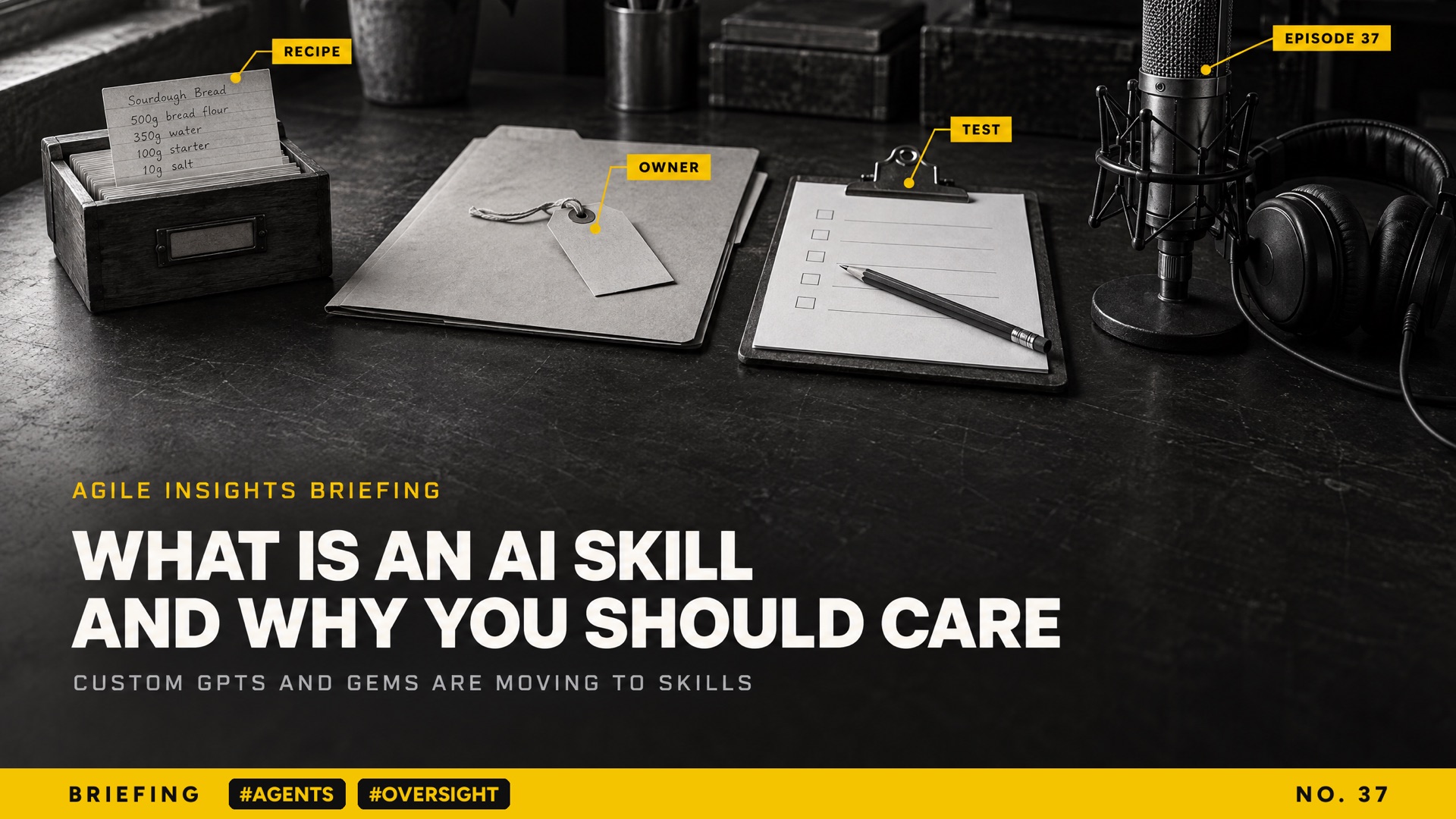
01A skill is a recipe in a folderA skill is a folder holding one plain text file, SKILL.md, with a name, a description of when to use it, and the instructions. It can carry templates, reference files or code.
02The assistant chooses the skillThe assistant reads only each skill's name and description until a request matches, then loads the full recipe. Anthropic calls this progressive disclosure, so the description decides when a skill fires.
03One format, two deadlinesOpenAI says custom GPTs retire on 11 December 2026, and Google is moving Gems to skills, no sooner than 1 March 2027 for Workspace business customers. Both convert the old assistants into skills.
04Portable is true, identical is notThe format is shared, but each product supports it differently. OpenAI says a converted version may respond differently and will not necessarily run on every request, so test on each platform.
05What to doUse the retirement as an inventory; give each skill an owner, one home and a version history; read its description and check nothing sensitive is bundled; test conversions against the original.
Sources and links (7)
Custom GPT retirement and migration FAQ · help.openai.com
OpenAI Help Center. The retirement dates and what the migration to plugins carries over.
OpenAI Help Center. The retirement dates and what the migration to plugins carries over.
Introducing skills in the Gemini app and Workspace, plus what's next for Gems · workspaceupdates.googleblog.com
Google Workspace Updates, 30 September 2026, updated 9 November 2026. Google's dates for moving Gems to skills.
Google Workspace Updates, 30 September 2026, updated 9 November 2026. Google's dates for moving Gems to skills.
About the transition from Gems to skills · knowledge.workspace.google.com
Google Workspace Help, updated 9 November 2026. How remaining Gems become draft skills.
Google Workspace Help, updated 9 November 2026. How remaining Gems become draft skills.
Introducing Agent Skills · anthropic.com
Anthropic, 16 October 2025, updated 18 December 2025. The launch of skills and the open standard.
Anthropic, 16 October 2025, updated 18 December 2025. The launch of skills and the open standard.
Equipping agents for the real world with Agent Skills · anthropic.com
Anthropic Engineering, 16 October 2025. How progressive disclosure works, and the security advice.
Anthropic Engineering, 16 October 2025. How progressive disclosure works, and the security advice.
Agents have skills now: how they work in Copilot Studio · microsoft.github.io
Microsoft Copilot Studio team blog, 15 June 2026. A staff blog, not product documentation.
Microsoft Copilot Studio team blog, 15 June 2026. A staff blog, not product documentation.
Checked against each vendor's own notice and documentation on 13 November 2026. Vendor dates are targets and vary by plan and account, so check the original notice before quoting a date.
Our fact check · 15 claims: 11 verified, 3 partly right, 1 unverified
Before we record, every claim the hosts make is checked against the sources (this table was last updated 13 October 2026). Confirmed means a primary source or two independent reports; Reported means one party says so; Partly right, Disputed, Unverified and Not yet known mean what they say, and the hosts say so on air. This is the table as we left it.
- VerifiedA skill is a folder with a SKILL.md file holding at least a name, a description of when to use it, and instructions; it may bundle scripts, references and templates.Agentskills.io; OpenAI, Skills
- VerifiedThe assistant sees only each skill’s name and description until a task matches, then loads the full instructions.Anthropic Engineering, 16 Oct 2025; agentskills.io; Called “progressive disclosure”.
- VerifiedAnthropic introduced Agent Skills on 16 Oct 2025 and published them as an open standard on 18 Dec 2025.Anthropic, Introducing Agent Skills
- VerifiedOpenAI plans to retire custom GPTs on 11 Dec 2026; FedRAMP workspaces and Enterprise workspaces with an approved deferral retire on 11 Feb 2027.OpenAI, Custom GPT retirement and migration FAQ (as captured 5 Nov 2026); Past conversations stay accessible.
- Partly rightNo new GPTs can be created from 26 Oct 2026 on any plan.The episode of 11 Oct 2026; OpenAI gives 26 Oct for affected Enterprise workspaces only, and no creation cutoff for other plans.
- Verified“Migrate to plugin” turns a GPT’s instructions into a skill and its knowledge files into reference files; custom actions and the chosen model do not carry over; the original becomes read-only; the plugin starts private.OpenAI FAQ; OpenAI says a migrated plugin may respond differently, and advises comparing familiar prompts and at least one harder case.
- VerifiedChatGPT may pick an installed skill automatically when its description matches, but “will not necessarily” use it on every request.OpenAI FAQ
- VerifiedGoogle’s skills replace Gems, can be stacked in one prompt, and use the open SKILL.md standard, so skills from other platforms can be copied in.Google Workspace Updates, 30 Sep 2026; Google blog, 30 Sep 2026
- VerifiedGemini app skills roll out from 13 Oct 2026; on 17 Nov 2026 Gems move to Settings and keep working; Workspace business and enterprise Gems stop no sooner than 1 Mar 2027, education no sooner than 1 Jun 2027; remaining Gems become draft skills their creators must activate.Google Workspace Updates; Google Workspace Help, 9 Nov 2026; Skills made in the Gemini app do not sync with Workspace apps.
- Partly rightIndividual users’ Gems switch off at the end of November 2026.The episode of 11 Oct 2026; Google says removal for personal accounts starts in November, but on 17 Nov Gems only move to Settings. No end date was published as at 9 Nov 2026.
- VerifiedCopilot Studio agents take skills in the same open format, chosen by name and description.Microsoft Copilot Studio team blog, 15 Jun 2026; A staff blog, not product documentation.
- VerifiedPowerPoint Copilot on the web lets users add their own SKILL.md skills from OneDrive with no admin step; Microsoft recommends reviewing governance for user-created skills.Microsoft 365 Message Center MC1434580, 20 Jul 2026
- VerifiedSkills can contain code that runs; Anthropic advises installing them only from trusted sources and auditing others first.Anthropic Engineering
- Partly rightA skill built on one platform runs on another, with “a small asterisk”.The episode of 8 Nov 2026; The format is shared, but products differ in what they support. Test on each platform.
- UnverifiedCopilot agents are not being retired.The episode of 8 Nov 2026; No notice found either way.
Want to know more?
Sign up for our podcast at agile-insights.com.au.
Read the transcript · Primer
Linda Here is the idea for today. A skill is a written recipe. An A I assistant takes it off the shelf by itself when the work matches. ChatGPT, Gemini, Copilot and Claude now all use the same format for them. So the skills inside your organisation are becoming a real asset. Each one needs an owner, a home and a test. By the end, you will know what a skill is and how the assistant chooses one. You will also know what to do before the year ends.
Leonard The timing is why this matters now. Many staff have built custom G P Ts, the small tailored assistants inside ChatGPT. OpenAI says those are scheduled to retire on the eleventh of December. Some United States government workspaces, and enterprise workspaces with an approved delay, get until February. Google is moving its Gems over to skills as well. For Workspace business customers, Gems stop no sooner than the first of March next year. In both cases, the old assistants get converted into skills. So a lot of organisations are about to learn how many of these their people built.
Linda Which may be a surprisingly long list.
Linda Let me build it up in four steps. Step one is what a skill actually is. It is a folder. Inside is one plain text file called skill dot M D. That file has a name, a short description of when to use it, and then the instructions. It can also carry a template, some reference files, or even a small program. Take a weekly project report. The skill holds the steps, the report template, and a checklist to run before handing the report back. It is a recipe, not a separate chatbot.
Leonard A recipe card, then.
Leonard So how is that different from a custom G P T or a Gem? Those also had instructions and a few files attached, and plenty of people were happy with them. What actually changes for the person using it?
Linda Step two is the difference, and it is the important one. You had to open a G P T or a Gem and choose to talk to it. A skill gets chosen by the assistant. At the start, the assistant reads only the name and description of every skill it has. When your request matches a description, it loads the full recipe and follows it. Anthropic, which created the format, calls this progressive disclosure. It means an assistant can keep dozens of skills on hand without slowing down. It also means the description decides when a skill fires.
Leonard So the description does the real work.
Leonard Step three is the shared format. Anthropic introduced skills in October last year and published the format as an open standard in December. OpenAI now builds its ChatGPT plugins from skills. Google says its Gemini skills use the same open format, so skills from other platforms can be copied in. Microsoft has added them to Copilot Studio agents and to Copilot in PowerPoint. Because a skill is just a folder, you can hand the recipe to a colleague without handing over your data. On the How I A I podcast, Neo Aplin described it as sharing the recipe, not the files.
Linda Step four is what converting looks like. In ChatGPT, a migration button turns a G P T's instructions into a skill. Its knowledge files become reference files. Custom actions, the connections to other systems, do not come across and have to be rebuilt. The original becomes read only. And OpenAI says plainly that the new version may respond differently. Its advice is to compare familiar prompts and at least one harder case before relying on it. Google will turn leftover Gems into draft skills that their creators must review and switch on.
Leonard Fair warning, at least.
Leonard So the common belief is that one standard means a skill runs the same everywhere. Write it once, copy it into every tool, and forget about it. Is that how it works in practice?
Linda Only partly. The format is shared, but each product supports it differently. Aplin's answer was yes, with a small asterisk: some tinkering, and different file limits. Google's own Gemini app and its Workspace apps do not share skills yet, so you make one twice. And because the assistant chooses when to use a skill, OpenAI warns it will not necessarily run on every request. Portable is true. Identical is not. Every skill needs testing on each platform it will run on.
Leonard Portable, not identical. Noted.
Leonard Which brings us to governance. Look at what a skill now is. It is a file that moves between people and platforms, outside each vendor's sharing controls. It can contain code that runs. Anthropic warns that a malicious skill could open security holes or direct the assistant to send data out. It advises installing skills only from trusted sources. In PowerPoint on the web, staff can add their own skills with no admin step. Microsoft itself recommends reviewing governance for them. That is shared software, arriving without a software process.
Linda So here is what to do. First, use the retirement as an inventory. Find every custom G P T and Gem your people rely on, and who built it. Second, give each skill an owner, one place where it is kept, and a version history. Third, read the description, because that decides when it fires. Check that no client or personal data is bundled inside. Fourth, test a converted skill against the original on a few known cases before anyone relies on it. And check the vendor's own notice for your dates, because they vary by plan.
Linda If you'd like to know more, sign up for our podcast at agile-insights.com.au.
Leonard Thanks for listening.
More on #agents
Episode 36 · Primer and discussionChecking agents in production, even when you can’t read their workEpisode 26 · Primer and discussionThe agent that speaks first: what to decide before proactive agents reach work accounts.Episode 14 · Primer and discussionWrite down what the agent must never do, and what it must still do.Episode 38 · Primer and discussionBudgeted for seats, billed for workEpisode 33 · Primer and discussionAgents in production: the platform runs it, you still own itEpisode 29 · Primer and discussionCrowdStrike Uncovers New Agentic AI Campaigns
All of the briefings (38) · Follow Briefing in Apple Podcasts or any podcast app
Everything from Agile Insights: briefings, Making You Think and the reference series