 Briefing
Episode 3 · Primer · About 5 minutes
Is your AI making decisions about people? What the Privacy Act now asks of you
Download the MP3 · Linda, an AI voice, reads a script written from the sources below.
In this episode
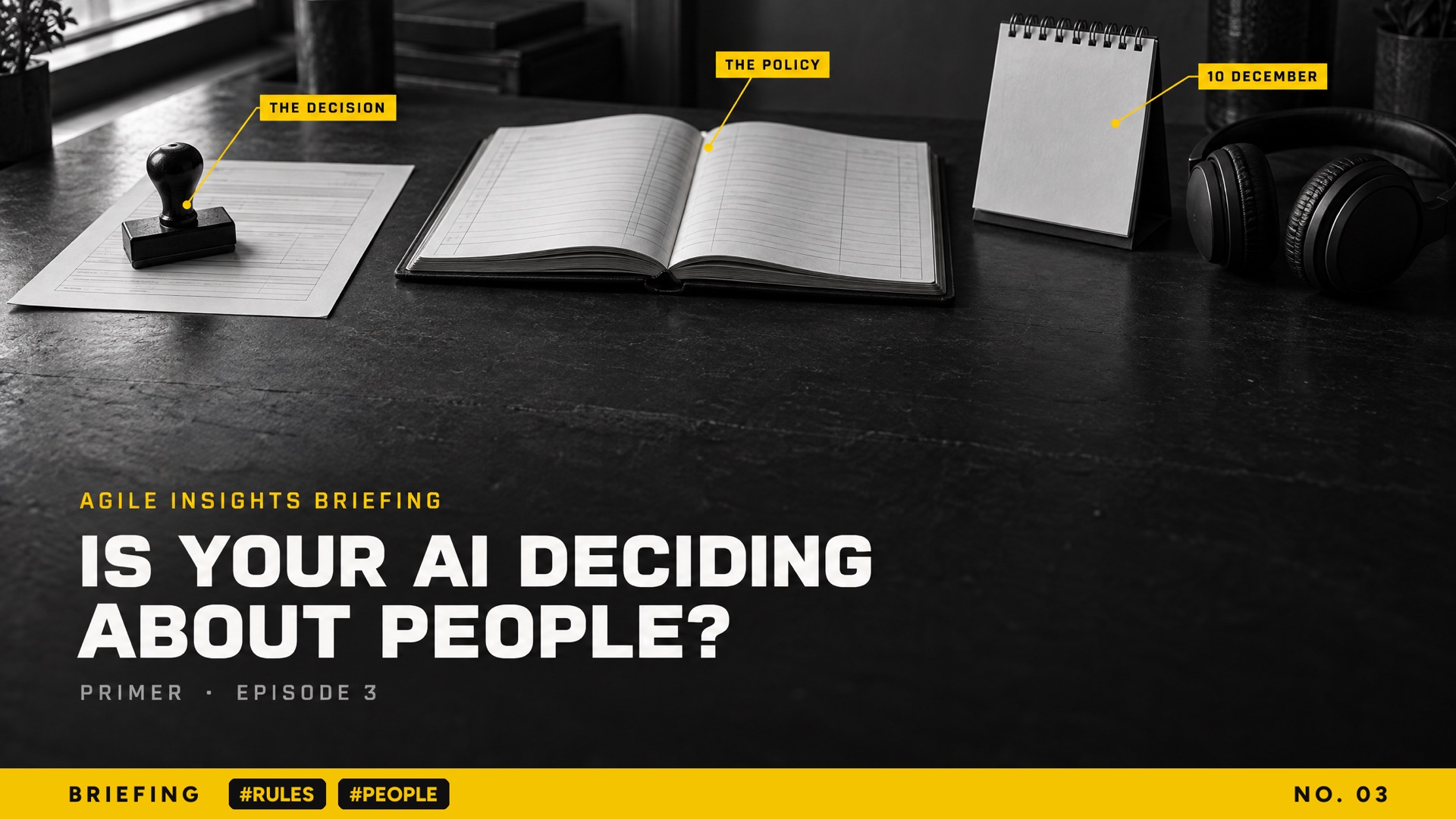
01What the new duty requiresFrom 10 December 2026, a privacy policy must say when a computer program makes, or substantially shapes, decisions that significantly affect people using their personal information. It is a transparency duty only, with no right to contest or an explanation.
02Why it reaches beyond AIThe regulator's final guidance of 30 September 2026 says a computer program includes rule based processes, everyday software and generative AI, including chatbots. A human signing off does not remove the duty if the program's output is a key factor.
03What the privacy policy must sayThe policy must describe the kinds of personal information the programs use, the kinds of decisions made solely by programs, and those a program substantially shapes. Decisions can be grouped, but the detail must mean something to a reasonable person.
04Buying a tool keeps the dutyThe regulator expects the duty to stay with the organisation that uses the personal information to make the decision, not the vendor that supplied the tool. Its guidance says to take a cautious approach where you are unsure.
05Three steps before DecemberAsk every division which tools score, rank, filter or recommend about people, including AI features a supplier switched on. Test each against the three conditions in a register with an owner, then draft the policy wording from that register.
Sources and links (8)
The OAIC announcement · Read on OAIC
The Information Commissioner's 30 September 2026 release of the transparency resources and updated guidelines.
The Information Commissioner's 30 September 2026 release of the transparency resources and updated guidelines.
The OAIC fact sheet · Open the fact sheet (PDF)
A short practical guide to APP 1.7 to 1.9, with worked examples.
A short practical guide to APP 1.7 to 1.9, with worked examples.
APP 1 Guidelines · Read on OAIC
The regulator's detailed reading of the principle, updated 30 September 2026.
The regulator's detailed reading of the principle, updated 30 September 2026.
The Act · Read on legislation.gov.au
Privacy and Other Legislation Amendment Act 2024, on the Federal Register of Legislation.
Privacy and Other Legislation Amendment Act 2024, on the Federal Register of Legislation.
Key takeaways from the guidance · Read on Allens
Allens on scope, human oversight and who carries the duty.
Allens on scope, human oversight and who carries the duty.
Tranche 2 consultation · Visit the consultation page
Attorney-General's Department page for the exposure draft, which closed on 18 September 2026.
Attorney-General's Department page for the exposure draft, which closed on 18 September 2026.
What the draft Tranche 2 reforms mean · Read on MinterEllison
MinterEllison on the fair and reasonable test and other proposals.
MinterEllison on the fair and reasonable test and other proposals.
Enforcement powers · Read on Corrs
Corrs on the penalty tiers and investigative powers added in 2024.
Corrs on the penalty tiers and investigative powers added in 2024.
Written from public sources and checked on 10 October 2026. The law is paraphrased, not reproduced, and this is not legal advice. Penalty detail comes from law firm commentary. Check the current text before relying on it.
How this maps to what we do
The rules that apply to AI in Australia and for Australian organisations with European exposure, and the practical work each one calls for.
Standard or rule
What an organisation needs
Where we help
Privacy Act: automated decision-making transparency (from 10 December 2026)
A list of the automated decisions made about people, including those buried in vendor software, and the policy wording that describes them.
AI Risk & ComplianceUse Case Portfolio & AssessmentAI Governance Framework Alignment
Australia's AI guidance: the six essential practices (with VAISS, SafeAI-Aus and NAIC)Episode: Australia's AI guidance: the six essential practices
A baseline against the six practices, then a prioritised roadmap to close the gaps.
AI DiagnosticAI Governance Framework AlignmentAI Strategy Build
Each AI system classified by risk tier, with the obligations and dates that apply to it, including for non-EU organisations.
AI Risk & ComplianceUse Case Portfolio & AssessmentAI Governance Framework Alignment
Australian sector overlays: government, health, finance, education, disability, aged care, not-for-profitEpisode: Australian sector rules for AI: what applies to your industry
The sector's own obligations mapped onto one set of AI controls, so that nothing is done twice.
AI Risk & ComplianceAI Governance Framework Alignment
Work health and safety: digital work systemsEpisode: Is your digital workplace a safety risk? AI, monitoring and work health and safety
A review of worker monitoring and automated decisions about people for safety and psychosocial risk.
AI Risk & ComplianceAdoption & Engagement
These are Agile Insights AI Strategy & Governance offerings. Which of them you need depends on where your organisation starts.
Want to know more?
Sign up for our podcast at agile-insights.com.au.
Read the transcript
Linda From 10 December 2026, Australian organisations must tell the public, in their privacy policy, when software makes or shapes decisions that significantly affect people. If you use AI, scoring tools or even clever spreadsheets on customers, staff or clients, that includes you. By the end of this episode you will know what the duty says, what the regulator has now clarified, and the first steps to take. This is the position as at October 2026.
Linda First, what it is. It is a change to the Privacy Act 1988, made by the Privacy and Other Legislation Amendment Act 2024. It adds three short rules to the first Australian Privacy Principle, numbered 1.7 to 1.9. It binds what the Act calls A P P entities, which includes most larger private organisations and federal agencies. It is mandatory. It is also only a transparency duty. It does not give people a right to contest a decision, or to an explanation.
Linda Here is the problem it solves. Decisions about people are increasingly made, or heavily steered, by software. A hospital ranks patients by a score. A lender uses a model to approve credit. A recruiter filters candidates automatically. The person affected usually has no idea. The new rule makes organisations say so publicly, in plain terms, so that customers, staff and the regulator can see where software is involved.
Linda Who uses this? Privacy officers and general counsel will own the wording. But the hard part sits with chief information officers, data leaders, and the business heads who run the processes. It comes up in procurement, because buying a tool that scores people means you inherit the duty. It comes up when a regulator asks questions. And it should come up in a board paper before December.
Linda Now, what is in it. Four ideas carry the whole thing. The first is the trigger. Three conditions must all be true. Your organisation has arranged for a computer program to make a decision, or to do something substantially and directly related to making it. The decision could reasonably be expected to significantly affect someone's rights or interests. And personal information about that person is used.
Linda The second idea is that the net is wide. On 30 September 2026 the Office of the Australian Information Commissioner, the O A I C, published final guidance. It says a computer program includes rule-based processes, artificial intelligence, everyday software and generative AI, including chatbots. A human signing off does not take you out of scope. If the program's output is a key factor in the human's decision, the duty can still apply. The regulator also says refusing to act counts as a decision.
Linda The third idea is what you must publish. Your privacy policy must describe the kinds of personal information the programs use. It must describe the kinds of decisions made solely by programs. And it must describe the kinds of decisions where a program does something substantially and directly related to the decision. You may group decisions into categories, but the detail must mean something to a reasonable person. Sensitive information, such as health data, should be clearly flagged. Trade secrets are excluded, but the exclusion is narrow.
Linda The fourth idea is who carries it. The O A I C expects the duty to stay with the organisation that uses the personal information to make the decision. Buying the tool from a vendor does not move the duty to the vendor. The guidance says to take a cautious approach where you are unsure.
Linda How does this connect to AI governance more broadly? The duty is a disclosure test, but you cannot disclose what you have not found. That needs an inventory of the systems and decisions involved, with named owners. The same inventory serves the international AI management standard and your risk register. In the local rules layer, the Privacy Act sits beside sector rules and the voluntary national guidance on AI.
Linda Three first steps. One, run a discovery exercise. Ask every division which tools score, rank, filter or recommend about people, including software with AI features switched on by a supplier. Two, test each against the three conditions and record the result in a register with an owner. Three, draft the privacy policy wording from the register, and have it reviewed before December. Do the discovery first. The wording follows. The primary sources are the O A I C fact sheet and updated A P P 1 guidelines, and the Act itself. All are linked in the show notes.
Linda Now, currency, as at October 2026. The duty starts on 10 December 2026. The final O A I C guidance is out, so the long wait for it is over. Separately, the Attorney-General's Department released an exposure draft of a second tranche of privacy reform on 31 August 2026, and consultation closed on 18 September. It proposes a general test that handling of personal information be fair and reasonable. It is a draft only, with no commencement date announced. On penalties, the 2024 Act created tiered civil penalties, with serious interferences reaching tens of millions of dollars. Which tier a poor disclosure would attract is a question for your lawyers. Check the current text before relying on any of this.
Linda To recap: if software shapes significant decisions about people, you must say so in your privacy policy from 10 December, and the regulator reads that duty broadly. If you'd like to know more, sign up for our podcast at agile-insights.com.au.
More on #rules
Episode 4 · PrimerIs your digital workplace a safety risk? AI, monitoring and work health and safetyReference 15 · PrimerThe quiet obligations: records, data ethics, digital experience and cloudReference 14 · PrimerSecurity for government AI: the PSPF, the ISM and the frontier AI eraReference 13 · PrimerThe Commonwealth AI rulebook: the Policy, the technical standard and the APS AI PlanReference 12 · PrimerThe DTA AI Reference Architecture: one blueprint for government AIEpisode 21 · DiscussionTrust cannot be rushed: how much authority will you give AI?
All of the briefings (38) · Follow Briefing in Apple Podcasts or any podcast app
Everything from Agile Insights: briefings, Making You Think and the reference series