 Briefing
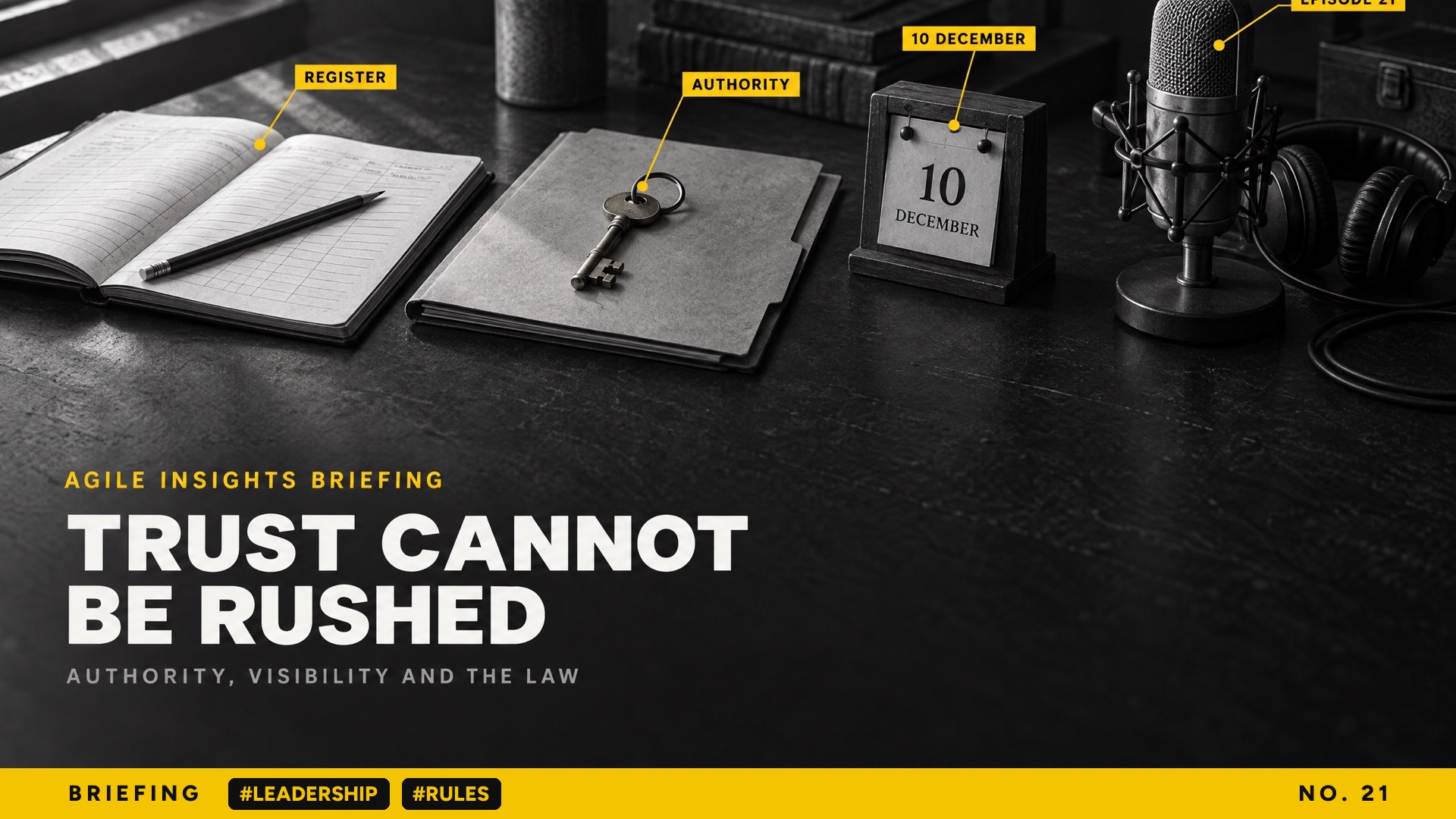
Episode 21 · Discussion · About 10 minutes
Trust cannot be rushed: how much authority will you give AI?
Download the MP3 · Linda and Leonard, AI voices, read a script written from the sources below.
In this episode
01Trust is authority you grantMike Morgan argues the question is no longer what AI can do but how much authority to give it, tested by four questions on data, challenge, accountability and the result.
02You cannot grant what you cannot seeTools and agents often arrive before leaders know what they touch. One 2024 Microsoft survey found 78% of AI users bring their own tools, self-reported. A light register comes first.
03The legal floor is already hereThe National AI Plan relies on existing law. From 10 December 2026, privacy principles 1.7 to 1.9 require disclosure of programs that make or substantially inform significant decisions, even with human review.
04Faster governance is a betMorgan says clear governance makes organisations faster. The article offers no evidence, and its Volpara example states aims, not results. Treat it as a claim to test.
05What to do nowBuild a light register of AI in use, name an owner for each tool, check which decisions about people it informs, and measure approval time and problems caught.
Sources and links (6)
AI can scale quickly. Trust cannot be rushed. · Read on LinkedIn
Mike Morgan, Insight, LinkedIn, 23 October 2026. The article the episode responds to.
Mike Morgan, Insight, LinkedIn, 23 October 2026. The article the episode responds to.
National AI Plan · industry.gov.au
Department of Industry, Science and Resources, 2 December 2025. Builds on existing, largely technology-neutral law.
Department of Industry, Science and Resources, 2 December 2025. Builds on existing, largely technology-neutral law.
APP Guidelines, Chapter 1: APP 1 · oaic.gov.au
Office of the Australian Information Commissioner. APP 1.7 to 1.9 on automated decision-making, from 10 December 2026.
Office of the Australian Information Commissioner. APP 1.7 to 1.9 on automated decision-making, from 10 December 2026.
Annual Cyber Threat Report 2024-25 · cyber.gov.au
Australian Signals Directorate's Australian Cyber Security Centre, on AI and the scale and speed of attacks.
Australian Signals Directorate's Australian Cyber Security Centre, on AI and the scale and speed of attacks.
Work Trend Index 2024 · microsoft.com
Microsoft and LinkedIn, 8 May 2024. The 78% bring-your-own-AI figure (self-reported).
Microsoft and LinkedIn, 8 May 2024. The 78% bring-your-own-AI figure (self-reported).
Empathy at scale: Volpara Health · au.insight.com
Insight's case study, 23 June 2026. States aims, not measured results.
Insight's case study, 23 June 2026. States aims, not measured results.
Checked against the government, regulator and company pages on 27 October 2026. The article's speed claim is argued, not shown, and the Volpara example states aims only. Check the original sources before quoting a date or figure in a board paper.
Our fact check · 6 claims: 3 confirmed, 2 partly right, 1 unverified
Before we record, every claim the hosts make is checked against the sources (this table was last updated 27 October 2026). Confirmed means a primary source or two independent reports; Reported means one party says so; Partly right, Disputed, Unverified and Not yet known mean what they say, and the hosts say so on air. This is the table as we left it.
- ConfirmedNational AI Plan relies on existing legal and regulatory frameworksDISR, 2 Dec 2025: “build on Australia’s robust existing legal and regulatory frameworks”; laws “largely technology-neutral”; regulators keep responsibility; government “will not hesitate to intervene”. AI Safety Institute being set up to monitor, test and advise regulators
- ConfirmedADM transparency from 10 Dec 2026OAIC APP 1 guidelines: APP 1.7 to 1.9. In scope when a program makes, or does something substantially and directly related to making, a decision that could significantly affect someone, using their personal information; in scope even with human review; generative AI and chatbots count; the duty stays with the entity that arranged the program, including through a vendor contract. A privacy-policy disclosure, not a per-decision notice. Final guidance 30 Sep 2026 (per Allens)
- ConfirmedAttackers use AI for speed and scaleASD ACSC Annual Cyber Threat Report 2024–25: AI “almost certainly enables malicious cyber actors to execute attacks on a larger scale and at a faster rate”
- Partly rightAdoption is outrunning visibilityNo data in the article. Microsoft’s Work Trend Index (May 2024): 78% of AI users bring their own AI tools to work (self-reported, 31 markets including Australia)
- Partly rightVolpara: governance and security “made it possible”Insight case study (23 Jun 2026): production-ready plain-language breast-screening summaries on Azure OpenAI; outcomes “reflect what Volpara aims to achieve”; no metrics, no statement of clinician review or live use
- UnverifiedClear governance makes organisations faster; trust becomes the advantageAssertion and prediction; no evidence offered
Want to know more?
Sign up for our podcast at agile-insights.com.au.
Read the transcript
Linda Here is the idea for this episode. Trust in A I is the amount of authority you decide to give it. That authority has to be earned, and it starts with being able to see what A I you have. In Australia, the law already sets a floor, and a new disclosure duty starts on the tenth of December. By the end, you will know what that duty asks and how far the evidence goes. You will also have five things to do before Christmas.
Leonard A quick recap of three terms we will lean on. An A I register is the list of the A I in use. It records who owns each tool and what it touches. Automated decision making means a computer program that makes, or substantially informs, a decision about a person. And the line between assist and act matters. A tool that assists leaves a person in charge of the result. An agent that acts changes a record or sends something on its own, so it needs an owner and limits.
Linda Our starting point is an article on LinkedIn from the twenty third of October. It's by Mike Morgan, who leads the Asia Pacific business of Insight, a technology services firm. His title is "A I can scale quickly. Trust cannot be rushed." His opening move is a good one. For years we asked what A I can do. Now, he says, the question is how much authority we are prepared to give it. He turns trust into four questions. Can we trust the data? Can we understand and challenge the outcome? Do people know when a human must stay accountable? And will customers and staff trust the result?
Leonard Four good questions. Not easy ones. He then grounds it in Australian rules, and those facts check out. The government released its National A I Plan on the second of December last year. It does not create a separate A I law. It says the approach will build on existing legal and regulatory frameworks, which it calls largely technology neutral. Privacy, consumer, workplace and product liability law already apply to A I. Each regulator keeps responsibility for harms in its own area. The plan also says the government will not hesitate to step in if more regulation is needed. So the obligations are here today, spread across laws you already know.
Linda The second fact is the date. From the tenth of December this year, new privacy principles, numbered one point seven to one point nine, take effect. Some programs use personal information to make, or substantially inform, a decision that could significantly affect someone. If you use one, your privacy policy must say so. It must describe the kinds of decisions and the kinds of information used. Three details from the regulator's guidance matter most. A decision is still in scope when a person reviews the output. Chatbots and generative A I count as programs. And if a vendor's tool does the work, the duty usually stays with you.
Leonard That one will catch people out.
Linda It will.
Leonard Now, what is confirmed and what is not. The plan and the privacy guidance are confirmed from the government and the regulator's own pages. Australia's cyber security centre also confirms the security point in the article. It says A I almost certainly lets attackers work at a larger scale and a faster rate. Two things are still argued rather than shown. The article's worked example, from Volpara Health, is drawn from Insight's own case study. That case study says its outcomes are what the company aims to achieve, not measured results. And nobody has yet seen how the regulator will enforce the new duty.
Linda So here is the question for this episode. Is trust something an organisation can build quickly, or does it really take time? I want to take three views. The first is Morgan's own case, that clear governance is what lets people move fast. The second is that you cannot give authority to something you cannot see. The third is that trust is earned in steps, through evidence, and no framework skips that part. Leonard, would you make the first case?
Leonard Happily, because a lot of it rings true. Morgan's line is that governance is not the brake, it is the guardrail that makes speed possible. His reasoning is practical. When people know where they have permission to act, they stop asking and start working. Ownership and decision rights are written down. Acceptable uses are explicit. Everyone knows who is accountable when something goes wrong. Think of a team that wants to summarise customer emails. If the rules already say this is low risk and who signs it off, they start on Monday. Without the rules, they wait for a meeting that nobody wants to chair.
Linda We have all sat in that meeting.
Leonard Twice.
Linda I agree with the shape of that, but notice the order it assumes. You can only write those rules for systems you know about. Morgan says it himself: many organisations do not have an A I problem, they have a visibility problem. Tools get switched on and agents get connected to data before leaders see them. Microsoft ran one large survey in twenty twenty four. It found that seventy eight percent of people using A I at work were bringing their own tools. That figure is self reported and more than two years old, but it points the same way. And the tenth of December makes this concrete. You cannot write that privacy disclosure without a list of where programs shape decisions. And once you can see it...
Leonard Here is where I'd push back a little. "Build the register first" can turn into exactly the gate Morgan warns about. I have seen inventories run for six months while the business waits, and the shadow tools multiply in the meantime. If the register becomes a precondition for any use at all, people route around it. So is visibility first really compatible with moving fast, or are we just swapping one queue for another?
Linda It's a fair worry, and I think the answer is in how light the register is. It doesn't need to be complete before anything moves. It needs to be the front door. A new tool gets listed in a few minutes, with an owner and what it touches. Low risk uses go straight through. Anything that informs a significant decision about a person gets a closer look. That is now a public disclosure. So visibility and speed are not rivals. The register is what lets you say yes quickly and still know what you said yes to.
Leonard Fair. A front door, not a fortress. That works for me. Which brings us to the third view, and to Morgan's title. Trust cannot be rushed, because trust is evidence collected over time. You give a system a small amount of authority and watch what it does. Then you widen it when the record supports that. The Volpara example shows why this matters. The project produced plain language breast screening summaries on Microsoft's cloud, built for security and reuse. That is a sensible foundation. But the case study states aims, not results, and it does not say whether a clinician checks each summary. Foundations make trust possible. Only results over time actually earn it. Which is a slower kind of...
Linda So where does the evidence settle? The legal floor is solid. Existing laws apply now, and the disclosure duty has a date and a regulator's guidance behind it. The security point is backed by the government's own threat report. Where it does not settle is the headline promise. That clear governance makes organisations faster is a reasonable bet, and many of us believe it. The article offers no evidence for it, though, and neither does its example. So treat it as something to measure in your own organisation, not something to quote.
Leonard Then here is what to do, in plain terms. First, open a register as a front door, not a project. Every A I tool and agent gets an owner and a line on what it touches. Second, find your automated decisions before the tenth of December. Look for any program that makes or substantially informs a significant decision about a person, including vendor tools and chatbots. Remember that a human reviewing the output does not take it out of scope. Third, update the privacy policy to describe those decisions, and check it against the regulator's guidance.
Linda Fourth, grant authority in steps. Start a system on assisting, write down what evidence would justify letting it act, and review that on a schedule. Fifth, measure whether your governance is a guardrail or a gate. Track how long a low risk use takes to approve, and how many problems you catch before a customer does. If the first number is long and the second is small, you have a gate. That is how trust gets built at the speed it actually moves. If you'd like to know more, sign up for our podcast at agile-insights.com.au.
Leonard Thanks for listening.
More on #leadership
Episode 38 · Primer and discussionBudgeted for seats, billed for workEpisode 34 · Primer and discussionWhen the test stops telling you anything: hunger beats tenureEpisode 23 · Primer and discussionWhat FDE means at OpenAI: skills, not custom code.Making You Think 13 · Primer and discussionHow to Lead a Quest, by Jason FoxMaking You Think 12 · Primer and discussionThe Game Changer, by Jason FoxEpisode 16 · Primer and discussionWhen making something gets cheap, checking it becomes the real work.
Every episode tagged #leadership
All of the briefings (38) · Follow Briefing in Apple Podcasts or any podcast app
Everything from Agile Insights: briefings, Making You Think and the reference series