 Briefing
Episode 9 · Primer · About 8 minutes
Your company brain is a copy. Govern it like one.
Download the MP3 · Linda and Leonard, AI voices, read a script written from the sources below.
In this episode
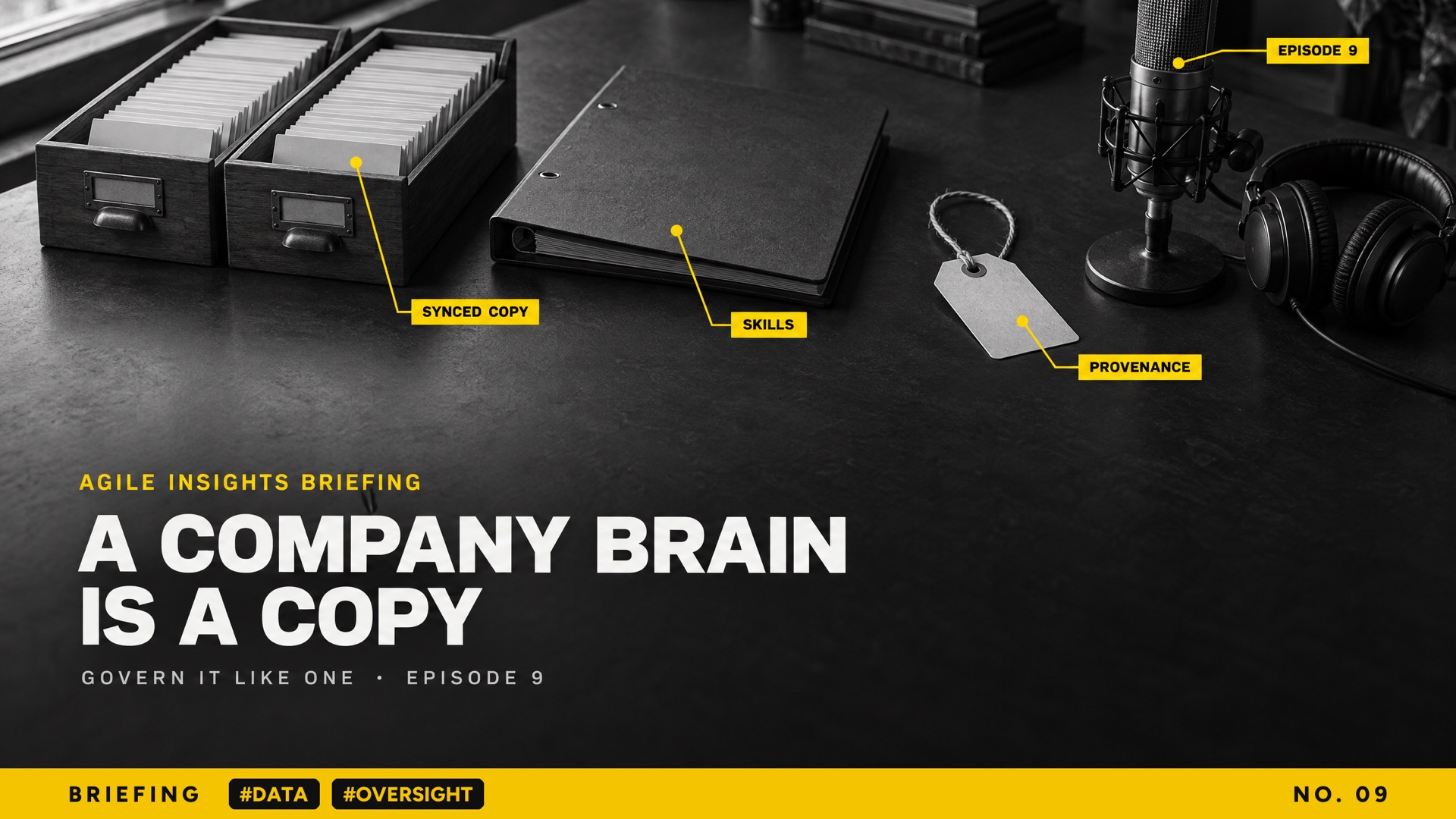
01A company brain is two copiesA company brain is a copy of your data and a copy of your rules. Before you build one, decide who owns each copy, who may see it, how long it lives and who checks it.
02Why live lookups are not enoughThe speaker, Gil Feig of Merge, argues that live lookups only answer narrow questions, so he recommends syncing a searchable copy. He admits a copy costs more and is harder to keep current. His company sells tools for this.
03The copy carries the same dutiesThe security project OWASP warns that poor access control on such a store can disclose personal information. The privacy regulator's guidance says you still hold information stored with an outside provider, so the copy needs a deletion rule.
04A skill is a ruleThe speaker says how you find an answer is itself company policy, and the talk leaves open who signs a rule off. One useful approach: a draft, a review by someone else, then a named owner.
05Seven things to settle firstName owners. Write down what each copy is for and who may see it. Make it obey the source's permissions. Set lifespans and deletion rules. Keep provenance. Let the AI propose and a person confirm. Schedule reviews.
Sources and links (8)
Why Your Company Needs a Context Graph · Watch on YouTube
Gil Feig, co-founder and CTO of Merge, on the AI Engineer channel (uploaded 9 October 2026). A vendor's view of the company brain pattern.
Gil Feig, co-founder and CTO of Merge, on the AI Engineer channel (uploaded 9 October 2026). A vendor's view of the company brain pattern.
Context Graphs: AI's Trillion-Dollar Opportunity · Foundation Capital
The December 2025 investor essay that made the term popular, with its narrower meaning: a record of decisions and the reasons for them.
The December 2025 investor essay that made the term popular, with its narrower meaning: a record of decisions and the reasons for them.
Introducing the Model Context Protocol · Anthropic
Anthropic's November 2024 announcement of the open standard for connecting AI applications to data sources and tools.
Anthropic's November 2024 announcement of the open standard for connecting AI applications to data sources and tools.
LLM08:2025 Vector and Embedding Weaknesses · OWASP Gen AI Security Project
OWASP on the risks of a searchable store, including poor access control, and its advice on stores that enforce permissions.
OWASP on the risks of a searchable store, including poor access control, and its advice on stores that enforce permissions.
LLM01:2025 Prompt Injection · OWASP Gen AI Security Project
OWASP on instructions hidden in outside content, such as a document, that change what a model does.
OWASP on instructions hidden in outside content, such as a document, that change what a model does.
APP Guidelines, Chapter 6: use or disclosure of personal information · OAIC
The privacy regulator's guidance on the purpose personal information was collected for, and what it means to hold it.
The privacy regulator's guidance on the purpose personal information was collected for, and what it means to hold it.
APP Guidelines, Chapter 11: security of personal information · OAIC
The guidance on securing personal information and destroying or de-identifying it once it is no longer needed.
The guidance on securing personal information and destroying or de-identifying it once it is no longer needed.
Guidance on privacy and the use of commercially available AI products · OAIC
The October 2024 guidance on personal information put into, or produced by, an AI product, and on continuing due diligence.
The October 2024 guidance on personal information put into, or produced by, an AI product, and on continuing due diligence.
Written from public sources and checked on 12 October 2026. The talk transcript and the OWASP page on vector stores were read in full; the investor essay, the Model Context Protocol announcement and the privacy regulator's guidance were read in part. The talk is a vendor's view, and its engineering claims are the speaker's own. Quotations from the talk come from automatic captions. Please check the originals before quoting. This is general information, not legal advice.
Our fact check · 18 claims: 11 confirmed, 4 reported, 1 partly right, 1 unverified, 1 not yet known
Before we record, every claim the hosts make is checked against the sources (this table was last updated 12 October 2026). Confirmed means a primary source or two independent reports; Reported means one party says so; Partly right, Disputed, Unverified and Not yet known mean what they say, and the hosts say so on air. This is the table as we left it.
- ConfirmedGil Feig is co-founder and CTO of Merge; talk uploaded 9 Oct 2026, recorded at AI Engineer World's Fair 2026Talk, channel metadata, Merge About page
- Confirmed"Context graph" in the talk means a company brain of third-party data, structured context, memories and skillsTalk 02:18 to 03:11; Talk content
- ReportedLive lookups through MCP cannot answer questions across a large dataset; sync a copy into a vector storeTalk 04:02 to 05:53; Vendor opinion, no data
- ReportedA synced copy costs more and is harder to keep up to dateTalk 08:50 to 09:22
- ReportedSkills and memory first, because how you find an answer is company policyTalk 06:44 to 07:52; Design opinion
- ConfirmedThe traceability list (where, when, ID and scopes, who, permissions, transformation, invalidation)Talk 11:31 to 12:44; Talk content
- ConfirmedThe term was popularised by Foundation Capital, 22 Dec 2025, as a record of decision tracesFoundation Capital essay
- ConfirmedMCP is an open standard announced by Anthropic on 25 Nov 2024Anthropic announcement; specification
- Partly rightThe MCP specification says the protocol cannot enforce its security principles itselfSpecification, 18 Jun 2025 version; Not found on the latest overview page
- ConfirmedOWASP LLM08:2025: poor access control on a vector store can disclose personal or proprietary information; recommends permission-aware storesOWASP
- ConfirmedOWASP LLM01:2025: indirect prompt injection through external content, including a document in a retrieval storeOWASP
- ConfirmedAPP 6: use for the primary purpose, or a secondary purpose if an exception appliesOAIC APP Guidelines ch. 6
- ConfirmedAPP 11: secure what you hold; destroy or de-identify when no longer needed; "holds" includes outsourced storageOAIC APP Guidelines ch. 11
- ConfirmedOAIC AI guidance (21 Oct 2024): AI-generated or inferred personal information is a collection; due diligence is not "set and forget"; PIA recommendedOAIC
- Not yet knownCopying support tickets into a searchable store is a new purpose needing consentOAIC chapters above; Depends on the facts. Pose as a question
- ConfirmedNIST AI RMF Govern 6 and Map 4 call for policies and risk mapping for third-party software and dataNIST AI RMF Core
- ReportedISO/IEC 42001 Annex A.7 (data for AI systems); ISO/IEC 5259 (data quality, provenance, currency)Our own Standards Library summaries; Standards not opened
- UnverifiedNamed analysts call the term a rebrand of the knowledge graphSearch summary only; Do not use
Want to know more?
Sign up for our podcast at agile-insights.com.au.
Read the transcript
Linda A company brain is a copy of your data... and a copy of your rules. So before you build one, decide who owns each copy, who may see it, how long it lives and who checks what it says. By the end you will know what one is, where the usual account stops, and seven things to settle first. I'm Linda, and Leonard will ask what a newcomer would.
Leonard So that's the main idea. Why now? Because of a talk. Gil Feig is co-founder and chief technology officer of Merge. His talk went up on the AI Engineer channel on the ninth of October 2026. He argues every company needs a context graph, by which he means a company brain. His company sells tools for this pattern, so it is a vendor's view. Linda, what is a company brain made of?
Linda Good place to start. In his account, four parts. Data from the other systems you use. Documents you place there yourself. Memories, which the AI system stores from earlier work. And skills, which are written instructions for how your company does a task.
Leonard And the name itself?
Linda The name context graph was made popular by an investor essay in December 2025. That essay meant something narrower, a record of decisions and the reasons for them. The speaker uses it loosely, for the whole company brain.
Leonard Good. That helps. Here is my newcomer's question. Say an organisation has already connected its AI to its systems with M C P, the Model Context Protocol. That is an open standard, announced by Anthropic in November 2024. It gives AI applications one common way to reach data sources and tools. So if the AI can already look things up live... why keep a copy as well?
Linda Fair question. Here is his answer. The speaker argues that live lookups only answer narrow questions. Why was one customer upset last week? The AI just asks the ticketing system. Which customers were upset last year? Now it must page through every ticket... and he says it times out. So he recommends syncing a copy into a store you keep, one that can be searched by meaning. He admits a copy costs more and is harder to keep current. That is step one.
Leonard That's step one. What comes next?
Linda Step two. The copy is a new store of the same information, so it carries the same duties. The talk covers freshness, with a limit past which the AI asks the live system. It does not say who may search the copy, yet the source system had its own permissions.
Leonard And does that matter?
Linda The security project OWASP warns that poor access control on such a store can disclose personal or proprietary information. Picture a pay question answered for someone barred from the payroll system...
Leonard An awkward Monday. Then there is privacy. His running example is support tickets, and tickets can hold personal information. Australia's privacy regulator is the Office of the Australian Information Commissioner. Its guidance says personal information may be used for the purpose it was collected for, unless an exception applies. So is copying tickets into a searchable store for staff AI a new purpose?
Linda Good one. Let me be careful here. That is a question each organisation must answer... and it depends on the facts. What was collected, what people were told, and what they would reasonably expect. The regulator's guidance says a reasonable expectation may be difficult to establish for an AI use. It also says you still hold information stored with an outside provider. And you must destroy or de-identify personal information once it is no longer needed. So the copy needs a deletion rule. This is general information, not legal advice.
Leonard Noted. So that's the privacy question. Step three. A skill is a rule. The speaker's example is the question, how do we decide a customer is unhappy? One firm counts tickets and another reads survey scores. He says the AI should check skills first, because how you find an answer is itself company policy. He calls skills principles and processes. Rules is our word. If every AI answer follows that definition, who writes it and who signs it off?
Linda Good question. The talk leaves that open. One workable approach has three levels. A rule starts as a draft. Someone who did not write it reviews it. Then a named owner endorses it for a stated scope.
Leonard Clear. That's step three.
Linda Step four. Memories and stored summaries are new records, sometimes about people. The regulator's guidance treats personal information an AI generates or infers as a new collection. So the AI proposes a memory and a person confirms it. A summary carries the restrictions of its source.
Leonard And that's step four. Now for a trap. Here is the common misunderstanding. We connected the tools, so the AI has our company's knowledge. Connecting tools gives lookups. Knowledge needs a copy and a set of rules, and you own both. In fairness, the strongest part of the talk is here. He says to store, with every item, where it was fetched, when, and under whose access. Also how it was changed, and what should make it invalid. His reason is that something will go wrong, and you must investigate.
Linda Yes. That is the governance point. The model is bought. The copy and the rules are yours, and a board, an auditor or a regulator will ask about them.
Leonard Anything else to watch?
Linda OWASP also describes instructions hidden in a document that change what the AI does. So treat anything the AI reads as information, never as an instruction. And the regulator's guidance says checking an AI product is not set and forget.
Leonard If only. So, what do we do?
Linda Seven things to settle first. One, name an owner for the brain and for each skill. Two, before you sync, write down what each copy is for and who may see it. Three, make the copy obey the source's permissions, then test it as someone who should be refused. Four, give every copy, summary and memory a lifespan and a deletion rule.
Leonard That's four. Keep going.
Linda Nearly there. Five, keep the provenance on every answer. Six, let the AI propose and a person confirm. Seven, schedule reviews, and let staff flag a wrong answer.
Leonard And that's the list. Thank you, Linda.
Linda If you'd like to know more, sign up for our podcast at agile-insights.com.au.
Leonard Thanks for listening.
More on #data
Episode 30 · PrimerThe prompt that shows what your AI actually knows about you (and it’s less than you might think)Episode 28 · Primer and discussionWhen an AI keeps the wiki, checking has to keep pace with writing.Reference 15 · PrimerThe quiet obligations: records, data ethics, digital experience and cloudEpisode 24 · PrimerRemember, retrieve, recheck, forget: governing agent memory.Episode 18 · Primer and discussionWhen agents share one memory, memory is a data flow to govern.Reference 10 · PrimerISO/IEC 5259: data quality for analytics and machine learning
All of the briefings (38) · Follow Briefing in Apple Podcasts or any podcast app
Everything from Agile Insights: briefings, Making You Think and the reference series