 Briefing
Episode 24 · Primer · About 7 minutes
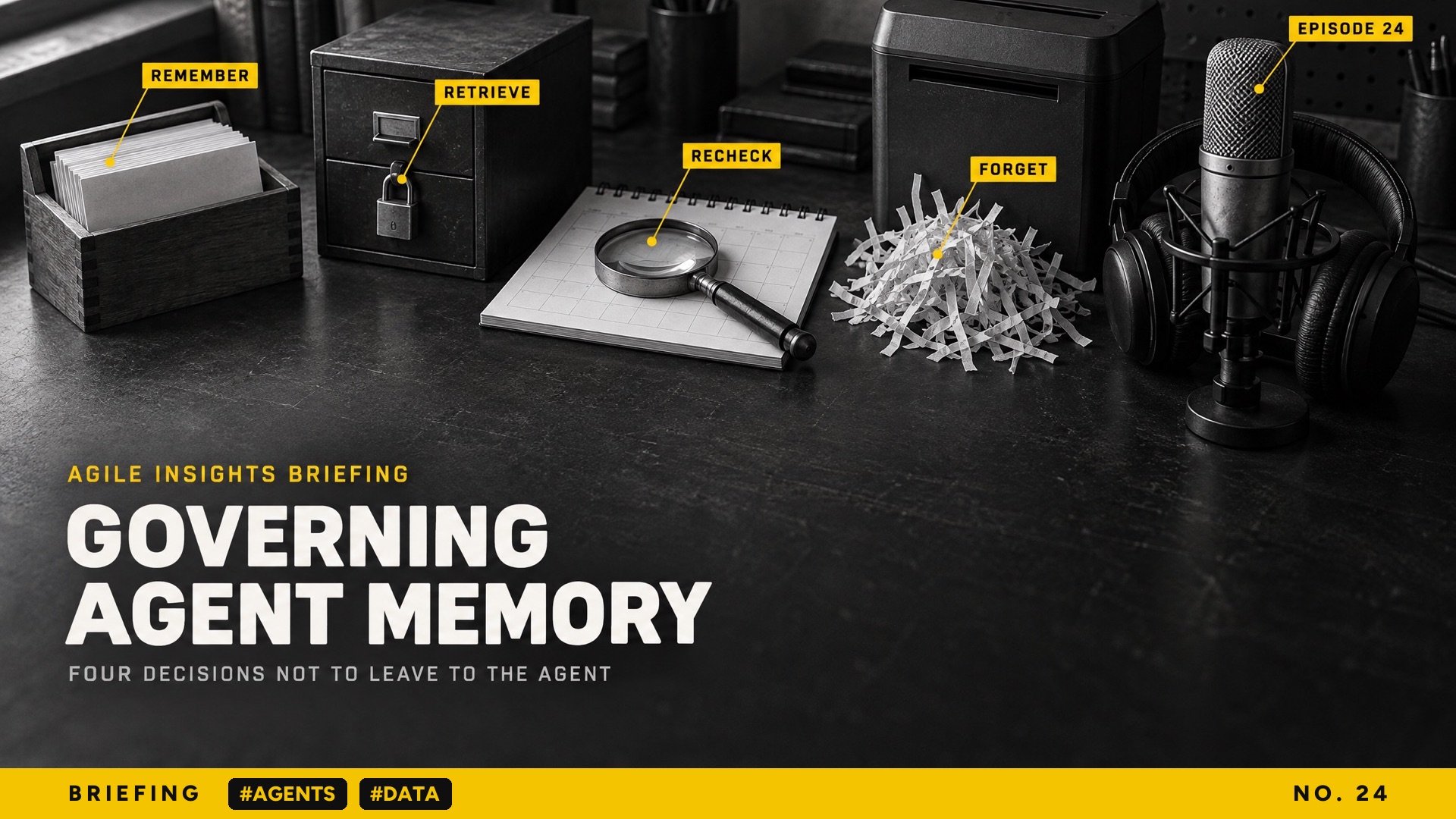
Remember, retrieve, recheck, forget: governing agent memory.
Primer · About 7 minutes
Download the MP3 · Linda and Leonard, AI voices, read a script written from the sources below.
In this episode
01Memory is candidate contextRemember the lead's preference, but fetch the changing project date from the system of record. Microsoft's security guidance says memory is candidate context, not authoritative truth.
02Writing to memory is privilegedThe agent may only nominate a memory; a gate in the application decides. No passwords, failed tool output or untrusted content, because a poisoned memory keeps working after the session ends.
03Authorise before you rankSimilar is not permitted: narrow memory to what this user and agent may see, then search. Facts that change, like prices, permissions and dates, each need a named recheck rule.
04A time to live is not validityAn expiry says how long a record is kept, not whether it is still true. Forgetting means excluded, quarantined, expired or deleted, and deletion must reach summaries and embeddings.
05Name an owner for each decisionBefore switching memory on, name owners, ban some memories in code, check permission before search, set recheck rules, test deletion reaches every copy, and switch on the memory logs.
Sources and links (7)
Remember, Retrieve, Revalidate or Forget? Architecting memory for production AI agents · techcommunity.microsoft.com
Microsoft Foundry blog post, October 2026. The four operations framework this episode is about.
Microsoft Foundry blog post, October 2026. The four operations framework this episode is about.
Memory in Microsoft Foundry Agent Service (preview) · learn.microsoft.com
Microsoft Learn. Short and long term memory, extraction and retrieval, preview status and time to live.
Microsoft Learn. Short and long term memory, extraction and retrieval, preview status and time to live.
Create and use memory in Foundry Agent Service · learn.microsoft.com
Microsoft Learn. Scopes that keep each user's memories separate, and item level create, read, update and delete.
Microsoft Learn. Scopes that keep each user's memories separate, and item level create, read, update and delete.
Manage AI memory safety in agentic systems · learn.microsoft.com
Microsoft Learn security guidance. Memory as candidate context and a configuration layer; gate writes, give people view, edit and delete controls, log every change.
Microsoft Learn security guidance. Memory as candidate context and a configuration layer; gate writes, give people view, edit and delete controls, log every change.
AI memory and context poisoning (corruption) · learn.microsoft.com
Microsoft Zero Trust AI attack catalogue. Treat memory writes as privileged operations; scope retrieval.
Microsoft Zero Trust AI attack catalogue. Treat memory writes as privileged operations; scope retrieval.
Memory is a feature. It is also an attack surface · genai.owasp.org
OWASP GenAI Security Project, 13 May 2026. Memory and context poisoning (ASI06) in the Top 10 for Agentic Applications.
OWASP GenAI Security Project, 13 May 2026. Memory and context poisoning (ASI06) in the Top 10 for Agentic Applications.
New resources on transparency for use of AI and automated decision-making · oaic.gov.au
OAIC, 30 September 2026. Privacy policy disclosure of automated decisions from 10 December 2026.
OAIC, 30 September 2026. Privacy policy disclosure of automated decisions from 10 December 2026.
Written from Microsoft's blog post and documentation, OWASP and the OAIC, checked on 30 October 2026. Microsoft's memory service is in preview and its details may change, so check the originals before quoting.
Our fact check · 12 claims: 7 verified, 4 partly right, 1 unverified
Before we record, every claim the hosts make is checked against the sources (this table was last updated 28 October 2026). Confirmed means a primary source or two independent reports; Reported means one party says so; Partly right, Disputed, Unverified and Not yet known mean what they say, and the hosts say so on air. This is the table as we left it.
- VerifiedFour operations across agent, policy layer, memory service and system of record; the December 15 exampleBlog; The post’s framework
- VerifiedLong-term memory extracts and consolidates; three types on by default; previewLearn memory concepts and how-to
- Partly rightMemory is context, not authorityBlog vs Learn SFI wording
- VerifiedMemory acts as configuration; writes are privileged; XPIA becomes persistentLearn SFI and Zero Trust catalogue
- Partly rightSummary memory typically does not consolidateBlog; Learn says it varies
- Partly rightEmail-borne injection is a common path to memory writesBlog; not found in cited Learn page
- VerifiedOWASP ASI06 Memory & Context PoisoningOWASP GenAI blog
- VerifiedScope isolation; authorise before rank; TTL is retention not validity; five recheck triggersLearn how-to; blog
- Partly rightDeleting a chat leaves derived memories behindBlog; consistent with Learn
- Unverified“Hidden called deleted is prohibited”; inferences are personal dataBlog; secondary only; / Partly right
- VerifiedMemory tracing spans; user controls; CRUD logging with provenanceLearn tracing, SFI
- VerifiedAustralian ADM privacy-policy disclosure from 10 Dec 2026OAIC
Want to know more?
Sign up for our podcast at agile-insights.com.au.
Read the transcript · Primer
Linda Here is the idea for today. Agent memory is not one feature. It is four decisions. What may the agent remember? Who may retrieve it? When must it be rechecked against the real record? And how does it truly forget? None of those decisions should be left to the agent. By the end of this primer you will know all four, and what to ask before anyone switches memory on.
Leonard Memory is turning up everywhere. Microsoft's agent service in Foundry has a memory feature in preview. In late October, a post on Microsoft's Foundry blog argued that giving an agent memory is not a design. So start me at the beginning. What counts as memory here?
Linda There are two kinds. Short term memory is the conversation in front of the agent, and it ends with the session. Long term memory is kept across sessions. In plain words, a model reads your conversations, pulls out things worth keeping, and stores them for next time. That might be a preference, a summary of past chats, or a routine. The post's warning starts with an example. An engineering lead tells an agent that a project targets December fifteenth. The agent keeps that as a fact...
Leonard And a week later the real project plan moves the date to November eighteenth. Someone asks the agent, and it answers December fifteenth, beautifully formatted and wrong. The post's fix is not a better model. Remember the lead's preference for how answers are laid out. Fetch the date fresh from the system that owns it, called the system of record. Microsoft's security guidance puts it in one line. Memory is candidate context, not authoritative truth.
Linda We have all met that agent.
Leonard We have.
Linda That is the first decision, remember. The post says the agent may only nominate something to remember. A gate in the application decides whether it is kept. Some things never go in. Passwords and access keys. Output from a failed tool. Anything from content you do not trust. Microsoft's Zero Trust guidance says to treat memory writes as privileged operations. That is because memory acts as a configuration layer. A memory made today can change which tools the agent picks, and how it reasons, weeks later.
Leonard Privileged is a strong word for writing down someone's preferences. Why does it need that much care?
Linda Because a bad memory keeps working after the conversation ends. Prompt injection is when instructions are hidden in content the agent reads, like a web page or a document. Without memory, the damage usually ends with the session. With memory, Microsoft says, a one off injection becomes a continuous one. OWASP, the open security community, now lists memory and context poisoning among its top ten risks for agentic applications. It is the main defence against an attack that waits.
Leonard An attack that waits. Lovely.
Linda Quite.
Leonard Then the second decision, retrieve, is about reading memory back. What is the rule there?
Linda Authorise before you rank. Memory search finds things that are similar in meaning, and similar is not the same as permitted. So the system first narrows the candidates to what this user and this agent may see. Only then does it search. Microsoft's service, for example, keeps each user's memories in a separate scope. The third decision is recheck. Some facts change: prices, permissions, dates. Each of those needs a named rule for when it is checked against the system of record. That might be on every use, on a schedule, or when the source announces a change.
Leonard Similar is not permitted. Noted. Here is where a newcomer gets it wrong, because I nearly did. Most memory stores let you set an expiry, called a time to live. Set it to thirty days and surely the stale date problem goes away. Is that not enough?
Linda That is the common misunderstanding, and the post answers it in four words. T T L is not validity. A time to live says how long a record is kept. It says nothing about whether the record is still true. The project date moved after one week. A thirty day expiry would have served the wrong date for three more weeks. Truth comes from checking the source, by version, by change event, or at the moment of use...
Leonard Which leaves the fourth decision, forget. I had assumed forgetting just meant delete. The post says there are four kinds. A record can be kept for audit but excluded from use. It can be quarantined because it looks poisoned. It can expire. Or it can be properly deleted. The post also warns about copies. Deleting a conversation does not by itself delete the summaries, embeddings and caches made from it. Embeddings are the number versions of text used for search. Memory services keep what they learn in a separate store.
Linda Which is why the post calls forgetting a correctness, privacy and security feature, not a database command. Its advice is to stop retrieval first, then delete across every copy, and record each deletion. And the owners are not only the AI team. Retention and deletion belong with privacy, compliance and records. Microsoft also recommends that people can see, edit and delete what an agent remembers about them. In Australia, privacy policies must soon disclose where a computer program makes or informs significant decisions about people. That starts on the tenth of December.
Leonard So the governing point is this. An agent with memory is a store of personal data and a source of configuration change, at the same time. It needs the controls of both. Microsoft's memory service is still in preview, with its memory types on by default. So someone has to decide to govern it, rather than discover it later.
Linda That is it exactly. So here is what to do. Before any agent gets long term memory, name an owner for each of the four decisions. Write down what may never be remembered, and enforce it in code, not in the prompt. Make retrieval check permission before it searches. For every fact that changes, name the system of record and the recheck rule. Test that a deletion reaches the summaries and embeddings, not just the chat. And switch on the memory logs. Remember for continuity, recheck for truth, and forget on purpose.
Linda If you'd like to know more, sign up for our podcast at agile-insights.com.au.
Leonard Thanks for listening.
More on #agents
Episode 18 · Primer and discussionWhen agents share one memory, memory is a data flow to govern.Episode 38 · Primer and discussionBudgeted for seats, billed for workEpisode 37 · PrimerWhat is an AI skill (and why you should care)Episode 36 · Primer and discussionChecking agents in production, even when you can’t read their workEpisode 33 · Primer and discussionAgents in production: the platform runs it, you still own itEpisode 29 · Primer and discussionCrowdStrike Uncovers New Agentic AI Campaigns
All of the briefings (38) · Follow Briefing in Apple Podcasts or any podcast app
Everything from Agile Insights: briefings, Making You Think and the reference series