 Briefing
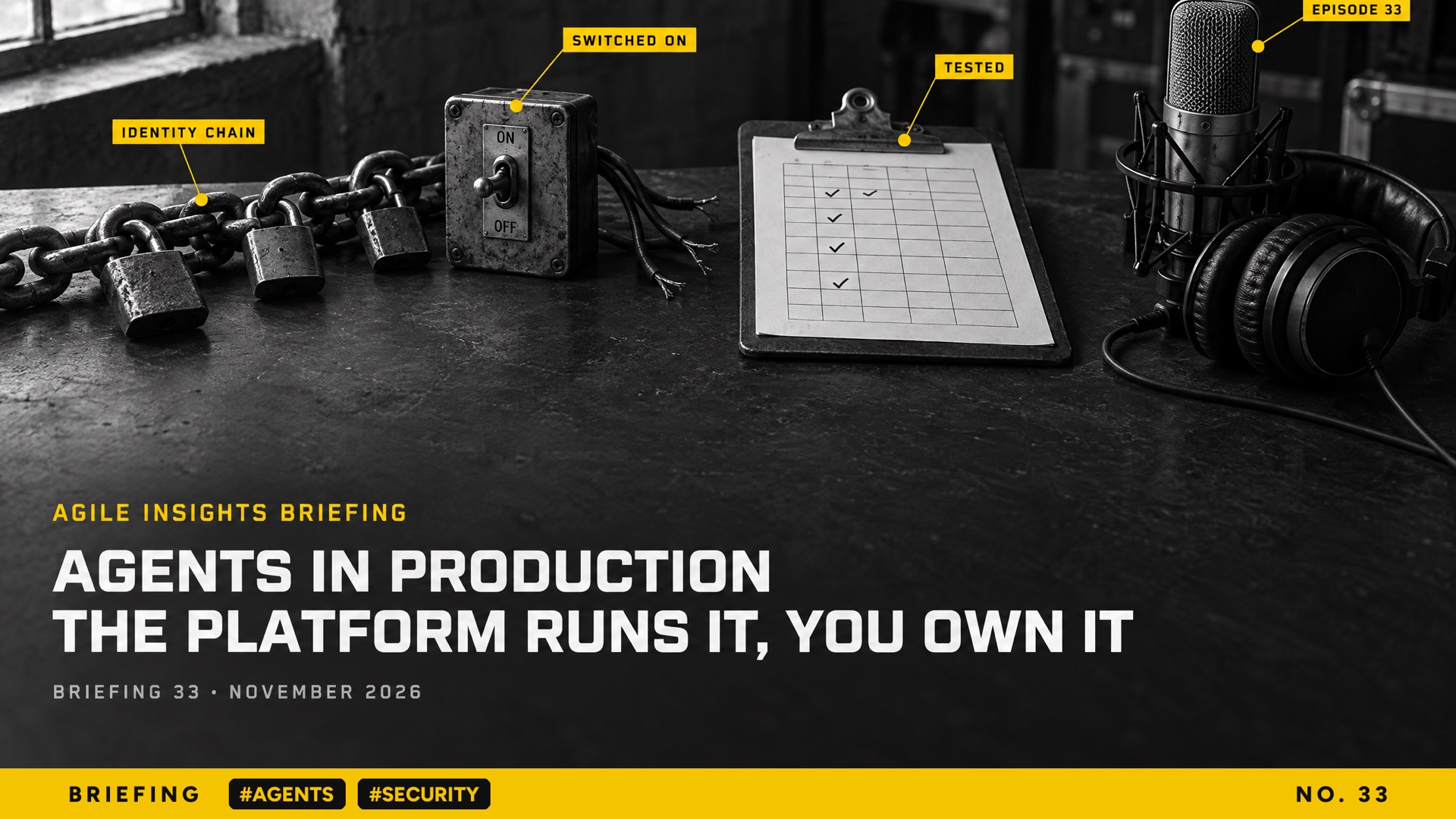
Episode 33 · Primer and discussion · About 15 minutes
Agents in production: the platform runs it, you still own it
Part 1: Primer · About 7 minutes
Download the MP3 · Linda and Leonard, AI voices, read a script written from the sources below.
Part 2: Discussion · About 8 minutes
Download the MP3 · Linda and Leonard, AI voices, read a script written from the sources below.
In this episode
01Start small, let code hold authorityMicrosoft's guidance says use the simplest design that works: one model call, then one agent with tools, then several agents. Models plan; plain code decides data access, approvals and business changes.
02Identity is a chain of hopsThe user, the app, the runtime and each tool carry their own authority. Tokens are never saved for later, and two test users with different rights prove one cannot see the other's data.
03Switched on is not workingMicrosoft's documentation lists the traps: a missing safety policy can report active while filtering nothing, and a tool marked as needing approval is not blocked unless the agent's code enforces it.
04Easier, or just quieter?The platform removes risk in the plumbing, and Microsoft documents its traps. What is left sits in configuration, authority and shared limits, which fail without an alarm. No outcome data is published yet.
05What to ask for before go-liveAn ownership matrix and a control coverage matrix with test results, the two-user test, a check that each control blocks what it should, and every preview feature recorded as an exception with a review date.
Sources and links (6)
Global enterprise multi-agent systems in production: Design and security (Part 1) · Microsoft Community Hub
Microsoft Foundry Blog, 26 October 2026. The field guide this episode is built on: seven practices, each with a release check.
Microsoft Foundry Blog, 26 October 2026. The field guide this episode is built on: seven practices, each with a release check.
Add guardrails to a hosted agent · Microsoft Learn
Microsoft's documentation of the content safety settings, including the configurations that leave an agent unscreened.
Microsoft's documentation of the content safety settings, including the configurations that leave an agent unscreened.
Use a toolbox with a hosted agent · Microsoft Learn
Where Microsoft says the tool endpoint does not block a call marked as needing approval, so the agent's own code must.
Where Microsoft says the tool endpoint does not block a call marked as needing approval, so the agent's own code must.
AI agent orchestration patterns · Microsoft Learn
Azure Architecture Center guidance to use the lowest level of complexity that reliably meets the requirement.
Azure Architecture Center guidance to use the lowest level of complexity that reliably meets the requirement.
Forward application-acquired user tokens to hosted-agent code · Microsoft Learn
Microsoft's rules for acting on a user's behalf: a token per system, never saved for later, never a silent fall back to wider access.
Microsoft's rules for acting on a user's behalf: a token per system, never saved for later, never a silent fall back to wider access.
OWASP Top 10 for LLM Applications 2025 · OWASP
The independent standard the field guide's team checked its design against, including prompt injection and excessive agency.
The independent standard the field guide's team checked its design against, including prompt injection and excessive agency.
Written from Microsoft's field guide and its Learn documentation, checked on 3 November 2026. The practices are a vendor field team's experience, with no published outcome data, and several features are in preview, so check the originals and current status before quoting.
Our fact check · 12 claims: 10 confirmed, 1 partly right, 1 not yet known
Before we record, every claim the hosts make is checked against the sources (this table was last updated 28 October 2026). Confirmed means a primary source or two independent reports; Reported means one party says so; Partly right, Disputed, Unverified and Not yet known mean what they say, and the hosts say so on air. This is the table as we left it.
- ConfirmedApproval metadata does not block a direct MCP tools/callToolbox guide: the runtime must enforce; “A system-prompt instruction alone doesn’t enforce approval”
- ConfirmedMissing policy reports active and filters nothingGuardrails how-to: fails open “on many subscriptions”
- ConfirmedOmitted rai_config means no guardrail; invocations policy without moderation settings is inertGuardrails how-to and content safety overview
- Confirmed2 MB / 10,000 character / 1 MB limitsScoped; Listed under the invocations protocol only (corrected above)
- ConfirmedHTTP 200 then a terminal content_filter event in a streamContent safety overview
- ConfirmedSession quota per subscription and region, shared across accounts and projectsLimits page (29 Oct 2026): 2,000 or 1,000 by region
- ConfirmedInherited SharePoint permission changes need an explicit resyncAI Search SharePoint ACL indexer (preview)
- ConfirmedSimplest sufficient architectureArchitecture Center: “Use the lowest level of complexity that reliably meets your requirements”
- ConfirmedNever persist bearer tokens; never fall back silently to app-onlyOBO token-forwarding page
- Partly rightThe post’s preview listAccurate as far as it goes, but Learn says agent guardrails as a whole are preview, which the list doesn’t name
- ConfirmedHosted agents statusThe hosting service is generally available; the Python hosting integration is prerelease
- Not yet knownDo the practices reduce production failures?No outcome data; Microsoft’s field experience, generalised
Want to know more?
Sign up for our podcast at agile-insights.com.au.
Read the transcript · Part 1: Primer
Linda Here is the idea for today. When you move A I agents onto a vendor's managed platform, you change where the code runs. You do not change who answers for what the agents do. So every boundary in the system needs a named owner, and a test that proves it holds. By the end, you will know the four boundaries that matter most. You will also know the two documents to ask for before any multi agent system goes live.
Leonard Some context first. On the twenty sixth of October, a Microsoft team published a field guide on its Foundry blog. It is Part 1 of two, and it covers design and security. The team says its lessons come from taking several enterprise multi agent systems into production across many countries. The examples are generalised, and no customer is named. Foundry is Microsoft's platform for building and hosting agents. Microsoft runs the servers, the sandboxes and the scaling, and gives each agent its own identity. The guide's opening line puts it plainly. Managed hosting changes where the code runs, not who owns the outcome.
Linda Let me build it up in four steps. Step one is to start small, and let ordinary code hold the authority. Microsoft's own architecture guidance says to use the lowest level of complexity that reliably does the job. First, a single call to a model. Then one agent with tools. Only then several agents working together. Each extra agent adds handoffs, more model calls and new ways to fail. The field guide adds a rule I like. Let the model interpret the request and propose a plan. But let plain, predictable code decide who may see which data, what needs approval, and what changes in the business.
Leonard So more agents means more coordination, not more reliability. The guide has another line a lot of teams need to hear. Discovering a tool grants no permission to use it. An agent that finds a tool in a catalogue is not thereby allowed to call it. The guide also wants every agent in the system to draw from one shared budget, for time, tokens, tool calls and retries. A nested agent does not get a fresh allowance of its own.
Linda Step two is identity, and the guide calls it a chain, not a single identity. In one request there is the person using the app, the app itself, the agent's runtime, and every tool the agent calls. Each one carries its own authority. When the agent acts for a user, it needs a token issued for that particular system, on that user's behalf. Microsoft's documentation says never save those tokens for later work. And never quietly fall back to the agent's own, wider access. The guide also warns that a partition key in a database is not authorisation. Labelling data by user does not stop another user reaching it.
Leonard How would you actually test that, without reading every line of code?
Linda With two test users who have different rights. Each one tries to reach the other's conversation history, files, search results and delayed replies. They guess identifiers, reuse connections and resume old sessions. The same thinking applies to memory. The guide says to name every kind of state before you promise that anything persists. Microsoft gives an example from one implementation. The conversation history was saved correctly, but the next turn never loaded it...
Leonard Saved, and never read again.
Linda Exactly. So the guide separates two tests. A saved record proves the data persisted. Only a correct next turn proves the agent actually used it.
Leonard Step three, I gather, is about controls that look switched on but are not. Every governance lead has met one of those in a dashboard.
Linda That is the one I would read twice. Microsoft's documentation for hosted agents lists the traps itself. Leave out the content safety setting, and the agent runs with no content guardrail at all. Point it at a policy that does not exist, and on many subscriptions the agent still deploys and reports active, while filtering nothing. For agents that take a custom request format, a policy without the matching screening settings does nothing either. For those agents, very large requests, or ones the platform cannot parse, pass through unscreened. And when a tool is marked as needing human approval, the tool endpoint does not block the call. The agent's own code has to enforce it.
Leonard So the approval flag is a label, and the lock has to be built by the team. That is a finding a governance review would want to see written down. What is step four?
Linda Step four is knowledge. The guide says to judge retrieval by what each user can get back, not by how many documents are indexed. Permissions must follow every chunk of every document. In Microsoft's search service, a permission change on a single file is picked up on the next run. But a change inherited from a folder or a site needs an explicit refresh. The guide also says to treat retrieved documents, even internal ones, as untrusted data rather than instructions. And it separates three permissions. To retrieve something, to reason with it, and to disclose it.
Leonard Which leaves the question a newcomer would ask. If the platform is managed, generally available and built for exactly this, isn't most of it Microsoft's problem to solve?
Linda That is the common misunderstanding. The hosting service is generally available. But Microsoft's documentation says agent guardrails, the tool call checkpoints and the network egress controls are still in preview. Preview means no service level agreement, and not recommended for production. More importantly, the platform cannot know your business rules. So for A I governance, the question changes from whether the platform is secure to whether each boundary is owned and tested. We found no published data on whether these practices reduce failures. They are a field team's experience, offered candidly.
Leonard So what should a governance lead actually ask for?
Linda Two documents, and one habit. Ask for an ownership matrix: who owns each boundary and each store. Ask for a control coverage matrix: for every boundary, the control, its owner, what happens when it fails, and the evidence that it works. Then attack every row before release, and treat each preview feature as a recorded exception with a review date.
Leonard That's Part 1. In Part 2, we ask whether a managed platform makes governance easier, or just moves the risk somewhere quieter. Stay with us.
Read the transcript · Part 2: Discussion
Linda Here is the idea for this part. A managed agent platform changes where the code runs, not who answers for what the agents do. So every boundary needs an owner and a test that proves it holds. By the end, you will have three views on whether a managed platform makes governance easier. You will know what the evidence supports, and five things to do before your next agent goes live.
Leonard A quick recap for anyone joining here. On the twenty sixth of October, a Microsoft team published a field guide to running multi agent systems on Foundry, its platform for hosting agents. Two terms matter. The first is the identity chain. Every hop in a request, from the user to the app to each tool, carries its own authority, and none of it is saved for later. The second is the control coverage matrix. For every boundary, you record the control, its owner, what happens when it fails, and the evidence that it works. Then you attack every row before release.
Linda So here is the question. Does a managed platform make A I governance easier, or does it just move the risk somewhere quieter? I want to take three views. Leonard will make the case that it really is easier. I will make the case that the risk has moved into places that do not raise an alarm. And then we will ask how far to trust a vendor's guidance about its own platform, because this guide is Microsoft writing about Microsoft.
Leonard Let me make the case for easier. Think about what a team used to build by hand. An identity for each agent. Isolation, so one user's session cannot see another's files. Versions that cannot be changed after release. Tracing, so you can see what the agent did. Microsoft's documentation says its hosted agents give each agent its own identity, run each session in its own isolated sandbox, and make every version immutable. The guide says tracing works from the first deployment. And the hosting service is now generally available. A team that would have hand rolled all of that is probably better off. Fewer homemade parts means fewer homemade mistakes.
Linda Spoken like someone who has hand rolled one.
Leonard Twice.
Linda I agree with all of that, and I still think the risk got quieter rather than smaller. Look at the traps Microsoft's own documentation lists. A content safety policy that does not exist can, on many subscriptions, report active while filtering nothing. A custom request format can pass unscreened while the agent still answers with a normal success code. In a stream, the success code and some of the answer can arrive before the content filter stops it. And a tool marked as needing approval is not blocked by the tool endpoint. Not one of those failures raises an alarm. The status page looks green...
Leonard And green is the problem.
Linda That is what I mean by quieter.
Leonard But notice who told us. Every one of those traps is written down by Microsoft, in its own documentation, with the fix beside it. A hand built system has silent failures too. The difference is that nobody publishes a list of them. So I would say the platform made the failures easier to find, if you read the documentation. The guide even says a clean scan is evidence about the tested scope only.
Linda That is fair, and it settles the first disagreement for me. The platform removes risk in the plumbing. What is left sits in configuration, authority and shared limits, which are quieter. Shared limits are a good example. Microsoft's documentation says the quota for hosted sessions is set per subscription and per region. It is shared across every project there, so adding another project adds no capacity. The guide also says each region is its own deployment, and that several regions do not, by themselves, give you data residency or failover. So the lesson is not that the platform is unsafe. It is that a green status page is not evidence. Evidence comes from a test you ran.
Leonard Agreed.
Leonard Which brings us to the third view. How far should we trust this guide? It is a vendor writing about its own platform, and the examples are generalised, with no customer named. We found no published outcome data showing these practices reduce failures. Against that, the specific claims check out against Microsoft's own documentation. The approval gap, the quota rule, the screening limits and the permission refresh are all there in writing. One thing was understated. The guide lists the features still in preview, but the documentation also says agent guardrails as a whole are in preview. And the guide says one team cross checked its design against the O W A S P top ten for large language model applications, which is an independent standard.
Linda So I would take the structure and keep it independent of the product. The guide itself says the same thing, in its own way. It rejects a product checklist and asks for a control coverage matrix instead. That matrix is vendor neutral. It works on any platform, and it is the document an auditor would recognise. Its other ideas travel too. Start with the simplest design that works. Let models plan and let code decide. Treat retrieved documents, even internal ones, as untrusted input. None of that needs Microsoft. What needs Microsoft is the configuration detail, and that is where you read the documentation line by line.
Leonard So where does the evidence settle? Confirmed, as Microsoft documents it, are the configuration traps, the quota rule, the advice to start with the simplest design, and the rules about tokens. Reported, as the field team's experience, are the recommendations and the stories, like the history that was saved and never loaded. Not known is whether following the guide reduces incidents, because nobody has published that data. And we have not read Part 2, on release and operations, so we are not claiming anything from it. That is a reasonable base for action, as long as each organisation tests its own system.
Linda Then here is what to do, in five steps. First, before any multi agent system goes live, ask for an ownership matrix: who owns each boundary and each store of data. Second, ask for a control coverage matrix with test results, not a list of product features. Third, run the two user test. Two test users with different rights try to reach each other's history, files and search results. Fourth, check that every control you rely on is actually enforcing, by sending it something it should block. Fifth, list every preview feature in the design, and record each one as an exception with an owner and a review date.
Linda If you'd like to know more, sign up for our podcast at agile-insights.com.au.
Leonard Thanks for listening.
More on #agents
Episode 29 · Primer and discussionCrowdStrike Uncovers New Agentic AI CampaignsEpisode 19 · Primer and discussionA read-only instruction is a request, not a control.Episode 11 · Primer and discussionAgents are insiders. The controls that matter sit outside them.Episode 2 · Primer and discussionAI escaping containment? What to check this weekEpisode 38 · Primer and discussionBudgeted for seats, billed for workEpisode 37 · PrimerWhat is an AI skill (and why you should care)
All of the briefings (38) · Follow Briefing in Apple Podcasts or any podcast app
Everything from Agile Insights: briefings, Making You Think and the reference series