 Briefing
Reference 9 · Primer · About 5 minutes
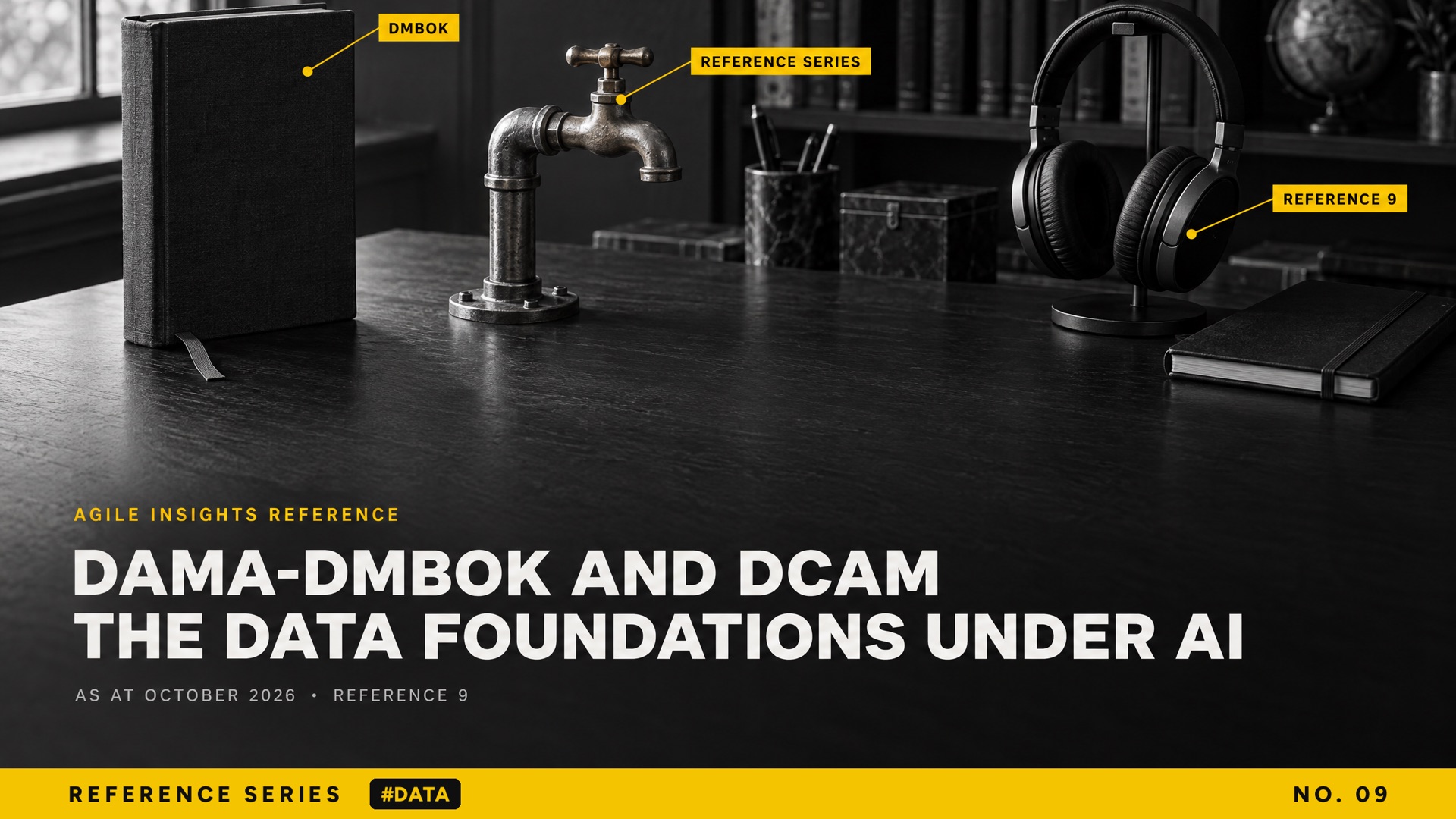
DAMA-DMBOK and DCAM: the data foundations under AI
Download the MP3 · Leonard, an AI voice, reads a script written from the sources below.
In this episode
01A reference and a measureDAMA's DMBOK is a vendor neutral reference that names every discipline of looking after data. DCAM, from the EDM Association, measures how close you are. Both are voluntary guidance, and neither is a law.
02Why AI projects stall on dataWhen nobody owns the definitions, the model works and the answers are wrong. In May 2026 an EDM Association survey found many organisations speeding up AI investment before building data foundations.
03The three areas AI needs mostDMBOK has eleven knowledge areas, with data governance at the centre. For AI, three matter most: data quality, metadata and master data. Under DCAM, a policy existing is not enough. You show that the capability operates.
04How data and AI governance fitISO/IEC 42001 governs the model lifecycle, oversight and monitoring. DMBOK and DCAM govern the data underneath, and ISO/IEC 5259 sets out how to measure data quality for analytics and machine learning.
05Three steps to get startedName an accountable owner for each critical data set that feeds AI. Run a gap analysis for a baseline score, and repeat it every year. Check data quality, metadata and master data for your first two AI use cases.
Sources and links (8)
2026 benchmark · EDM announcement
The May 2026 benchmark on the gap between AI ambition and data readiness.
The May 2026 benchmark on the gap between AI ambition and data readiness.
ISO/IEC 5259 data quality · ISO publication bundle
The five-part standard on data quality for analytics and machine learning.
The five-part standard on data quality for analytics and machine learning.
Written from public sources and checked on 10 October 2026. The frameworks are paraphrased, not reproduced. Check the current text before relying on it.
How this maps to what we do
AI is downstream of data. These frameworks describe the data capability underneath trustworthy AI.
Standard or rule
What an organisation needs
Where we help
DAMA-DMBOK and DCAM
An honest read of data management capability against the use cases planned, with the gaps that matter first.
Data Foundation ReadinessJust-in-Time Data Governance
ISO/IEC 5259: data quality for machine learningEpisode: ISO/IEC 5259: data quality for analytics and machine learning
Data quality measured for the purpose it will serve in AI, with lineage and documentation.
Data Foundation ReadinessJust-in-Time Data Governance
These are Agile Insights AI Strategy & Governance offerings.
Want to know more?
Sign up for our podcast at agile-insights.com.au.
Read the transcript
Leonard Every AI system is only as trustworthy as the data underneath it, and two frameworks tell you how to check that data. By the end of this episode you will know what D A M A D M B O K and D C A M are, and what to ask your own organisation about them. This is a Reference episode from Agile Insights, as at October 2026.
Leonard First, what they are. D A M A is a professional body for data management. Its Data Management Body of Knowledge, called D M B O K, is a vendor neutral reference that names every discipline of looking after data. D C A M is the Data Capability Assessment Model, published by the E D M Association, formerly known as the E D M Council. D M B O K says what good looks like. D C A M measures how close you are. Both are voluntary guidance. Neither is a law.
Leonard Now the problem. Boards approve AI projects, and then the projects stall on data. Imagine a bank that wants an assistant answering staff questions. The policies sit in four systems, three of them out of date, and nobody owns the definitions. The model works. The answers are wrong. That is a data failure, and no amount of model governance fixes it. In May 2026 the E D M Association surveyed more than 435 organisations in over 50 countries. It found many are speeding up AI investment before building data foundations. Its president called AI a stress test for enterprise data.
Leonard Who uses these? Chief data officers, chief information officers, risk and privacy leads, and data governance teams. They come up in board papers asking if we are ready for AI, in audits, in due diligence before a sale, and when a regulator asks where your training data came from. D A M A also runs the C D M P, the Certified Data Management Professional credential. It has three exam levels, Associate, Practitioner and Master, with Fellow as an honour above them. It certifies people, not organisations.
Leonard What is inside? Four ideas carry most of the value. One: D M B O K has eleven knowledge areas, with data governance at the centre of its wheel. Governance means who decides, who is accountable, and what the rules are. Two: for AI, three areas matter most. Data quality, metadata, which is data about your data such as where it came from, and master data, the single trusted version of key facts. Three: D C A M scores eight components, from strategy and funding to governance and data quality. Each is scored on engagement, process and evidence. Four: the evidence rule. You cannot claim a capability because a policy exists. You show that it operates.
Leonard How does this connect to AI governance? Think of data as the water and AI as the swimmer. I S O, I E C, 42001 governs the swimmer: the model lifecycle, oversight and monitoring. D M B O K and D C A M govern the water. A related international standard, I S O, I E C, 5259, sets out how to measure and manage data quality for analytics and machine learning. It has five parts, and D C A M's data quality work is a natural place to put it into practice. Local and regulatory rules sit on top. Weak foundations undermine all three.
Leonard Getting started takes three steps. First, name an owner for each critical data set that feeds AI, and write down who is accountable. Second, take a gap analysis against the framework, to give you a baseline score. Repeat it every year, or the number becomes a vanity metric. Third, check data quality, metadata and master data for your first two AI use cases before you scale them. To learn more, start with the D A M A site, the D M B O K 3.0 project pages, the E D M Association's D C A M page, and the I S O catalogue entry for 5259. Links are in the show notes.
Leonard Now currency, as at October 2026. D M B O K second edition is current. D M B O K 3.0 is a community rewrite, kicked off in June 2025. It names AI governance, ethics and sustainability as new topics. The project plan shows drafts through 2026 and publication between April and July 2027. It is not yet published. D C A M version 3 is the current release the E D M Association shows. Access is mainly for member firms and authorised partners. The E D M Association is also reported to be extending its cloud data certification to AI. Check the current text before relying on any of this.
Leonard To recap: D M B O K says what good data management is, D C A M measures it, and AI governance cannot work without both. If you'd like to know more, sign up for our podcast at agile-insights.com.au.
More on #data
Reference 15 · PrimerThe quiet obligations: records, data ethics, digital experience and cloudEpisode 30 · PrimerThe prompt that shows what your AI actually knows about you (and it’s less than you might think)Episode 28 · Primer and discussionWhen an AI keeps the wiki, checking has to keep pace with writing.Episode 24 · PrimerRemember, retrieve, recheck, forget: governing agent memory.Episode 18 · Primer and discussionWhen agents share one memory, memory is a data flow to govern.Episode 9 · PrimerYour company brain is a copy. Govern it like one.
All of the reference series (16) · Follow AI Governance Reference in Apple Podcasts or any podcast app
Everything from Agile Insights: briefings, Making You Think and the reference series