 Briefing
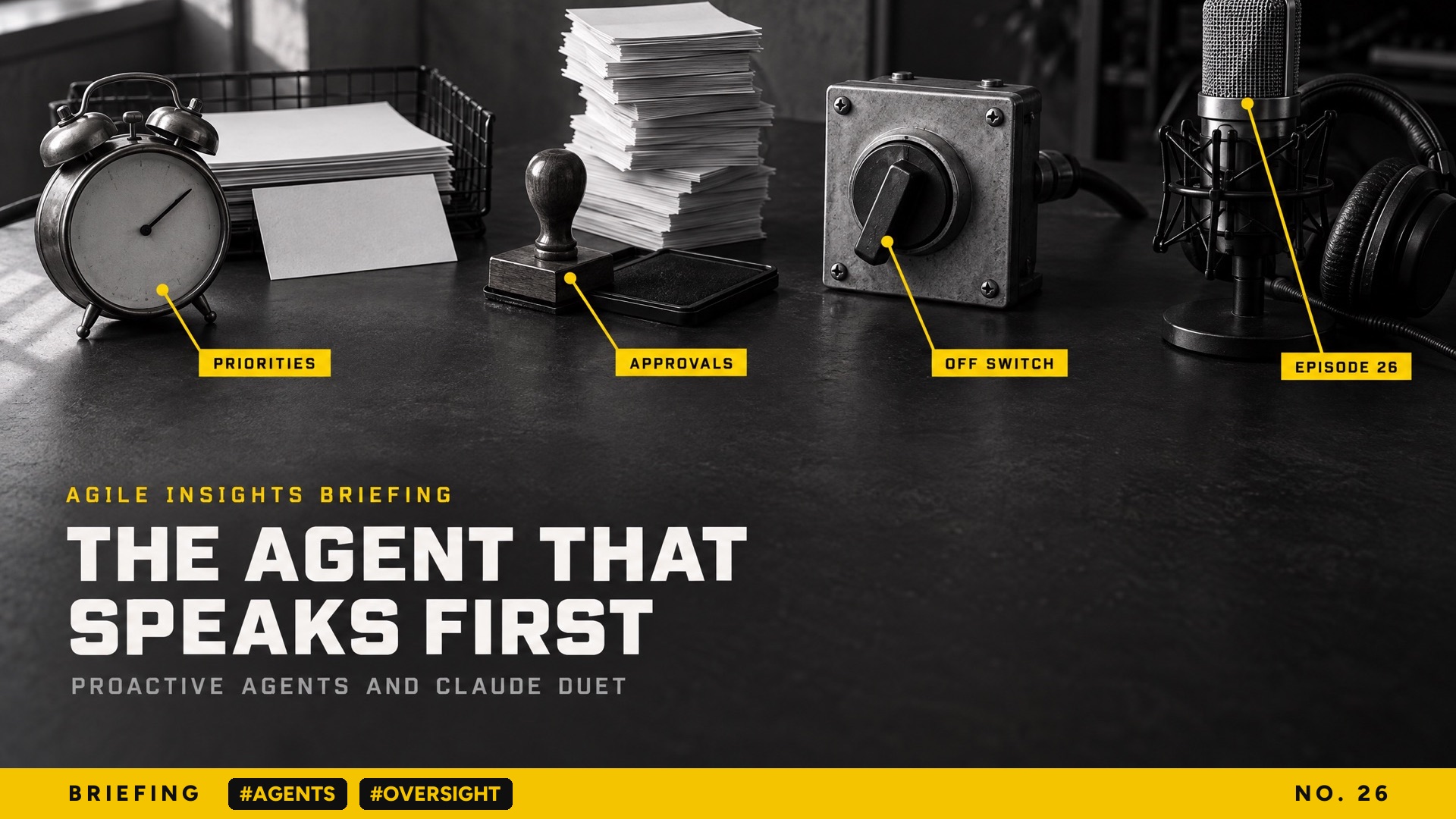
Episode 26 · Primer and discussion · About 14 minutes
The agent that speaks first: what to decide before proactive agents reach work accounts.
Part 1: Primer · About 7 minutes
Download the MP3 · Linda and Leonard, AI voices, read a script written from the sources below.
Part 2: Discussion · About 7 minutes
Download the MP3 · Linda and Leonard, AI voices, read a script written from the sources below.
In this episode
01The agent now goes firstOn 21 October Anthropic opened a research preview of Claude Duet. It sends a morning brief, checks connected accounts every few hours and messages you when something needs you.
02Proactivity is not priorityAnthropic says Duet might miscalibrate what is urgent. Nathaniel Whittemore says it reminded him four times about a double booking that was not one, until he told it that line of work did not matter to him.
03The value is in drafted repliesDuet drafted replies to emails Whittemore would have left for days, and he approved or edited them. On the most substantive one, he says the draft got him about ninety per cent there.
04Approvals wear outAnthropic's safety note calls approval fatigue a serious issue. Some steps always need a fresh yes, some are blocked outright, and what Duet learned stays until you reset its memory.
05Owner, approvals, kill rule, accountKeep work accounts off personal-plan agents, name an owner for every standing agent, design approvals with hard stops, give each a value review and kill rule, and add a memory reset to offboarding.
Sources and links (5)
Introducing Claude Duet · claude.com
Anthropic, 21 October 2026. The announcement: research preview, morning brief, checks every few hours, approval before it sends, pays, signs or deletes, and the urgency caveat.
Anthropic, 21 October 2026. The announcement: research preview, morning brief, checks every few hours, approval before it sends, pays, signs or deletes, and the urgency caveat.
Claude Duet product page · claude.com
Anthropic. Who can get the preview, that Team and Enterprise plans are not included yet, and that it can miss something between checks.
Anthropic. Who can get the preview, that Team and Enterprise plans are not included yet, and that it can miss something between checks.
Claude Duet: safety, privacy and security · claude.com
Anthropic, 23 October 2026. Approval design, approval fatigue, actions never allowed, and what stays after you disconnect an app.
Anthropic, 23 October 2026. Approval design, approval fatigue, actions never allowed, and what stays after you disconnect an app.
How I'm Actually Using AI Right Now (Including Claude Duet) · aidailybrief.ai
The AI Daily Brief, 25 October 2026. Nathaniel Whittemore's first days with Duet and why he switched off his earlier standing agents.
The AI Daily Brief, 25 October 2026. Nathaniel Whittemore's first days with Duet and why he switched off his earlier standing agents.
Claude Duet: Anthropic previews an AI agent that messages you first · vktr.com
VKTR, 22 October 2026. Independent press coverage of the launch.
VKTR, 22 October 2026. Independent press coverage of the launch.
Written from Anthropic's announcement, product page and safety note and from one user's first-person account, checked on 29 October 2026. Duet is a US-only research preview, the design details are Anthropic's own account, and one person's week is not a pattern, so check the originals before quoting.
Our fact check · 10 claims: 7 confirmed, 2 reported, 1 unverified
Before we record, every claim the hosts make is checked against the sources (this table was last updated 29 October 2026). Confirmed means a primary source or two independent reports; Reported means one party says so; Partly right, Disputed, Unverified and Not yet known mean what they say, and the hosts say so on air. This is the table as we left it.
- ConfirmedResearch preview 21 Oct 2026; standalone app; Opus 5.5Anthropic; VKTR
- ConfirmedUS Pro and Max by waitlist; Team and Enterprise not included yetAnthropic (announcement, product page); VKTR
- ConfirmedChecks accounts every few hours; background work on its own machineAnthropic; VKTR; “monitors continuously” in some coverage is partly right
- ConfirmedApproval before send, pay, sign, delete; some actions off-limits even with approvalAnthropic
- ConfirmedApproval fatigue named as a serious issue; cadence still being tunedAnthropic safety note
- Confirmed“May misread a thread or miscalibrate what’s urgent”Anthropic
- ConfirmedLearned context survives disconnecting an app until memory resetAnthropic safety note; As designed
- ReportedAd-slot false alarm reminded about four times; drafted replies 90% thereNLW; One user, days in
- ReportedEarlier standing agents switched off as not worth the upkeepNLW
- UnverifiedMicrosoft 365 not supportedVKTR only
Want to know more?
Sign up for our podcast at agile-insights.com.au.
Read the transcript · Part 1: Primer
Linda Here is the idea for today. An A I agent that comes to you first will chase what it can reach, not what matters most. So governing one is mostly about setting its priorities, designing its approvals and knowing when to switch it off. It is not only about granting access. By the end of this part you will know what a proactive agent is, how the newest one works, and the two ways it goes wrong.
Leonard Most of the A I I use at work waits for me. I open a chat, I ask, it answers, and then it sits there until I ask again. The assistant in my documents works the same way, and so does the chatbot on the intranet. I gather the new personal agents are different, and that one arrived from Anthropic last week. So what actually changes when the agent goes first?
Linda Step one is the difference between reactive and proactive. A reactive assistant answers when you ask. A proactive agent watches your email, calendar and chat, decides what needs you, and messages you first. On the twenty first of October, Anthropic opened a research preview of one, called Claude Duet. Each morning it sends a short brief. It checks your connected accounts every few hours and works on tasks in the background. Before it sends, pays, signs or deletes anything, it shows you the action and waits for your yes. For now it is only for paying individual subscribers in the United States, by waitlist. There is no team or enterprise version yet.
Leonard So it reads everything and decides what is important. How does it know what is important to me?
Linda Step two is that it does not, at least not at first. It knows what it can see, which is your inbox, and not what you know about your business. Nathaniel Whittemore, who hosts The A I Daily Brief, described his first days with Duet on the twenty fifth of October. Two sponsors had been offered the same date for an advert. Duet treated that as a double booking. It was not, because his show has several advert slots a day. It reminded him about four times, until he told it that whole line of work did not matter to him. His reading is that an agent overvalues the work it can be proactive about.
Leonard A keen new starter, then.
Leonard To be fair to it, a human assistant in their first week would make the same mistake. They would see two emails offering one date and raise it. The difference is that a person learns after the first time you tell them it is fine. And I suspect Anthropic knows this is a weak spot. Has the company said anything about it?
Linda It has, and plainly. Anthropic says Duet still might misread a thread or miscalibrate what is urgent. It also says Duet can miss something that arrives between its checks. So the vendor and the early user agree. That is step three. Proactivity is not priority. An agent that can reach your inbox will find work in your inbox, whether or not that work matters. Somebody has to tell it what to watch, what to ignore, and when a line of work should stop. That somebody is a person with a name, not a setting nobody owns.
Leonard Fair enough.
Leonard It cannot all be false alarms, or nobody would bother. Where did it actually earn its keep for him?
Linda In the dull, useful middle. Whittemore has a habit of starring important emails and coming back to them days later. Duet drafted replies to exactly those emails, and he approved or edited them from the chat. A couple he simply let it send. On the most substantive one, he says the draft got him about ninety per cent of the way there. Notice the shape of that. The agent prepares, a person decides, and the person reads what they approve. Anthropic's own testers tell similar stories, like a client call it offered to move because it fell just before a flight...
Leonard That last part is where I get uneasy, though. If it asks before it acts, that sounds safe enough on paper. But I have clicked yes on a great many prompts without reading a word of them. Cookie banners, software updates, terms and conditions, the lot. I doubt I am the only one, and I doubt an agent's prompts will be any different.
Linda We have all done that.
Linda You are not the only one, and that is the common misunderstanding. Anthropic names it too. Its safety note calls approval fatigue a serious issue, because too many requests teach people to tap through them. So some steps need a fresh yes every time, like paying or deleting an order. Some actions are blocked even with your approval, like moving money between accounts. Two more facts matter. What it learned from an app stays after you disconnect that app, until you reset its memory. And one person, a few days in, is an example, not a pattern. Whittemore says so himself.
Leonard So for someone running A I governance, what does this mean in practice?
Linda Four things. First, a standing agent needs a named owner who sets what it watches and what it ignores. Second, design approvals so that a yes means something. That means fewer of them, clear ones, and hard stops for money and deletion. Third, give it a value test and a kill rule. Whittemore switched off his earlier standing agents because they cost more to look after than they returned. Fourth, decide now whether staff may connect work email and chat to a personal agent on a personal plan. Duet is not in Australia yet, so you have time to write that rule before it arrives.
Leonard So the takeaway from part one is that an agent that speaks first still needs someone to tell it what matters. In part two, we argue about whether to let one into work accounts now, or to wait.
Linda See you in part two.
Linda If you'd like to know more, sign up for our podcast at agile-insights.com.au.
Leonard Thanks for listening.
Read the transcript · Part 2: Discussion
Linda Here is the idea again. An agent that comes to you first will chase what it can reach, not what matters most, so governing one is about priorities, approvals and an off switch. A quick recap for anyone starting here. Claude Duet is Anthropic's new proactive agent, in preview since the twenty first of October. It sends a morning brief, checks your accounts every few hours, and asks before it sends, pays, signs or deletes. It is for individual paying subscribers in the United States, with no team or enterprise version yet. Today's question is simple. Should an organisation let an agent like this into work email and chat now, or wait?
Leonard I will take the cautious side, and I think it is the stronger one today. Look at where the preview lives. It runs on personal plans. There is no team version, so there is no admin console and no central view of who connected what. Anthropic says it can use more than six thousand connectors, including finding the Gmail and Slack messages you missed. Put those two facts together and you get my worry. That is our reading, not something Anthropic has said, and nobody has counted how often it happens. But a keen staff member could connect a work inbox to an agent their employer cannot see.
Linda I share the worry, and I want to argue the other side anyway, because waiting has a cost too. The value showed up in the most ordinary place. Whittemore had emails he would star and leave for days. Duet drafted replies, he approved or edited them, and one substantive draft got him about ninety per cent of the way there. That is real time back for a busy person. And people do not wait to be asked. If the organisation has no position, the keenest staff will find their own way in once these tools reach Australia. I would rather learn what to watch on a small trial that I own...
Leonard A small trial you own, yes. A trial on a personal plan, no. And here is the part that makes me firm about it. Anthropic's safety note says that when you disconnect an app, Duet stops new access, but what it already learned stays until you reset its memory. So a trial in a work inbox leaves work context sitting in a personal account. If that person leaves, the context leaves with them, unless someone remembers the reset. That belongs in offboarding, and today nobody in the organisation could even check that it was done.
Linda Ah. The leaver problem.
Linda That is a fair point, and it moves me. So no work accounts on personal plans. Where I still want to start now is the rules, because the rules do not need the product. The lesson from Whittemore's week is that the agent's to do list is chosen by what it can reach. It nagged him four times about a double booking that was not one. Anthropic says the same thing in its own words. It might miscalibrate what is urgent. So the first rule is an owner. Someone with a name decides what the agent watches, what it ignores, and when a line of work stops.
Leonard And the second rule has to be about approvals, because that is what everyone points to as the safety net. I am less comforted by it than the marketing would like. Anthropic deserves credit for saying it out loud. Its safety note calls approval fatigue a serious issue, because too many requests teach people to tap through them. So an approval is only a control if a person actually reads it. An organisation should want fewer and clearer approvals, hard stops on money and deletion that no setting can switch off, and some way to see whether people are reading or just tapping.
Linda Anthropic has built some of that in. Some steps, like paying or deleting an order, never fall under a don't ask me again rule, however often you have said yes. Some are blocked even with approval, like moving money between accounts. And a separate check outside the working model tests each action against what you asked for. That is the company's account of its own design, and it has not been tested independently yet. My point is that your own rules should match that shape, whatever tool you end up with. Decide which actions always need a fresh yes, and which never happen at all...
Leonard The third rule is the one people skip, and it is the off switch. Whittemore had tried standing agents earlier in the year. He ran agents on timers, plus a chief of staff agent to coordinate them. He switched them all off, because the upkeep cost more than they gave back. His phrase was that the juice was not worth the squeeze. He is also fair about it, and says his own habits may explain some of that. But the lesson travels. Every standing agent needs a value review, and a rule for stopping a line of work that keeps crying wolf.
Linda Every inbox has one of those.
Linda Where I would push back a little is on how much one person's week can tell us. Whittemore is a solo operator, a few days in, and he says himself that it is early. The testers Anthropic quotes were chosen by Anthropic. So neither the false alarm nor the ninety per cent draft is a pattern. What is not known yet matters more. Nobody knows how well the urgency judgment holds up across many users, or how often people tap through approvals in practice. And there is no date yet for a managed version, or for Australia.
Leonard Which is why I end up close to you. Waiting for the product is right. Waiting to think is not.
Linda Agreed.
Linda So here is what to do. First, write a line into your A I use guidance now. No work email, chat or files connected to a personal agent on a personal plan. Second, name an owner for any standing agent, who sets what it watches and what it ignores. Third, design approvals so that a yes means something, with hard stops for money and deletion. Fourth, give every standing agent a value review and a kill rule. Fifth, add a memory reset to offboarding. Then, when a managed version arrives, trial it with a few willing people under your own controls.
Leonard And on that trial, count the boring wins, like replies drafted and approved, alongside the false alarms. That tells you whether the juice is worth the squeeze for you.
Linda If you'd like to know more, sign up for our podcast at agile-insights.com.au.
Leonard Thanks for listening.
More on #agents
Episode 37 · PrimerWhat is an AI skill (and why you should care)Episode 36 · Primer and discussionChecking agents in production, even when you can’t read their workEpisode 14 · Primer and discussionWrite down what the agent must never do, and what it must still do.Episode 38 · Primer and discussionBudgeted for seats, billed for workEpisode 33 · Primer and discussionAgents in production: the platform runs it, you still own itEpisode 29 · Primer and discussionCrowdStrike Uncovers New Agentic AI Campaigns
All of the briefings (38) · Follow Briefing in Apple Podcasts or any podcast app
Everything from Agile Insights: briefings, Making You Think and the reference series