 Briefing
Episode 25 · Primer and discussion · About 14 minutes
The managed loop: what you still own when the vendor runs your agent.
Part 1: Primer · About 6 minutes
Download the MP3 · Linda and Leonard, AI voices, read a script written from the sources below.
Part 2: Discussion · About 8 minutes
Download the MP3 · Linda and Leonard, AI voices, read a script written from the sources below.
In this episode
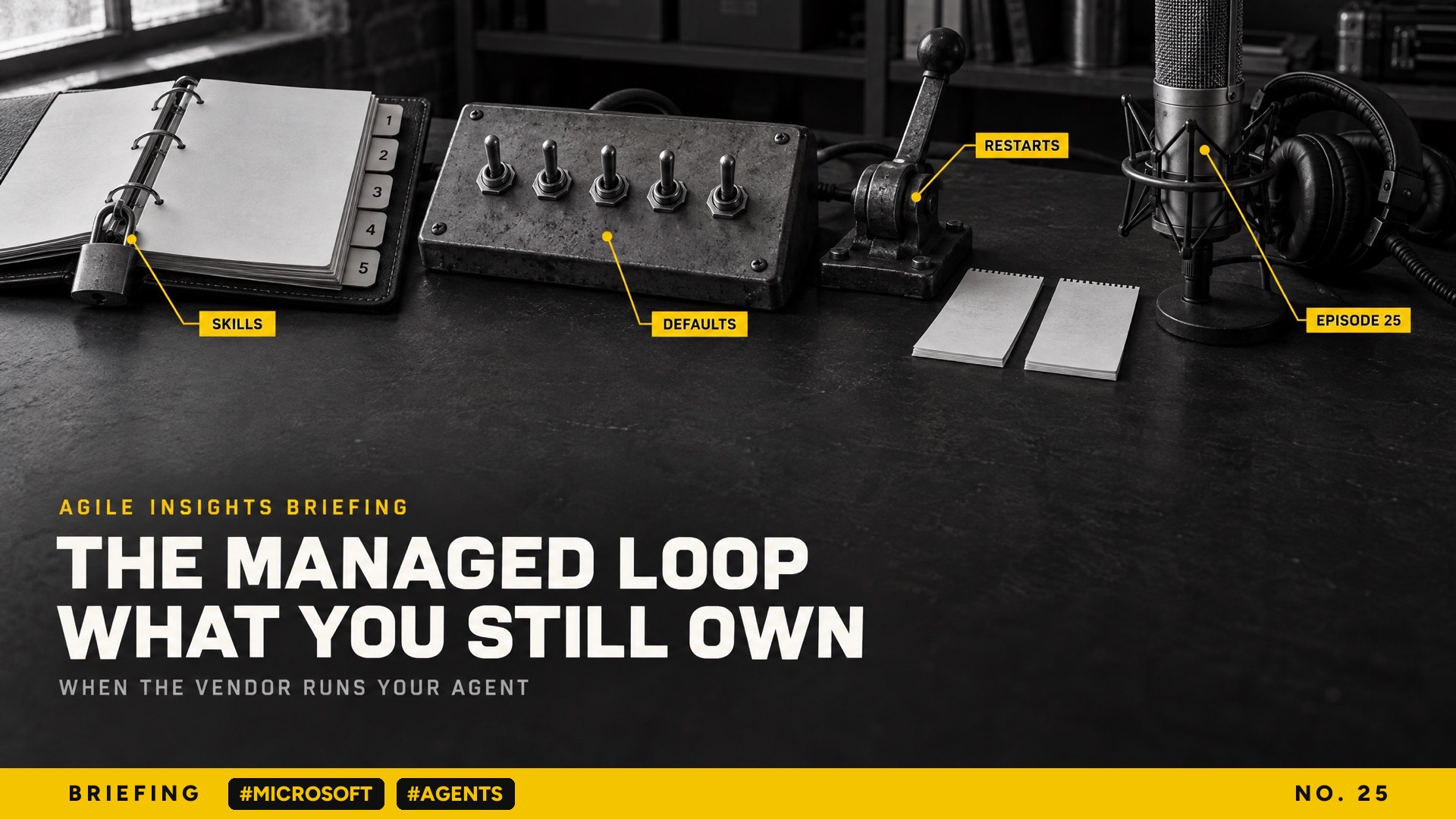
01A harness turns answers into workThe harness is the loop, working memory, sandbox and tools around the model. In late October Microsoft made its Copilot harness a public preview in Foundry Agent Service.
02Skills are versioned procedures you ownA skill is a folder with a short written file in an open format Anthropic first developed. In Foundry every change saves a new version that cannot be altered.
03The defaults start wide openMicrosoft's documentation says all five built in tools start on, shell included, and the shell is not a boundary. During the preview, approvals for those tools are set by the service.
04A restart starts again from the topFoundry restarts interrupted work from the original input, and recovery is off by default. Microsoft says your code must stop duplicate actions, such as a second report.
05Record it, close it, cost itWrite the agent's record before the pilot, switch off unneeded tools starting with the shell, demand an answer on duplicates, give every skill an owner, and budget for billing from 1 December.
Sources and links (7)
Introducing the Microsoft Copilot harness in Foundry Agent Service · devblogs.microsoft.com
Microsoft Foundry blog, October 2026. The announcement: what Microsoft runs, the three build options, pricing from 1 December.
Microsoft Foundry blog, October 2026. The announcement: what Microsoft runs, the three build options, pricing from 1 December.
Use tools and skills with the Copilot harness · learn.microsoft.com
Microsoft Learn. The five built in tools on by default, the shell warning, preview approvals, agent identity and network egress controls.
Microsoft Learn. The five built in tools on by default, the shell warning, preview approvals, agent identity and network egress controls.
Foundry Agent Service limits, quotas and regions · learn.microsoft.com
Microsoft Learn. Supported regions, harness-managed request settings and what the preview does not support.
Microsoft Learn. Supported regions, harness-managed request settings and what the preview does not support.
Long-running agent resilience · learn.microsoft.com
Microsoft Learn. Recovery re-enters the handler from the beginning; preventing duplicate actions is the application's job.
Microsoft Learn. Recovery re-enters the handler from the beginning; preventing duplicate actions is the application's job.
Recover long-running work · learn.microsoft.com
Microsoft Learn. Crash recovery is off by default and applies only to stored background responses.
Microsoft Learn. Crash recovery is off by default and applies only to stored background responses.
Skills in Foundry Agent Service · learn.microsoft.com
Microsoft Learn. Skills in the open Agent Skills format; every update is a new immutable version you can pin.
Microsoft Learn. Skills in the open Agent Skills format; every update is a new immutable version you can pin.
Agent Skills specification · agentskills.io
The open format's own site: a folder with a SKILL.md file carrying a name and a description.
The open format's own site: a folder with a SKILL.md file carrying a name and a description.
Written from Microsoft's announcement and documentation and the Agent Skills specification, checked on 30 October 2026. The harness is in preview, the blog and documentation disagree on whether resilience is generally available, and pricing may vary by region, so check the originals before quoting.
Our fact check · 12 claims: 9 verified, 1 partly right, 1 disputed, 1 unverified
Before we record, every claim the hosts make is checked against the sources (this table was last updated 29 October 2026). Confirmed means a primary source or two independent reports; Reported means one party says so; Partly right, Disputed, Unverified and Not yet known mean what they say, and the hosts say so on air. This is the table as we left it.
- VerifiedMicrosoft runs the loop and sandbox; customer brings skills and toolsBlog; Learn harness how-to
- VerifiedSkills use the open SKILL.md format; each update is an immutable versionLearn skills; agentskills.io
- VerifiedAll five built-in tools on by default; shell is not a boundaryLearn harness how-to, limits
- VerifiedHarness-tool approvals are service-managed in preview; require_approval is MCP onlyLearn harness how-to
- VerifiedEgress controls via RAI policy are preview; audit firstLearn harness how-to
- VerifiedChosen at creation; no switching; Australia East supported; no BYOM or Foundry MemoryBlog; Learn limits, FAQ
- VerifiedPreview: no SLA, not recommended for productionLearn
- DisputedLong-running resilience is GABlog says GA; Learn says preview
- VerifiedRestart re-runs from the original input; recovery off by default; duplicates are the customer’s problemBlog; Learn resilience, recover
- VerifiedFree until 1 Dec 2026, then US$0.0994/vCPU-hour, US$0.0118/GiB-hourBlog (vendor pricing)
- Partly rightLoop limits are harness-managed; “within configured limits” is only partly the customer’s configurationLearn limits vs blog
- UnverifiedTestimonials; “unified harness strategy”Blog
Want to know more?
Sign up for our podcast at agile-insights.com.au.
Read the transcript · Part 1: Primer
Linda Here is the idea for today. When a vendor runs your agent's working loop for you, you hand over the plumbing but not the accountability. What you still own is the skills, the tool settings and what happens on a restart. And in Microsoft's new preview, those come with open defaults that you have to close yourself. By the end of this part you will know what a harness is, what Microsoft now runs for you, and what to check first.
Leonard I hear the word harness a lot lately, and I nod along. I know a model writes answers. I know an agent is meant to do work, not just answer questions. But somewhere between the two sits this thing called a harness. Now Microsoft says it will run one for us, inside its Foundry Agent Service. So before we get to any settings, what actually is a harness, in plain words?
Linda Think of the model as a very capable new hire with no desk. The harness is the desk, the computer, the filing cabinet and the routine for getting through a job. In practice it runs a loop. The model proposes a step. A tool carries it out, like reading a file or running a command. The result comes back, and the model picks the next step, until the job is done. The harness also keeps track of what the agent has worked out so far. And it gives the agent a sandbox, which is a private computer to work on. Many teams have been building all of that themselves.
Leonard A desk. I like that.
Linda It is a very good desk.
Leonard That helps. The model is the brain, and the harness is everything that lets it finish a job. In late October, Microsoft announced it would run that harness for you, as a public preview, and called it the Microsoft Copilot harness. I read that it is one of three ways to build an agent in Foundry. Where does it sit among the three, and what do we still bring to it ourselves?
Linda Microsoft describes three levels. A plain prompt agent is instructions plus tools, for simple work. A prompt agent with the Copilot harness is the new middle option. Microsoft runs the loop and the sandbox, and you bring the knowledge, the procedures and the tools. A hosted agent is the top level, where you bring your own loop and Microsoft only hosts it. The procedures you bring are called skills. A skill is a folder holding a short written file, with a name and a description, plus any scripts it needs. It uses an open format that Anthropic first developed. In Foundry, every change to a skill is saved as a new version that cannot be altered...
Leonard Then here is my newcomer question. If Microsoft runs the loop, surely Microsoft is now responsible for what the agent does with it? That is what I would assume if I sat on a board and someone told me the vendor runs it.
Linda That is the common misunderstanding, and it is the heart of today. Microsoft runs the machinery. You still decide what the agent may touch, and in this preview the starting position is wide open. Microsoft's documentation says a new harness agent has all five built in tools switched on. They read files, write files, run shell commands, fetch web pages and hand work to helper agents called subagents. The shell is the broadest. Microsoft warns that switching the others off while the shell stays on is not a real security boundary. And during the preview, approvals for those built in tools are set by the service. You can require a person to approve the tools you connect, but not the shell.
Leonard Wide open. Huh. So the safe settings are not the default ones, and some of the approvals are not ours to set yet. You mentioned restarts at the very start, though. Why would a restart be a governance problem, rather than just an engineering one?
Linda Because of what can happen twice. Microsoft also announced recovery for long running hosted agents. Its blog calls that generally available. Its documentation, as we record this, still labels it preview, so check before you rely on it. The mechanism is the same either way. If the agent's process dies, Foundry starts the job again with the original input, from the beginning. It does not know where it was unless your code saved progress. Microsoft says plainly that your workflow must stop duplicate actions. Its own example is a report created in another system. Without a check, a restart creates it twice. Recovery is also switched off by default...
Leonard Let me try saying it back, to check I have it. Buying the harness moves the governance from code we write to settings we choose. So the record we keep for an agent cannot just say which model it uses. It has to say which skills, at which version, and which built in tools are on. It has to say who approves what, and what happens if it falls over halfway. That sounds like more to record, not less, even though Microsoft now does more of the work.
Linda Exactly right, and that is the A I governance point. Here is what to do. First, treat each skill as a procedure with an owner, a reviewer and a pinned version, and keep a copy in your own repository. Second, before any pilot, switch off the built in tools the agent does not need, starting with the shell. Third, for any agent that writes to another system, ask how it avoids doing things twice after a restart. And remember two facts. This is a preview, with no service level agreement, and Microsoft does not recommend previews for production. Billing for the harness starts on the first of December.
Linda If you'd like to know more, sign up for our podcast at agile-insights.com.au.
Leonard Thanks for listening.
Read the transcript · Part 2: Discussion
Linda Here is the idea again. When a vendor runs your agent's working loop, you hand over the plumbing but not the accountability. The skills, the tool settings and the restart behaviour stay yours, and in Microsoft's preview they start wide open. A quick recap for anyone starting here. A harness is everything around the model that turns an answer into finished work. That means the loop of steps, the working memory, the sandbox computer and the tools. In late October, Microsoft made its Copilot harness available as a preview in Foundry Agent Service. Microsoft runs the loop. You bring skills, which are short written procedures in an open format, plus your tools. Today's question is this. Does buying the loop make an agent easier to govern, or harder?
Leonard I will argue easier, and I think the case is strong. Look at what you no longer write. Every team that builds its own loop writes its own context handling, its own file handling and its own retry logic. Each one is a fresh place for a mistake, and nobody reviews it like a control. With the harness, the agent can be defined in a configuration file that sits in the code repository, with its skills, tools and model listed. Every change has an author, a reviewer and a difference you can read. Skills are saved as versions that cannot be altered afterwards. For an auditor asking what this agent was allowed to do last March, that is a gift...
Linda I agree on the evidence, and I want to push on the boundary, because that is where it gets harder. Microsoft's documentation says a new harness agent starts with all five built in tools on. That means reading files, writing files, the shell, web fetch and subagents. It warns that switching the others off while the shell stays on is not a strict security boundary. During the preview, the approval rules for those built in tools are managed by the service. You can require a person for the tools you connect yourself, but not for the shell. And limits such as the most tool calls in one request are set by the harness, not by you. A tidy record of an open boundary is still an open boundary.
Leonard That is fair, and I will concede the defaults. But the controls you need do exist. They are just not switched on for you. You can turn each built in tool off, or turn them all off and allow only the ones you want. There is a network policy, also in preview, that limits where the sandbox can reach. Microsoft suggests starting it in audit mode, to learn what the agent actually calls. The agent also gets its own identity, and it needs its own role before it can use shared tools or hand back files. So a careful team can close most of this today. The real question is whether the average team will.
Linda The average team. Quite. And that is where we land on the first point. Easier to evidence, harder to bound, at least during the preview. The tools are there, and the work is to use them on purpose. My second worry is concentration. With the harness, one supplier runs the loop, the sandbox, the skills store and the hosting. That is a lot to rebuild if prices change or the service changes shape. Here the open skill format genuinely helps. A skill is a folder with a written file, in a format Anthropic first developed and released as an open standard. Other agent products read the same format. If you keep your skills in your own repository, the most valuable part, the know how, can move.
Leonard Then let me take the restart question, because I think it is the one most likely to cause a real incident. Microsoft also announced recovery for long running hosted agents, the ones where you bring your own loop. The blog says that is generally available. The documentation we read this week still says preview. So treat its status as unsettled until Microsoft's own pages agree. The mechanism is clear either way. If the process dies, Foundry starts the job again with the original input, from the top. Recovery is off by default. And Microsoft says the customer must stop duplicate actions. Its example is a report created in another system. The same logic applies to an email or a payment...
Linda Which makes it a design question, not a platform one, and it belongs in the agent's record. Before an agent writes to another system, someone should be able to answer two things. What does it save as it goes, so a restart picks up rather than starts over? And how does it check that a step already happened before doing it again? Engineers call that idempotency, which just means doing it twice has the same effect as doing it once. If nobody can answer those two questions, the agent should not be acting on its own. And a duplicate after a restart belongs in your incident playbook, next to the runaway loop.
Leonard Now, the money. There is also a date for the business case. The harness runtime is free until the first of December. After that, Microsoft lists sandbox compute at just under ten US cents per virtual processor hour. Memory is a little over one US cent per gigabyte hour. That sits on top of model use and any tools billed separately, and Microsoft says prices may vary by region and agreement. None of that is large for one agent. But a pilot built in the free weeks has a running cost the original approval may not show. Running cost per agent belongs in the register, and it should be filled in before December, not after.
Linda Before December. Noted. Let me say what is settled and what is not. Settled, from Microsoft's own documentation: the defaults are open, and approvals for the built in tools belong to the service during the preview. Recovery starts again from the top and is off by default. Skills are versioned, in an open format. Not settled: whether resilience is preview or generally available, how approvals will work after the preview, and final Australian pricing. We also found no independent testing of the harness yet. Microsoft's customer quotes are testimonials, so we have left them out. This is a preview, with no service level agreement, and Microsoft does not recommend previews for production.
Leonard So, what to do. First, write the agent's record before the pilot, not after. Record its skills and their versions, which built in tools are on, and which connected tools need a person. Add its network policy, its own identity and roles, and whether recovery is switched on. Second, close the defaults. Turn off what the agent does not need, starting with the shell, and run the network policy in audit mode before you enforce it. Third, for anything that writes elsewhere, demand an answer on duplicates. Fourth, give every skill an owner and a reviewer, and keep a copy in your own repository. And put the first of December in the business case.
Linda If you'd like to know more, sign up for our podcast at agile-insights.com.au.
Leonard Thanks for listening.
More on #microsoft
Episode 22 · Primer and discussionFrom Pilots to Programs: govern an agent by what it does.Episode 17 · Primer and discussionSwitching on a role pack is a process decision, not an I T toggle.Episode 10 · Primer and discussionMicrosoft now ships the controls for AI agents. The decisions are still yours.Reference 6 · PrimerMicrosoft Agent Governance Toolkit: runtime control for AI agentsEpisode 20 · Primer and discussionUsage is not quality: who reads the feedback?Episode 15 · Primer and discussionMicrosoft governs the access. You still have to govern the answer.
Every episode tagged #microsoft
All of the briefings (38) · Follow Briefing in Apple Podcasts or any podcast app
Everything from Agile Insights: briefings, Making You Think and the reference series