 Briefing
Episode 10 · Primer and discussion · About 15 minutes in two parts
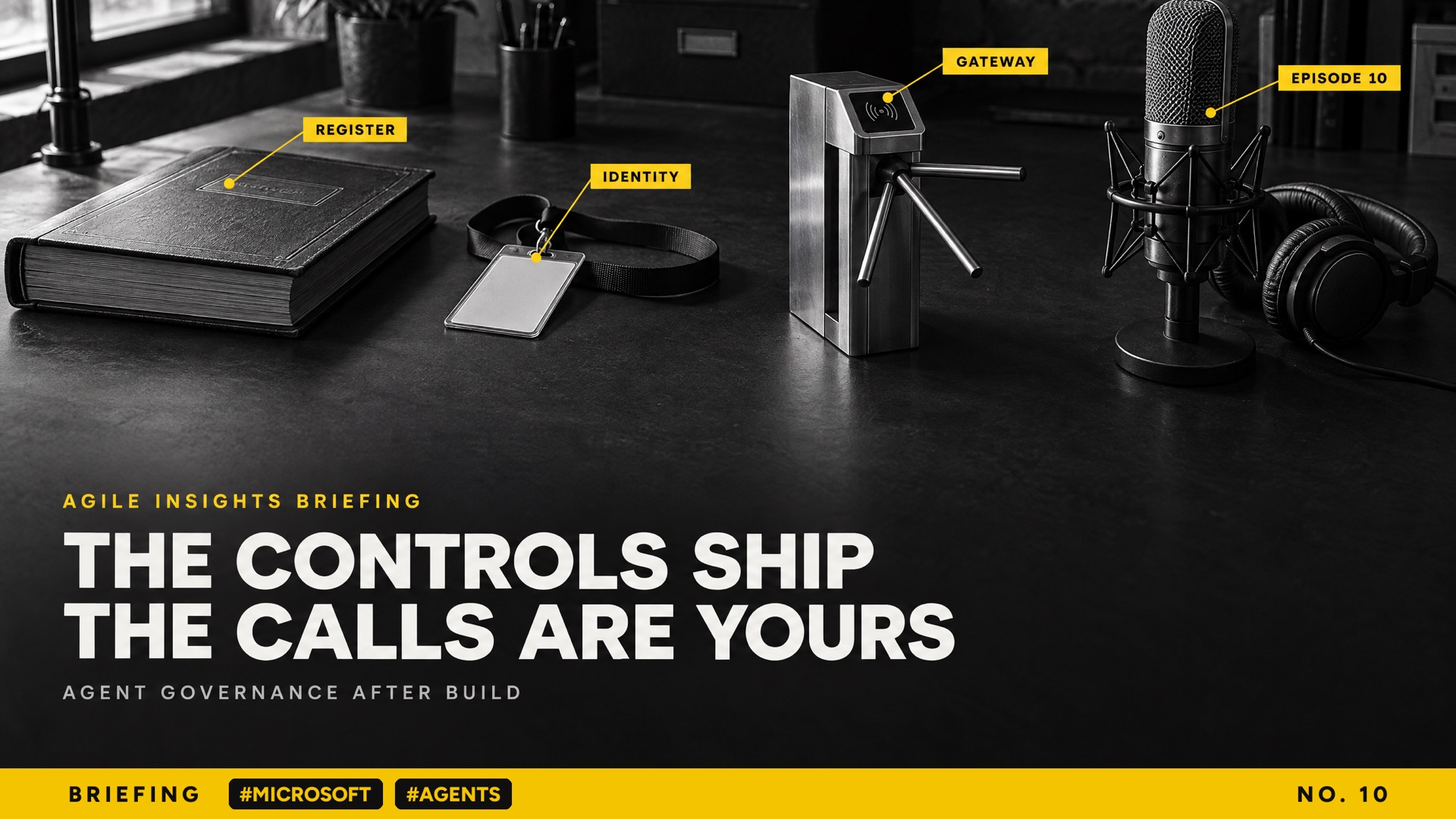
Microsoft now ships the controls for AI agents. The decisions are still yours.
Part 1: Primer · About 6 minutes
Download the MP3 · Linda and Leonard, AI voices, read a script written from the sources below.
Part 2: What each one fixes · About 9 minutes
Download the MP3 · Linda and Leonard, AI voices, read a script written from the sources below.
The agent governance brief. Our longer written version: the Microsoft stack layer by layer with release status as at October 2026, the ten decisions Microsoft leaves to you, the Australian layer, a first ninety days and a one page checklist (PDF, 10 pages). Read the agent governance brief.
In this episode
01Agent governance became productsAt Build in June 2026 Microsoft showed products for a register, agent identity, tool gateways, containment, runtime policy and testing. Agent 365 and Entra Agent ID are generally available; many other pieces were preview, and several still are.
02Every agent needs a sponsorEntra requires a business sponsor for every agent identity, and if nobody is named the person who created the agent becomes the sponsor. The platform makes sure there is a name. Choosing the right name is yours.
03Prompts do not hold, platforms doIn a Microsoft demo, rewording the prompt left multi turn policy violations at about 57 per cent, while deterministic checkpoints cut them to about 10. These are Microsoft's demo figures, so test them on your own agents.
04Proof is still your decisionYou set evaluation pass marks and how long agent interactions are kept. Purview data loss rules are enforced only when an agent works with a user's own sign in; otherwise activity is visible but not blocked.
05Three numbers, then ninety daysCount your agents, those with a named approver, and those under their own identity. Then build the register and risk tiers, name sponsors, put tools behind a gateway with change control, and set thresholds and retention.
Sources and links (8)
Microsoft Agent 365 · Read on Microsoft Learn
Microsoft Learn overview: observe, govern and secure agents; generally available since 1 May 2026.
Microsoft Learn overview: observe, govern and secure agents; generally available since 1 May 2026.
Owners, sponsors and managers in Entra Agent ID · Read on Microsoft Learn
Microsoft Learn on who is accountable for an agent identity, including the required sponsor.
Microsoft Learn on who is accountable for an agent identity, including the required sponsor.
Toolbox in Foundry · Read on Microsoft Learn
Microsoft Learn on one governed endpoint for agent tools, including versioning and the preview features.
Microsoft Learn on one governed endpoint for agent tools, including versioning and the preview features.
Govern tools with Agent 365 and API Management · Read on Microsoft Learn
Microsoft Learn on the preview integration where the registry decides and the gateway enforces.
Microsoft Learn on the preview integration where the registry decides and the gateway enforces.
The Agent Control Specification · Read on GitHub
Microsoft's Agent Governance Toolkit on GitHub (public preview, MIT licence), home of the deterministic policy engine.
Microsoft's Agent Governance Toolkit on GitHub (public preview, MIT licence), home of the deterministic policy engine.
Purview for Microsoft Foundry · Read on Microsoft Learn
Microsoft Learn on which interactions Purview policies enforce, and how retention is set.
Microsoft Learn on which interactions Purview policies enforce, and how retention is set.
APRA's letter to industry on AI · Read on APRA
APRA, 30 April 2026: its expectations of regulated entities on AI governance, including agentic workflows.
APRA, 30 April 2026: its expectations of regulated entities on AI governance, including agentic workflows.
Transparency for automated decisions · Read on the OAIC site
OAIC resources on the privacy policy duty for automated decision-making that starts on 10 December 2026.
OAIC resources on the privacy policy duty for automated decision-making that starts on 10 December 2026.
Written from public sources and checked on 16 October 2026. Release status is as at October 2026 and changes often; most of what Build showed was preview in June. The Microsoft Learn pages, the APRA letter and the OAIC guidance were read in full; the demo figures come from a Microsoft Build session and are Microsoft's own. Please check the originals before quoting. This is general information, not legal advice.
Our fact check · 16 claims: 15 confirmed, 1 reported
Before we record, every claim the hosts make is checked against the sources (this table was last updated 16 October 2026). Confirmed means a primary source or two independent reports; Reported means one party says so; Partly right, Disputed, Unverified and Not yet known mean what they say, and the hosts say so on air. This is the table as we left it.
- ConfirmedBuild 2026 ran 2 to 3 June 2026, San Francisco and onlineMicrosoft Build live blog
- ConfirmedAgent 365 GA 1 May 2026, Commercial, per userMicrosoft Learn; Microsoft Security blog 1 May 2026; "Works best" with E5
- ConfirmedEntra Agent ID generally availableMicrosoft Learn (what's new); Entra blog 2 Jun 2026; Month of GA not on the Learn page; KB note says April
- ConfirmedSponsor required; creator becomes sponsor if none namedMicrosoft Learn (owners, sponsors, managers); Delegated creation only; app-only creation must set one
- ConfirmedToolbox: guardrails at toolbox level; promotion updates agents without redeploy; tool search and skills previewMicrosoft Learn; Toolbox's own GA status not stated on the page; episode avoids claiming it
- ConfirmedAgent 365 with API Management: block MCP servers, tool-level control with a static allowed listMicrosoft Learn; Preview
- ConfirmedAI Gateway tier preview in East US 2 and Sweden Central only; residency depends on the full request pathMicrosoft Learn
- ConfirmedWindows 365 for Agents GA week of 1 June 2026Microsoft Learn; Microsoft's GA post said US only for some features at Agent 365 GA
- ConfirmedAgent Governance Toolkit public preview, MIT; ACS documented as deterministic fail-closed policy runtimeGitHub; Microsoft command line post 2 Jun 2026; Latest published Release v4.1.0 (9 Jun UTC, 10 Jun AEST); a v5.0.0 tag exists without a Release page
- ReportedDemo: multi-turn violations about 57% with prompt changes, about 10% with ACS; single-turn 28% to 15% by promptBuild session recording; Microsoft's demo; not independent
- ConfirmedFoundry evaluators many preview; you set acceptance thresholdsMicrosoft Learn
- ConfirmedPurview DLP enforced only for Entra user-context interactions; retention is a policy you setMicrosoft Learn
- ConfirmedAPRA letter to industry on AI, 30 Apr 2026APRA; Inventory, lifecycle ownership, human involvement in high-risk decisions, controls over agentic workflows, supply chain, continuous assurance
- ConfirmedCPS 230 in force 1 Jul 2025; contract transition ended 1 Jul 2026APRA; With update; Remade by determination of 23 Apr 2026, commenced 1 Jul 2026 (limited contract exemptions)
- ConfirmedCPS 234: 72-hour notification of material incidentsAPRA; 10 business days for unremediated control weaknesses
- ConfirmedADM transparency from 10 Dec 2026; APP 1.8 lists kinds of personal information, decisions made solely by the program, decisions it substantially and directly assistsAct (C2024A00128) s 2; OAIC 30 Sep 2026; Human review does not take a decision out of scope (OAIC)
Want to know more?
Sign up for our podcast at agile-insights.com.au.
Read the transcript · Part 1: Primer
Linda G'day, and welcome to the Agile Insights briefing. I'm Linda. Here is the main idea. Microsoft now sells the controls for governing AI agents, but deciding who approves what, and proving the controls work, is still your job. In this first part we will build up what Microsoft actually ships, one layer at a time. By the end you will know what each layer gives you, and the one thing each layer leaves for you to decide.
Leonard I'm Leonard. Let me start where a newcomer would. People keep saying agent governance became a product at Build this year. What does that actually mean?
Linda Build is Microsoft's developer conference, and the 2026 event ran in early June. For the last two years, governing agents was mostly an argument. Consultants and risk teams said you need a register, an identity for each agent, limits on what it can reach, and tests before release. At Build, Microsoft showed a product for nearly every one of those. Some are generally available now. Many were preview in June and several still are. So the change is real, and the dates matter. When we give a status today, it is as at October 2026.
Leonard Dates matter. Noted.
Linda Start with the register. Microsoft Agent three sixty five went generally available on the first of May. Microsoft describes it as the place to observe, govern and secure agents, with one registry for the organisation. It sits on top of tools you may already own: Entra for identity, Purview for data, Defender for threats. So the first thing you get is a list. The thing it leaves to you is what each agent on that list is allowed to be. Which agents count as high risk, and what extra checks they need, is not in the box.
Leonard And identity? I thought agents just used whoever's login set them up.
Linda That was the old habit, and it is the problem. Microsoft Entra Agent ID, now generally available, gives every agent its own identity, separate from any person. Here is the detail I like. Entra requires every agent identity to have a sponsor, a business person accountable for its purpose. If nobody names one, the person who created the agent becomes the sponsor automatically. So the platform makes sure there is a name in the box. It does not make sure it is the right name. Choosing who should be accountable is a decision only you can make.
Leonard Any name. Not the right name.
Linda Next come tools. An agent is only as risky as what it can touch. Microsoft now offers two places to control that. Foundry Toolbox gives agents one approved endpoint for their tools, with credentials held centrally and guardrails checking what goes in and out. Azure API Management has an AI gateway that sits in front of models, tools and other agents. Together they give you a door you can lock. What they leave to you is the list of what goes through the door, and who approves a change to it.
Leonard You mentioned containment earlier. Is that the sandbox idea?
Linda Yes. The line repeated through the conference was that a prompt cannot contain an agent; the platform has to. Windows 365 for Agents is the generally available piece. It gives an agent a managed cloud PC to work inside, with its own identity and device rules, and a person can take over. Lighter sandboxes for coding agents were shown too, but those were alpha or experimental in June. Then there is runtime policy. Microsoft showed the Agent Control Specification, part of its open source Agent Governance Toolkit, which is in public preview. It puts fixed checkpoints on what goes in, what the model says, which tool it calls, and what comes out.
Linda The last layer is testing. Foundry now has evaluators that score an agent on whether it finished the task. Others check whether it followed its instructions and used its tools properly. Many of them are still preview. You can run them before a release and on live traffic. Microsoft's own guidance says evaluation lets you set acceptance thresholds before a release. That word, you, is the theme of this whole episode.
Leonard So what is the common misunderstanding here?
Linda That buying the stack means you are governed. You have bought the switches. Somebody still decides which switch goes where, who signs off, what pass mark an agent needs, and how long the evidence is kept. Every layer we just walked through hands you a control and leaves you the decision. That is not a criticism of Microsoft. It is the right split, because only your organisation knows its risk appetite and its regulators.
Leonard Switches, not decisions.
Linda So here is what to do this month. Ask three questions. How many agents do we have? How many have a named person who approved them? And how many run under their own identity, not a borrowed login? If you cannot answer the first, start with the register. In part two, Leonard and I take each new capability and look at the problem it fixes. Then we look at what you still need to decide to make the fix stick.
Linda If you'd like to know more, sign up for our podcast at agile-insights.com.au.
Leonard Thanks for listening.
Read the transcript · Part 2: What each one fixes
Linda Welcome back to the Agile Insights briefing. I'm Linda. The main idea again. Microsoft now ships the controls for AI agents, and you still decide who approves what and how you prove it. In part one we walked through the layers: a register, an identity for each agent, a gateway for tools, containment, runtime policy and testing. In this part we take the problems organisations actually have with agents, one at a time. For each, we ask what the new capability fixes, and what you must decide for the fix to hold.
Leonard I'm Leonard. Let me take the first problem, because it is the one I hear most. Nobody knows how many agents they have. Some were built by developers, some came switched on inside products, some were made by a keen team in an afternoon. Agent three sixty five fixes the visibility part. It gives one registry, covering agents across Microsoft products and agents brought in through its toolkit. It also supports lifecycle rules, such as handing a leaver's agents to someone else. Agents built on other clouds can be synced in, though at Build that was shown as visibility, not control.
Linda The classic.
Linda And that is the right place to start, because you cannot govern a list you do not have. What the registry does not decide is what the entries mean. A register tells you an agent exists. It does not tell you whether it is a harmless summariser or something that can move money. So the decision that makes the fix hold is your risk tiering. Write down, in a page, what makes an agent low, medium or high risk in your organisation. What it can touch, what it can change, whether a person sees the result first. Then every agent in the register gets a tier, and the tier decides the checks.
Leonard Second problem. Agents acting as people. For a long time, an agent ran under the login of whoever built it. So in the logs, an agent sending an email looked exactly like the person sending it. Entra Agent ID fixes that by giving every agent its own identity. You can then apply the same identity controls you use for staff: conditional access, access reviews, blocking a risky sign in. Microsoft also says its telemetry is meant to tell a person acting directly from the same person acting through an agent. That is a claim worth testing in your own tenant.
Linda Always test the claim.
Linda And the sponsor rule from part one is the part that needs your decision. Entra will not create an agent identity without a sponsor, and it defaults to whoever created the agent. For a developer's test agent, fine. For an agent that touches customer records, the sponsor should be someone with business authority over that process, and they should know they are the sponsor. So decide who may sponsor which tier of agent. Then check the register against that rule, because the default will quietly fill the box with the builder's name.
Leonard Third problem. Agents reaching tools nobody approved. An agent connected straight to a dozen tools, each with its own credentials, is a nightmare to review. Foundry Toolbox and the API Management gateway fix this by giving you one place to put the tools, hold the credentials and check the traffic. There is also a preview link between Agent three sixty five and API Management, where the registry decides and the gateway enforces. It can block a tool server outright, and it can control individual tools if you give it a fixed list of allowed tools.
Linda Which brings us to change control, because the convenience has a catch. A toolbox can be versioned, and when you promote a new version, every agent using it picks up the change without being redeployed. That is efficient. It also means one change can alter what a fleet of agents can do, in one step. So decide what counts as a change that needs approval, and who gives it. Treat a toolbox promotion like a change to a production system, because it is one.
Leonard Because it is one. Fair.
Leonard Fourth problem. Instructions do not hold. Teams try to fix bad agent behaviour by writing better prompts. Microsoft showed why that runs out. In a demo at Build, rewording the prompt cut single turn policy violations from about twenty eight per cent to fifteen. On longer, multi turn conversations it did not move them at all, sitting at about fifty seven per cent. Adding deterministic checkpoints, through the Agent Control Specification, brought that down to about ten. Those are Microsoft's demo figures, so test them on your own agents.
Linda The lesson still holds, even with that caution. Limits that matter belong in the platform, not the prompt. The presenter even said you can push the number lower, to zero or to whatever threshold you care about. That phrase is the decision. Somebody has to set the threshold, and decide when a human must approve an action before it happens. Pick the triggers in plain terms: anything irreversible, anything over a set value, anything at unusual volume. Those thresholds are yours.
Leonard Fifth problem, and it is the auditor's question. Prove it. Evaluations help, because you can now score agents on task completion and tool use before release and on live traffic. Purview helps, because agents registered in Agent three sixty five are automatically audited. But two details matter. Purview's data loss prevention policies are only enforced when the agent works with a user's own sign in; otherwise the activity is visible but not blocked. And how long interactions are kept is a retention policy you create, with a period you choose.
Linda And in Australia that is where your obligations come in. Microsoft's sessions did not address them, which is fair, because they are yours. If you are regulated by APRA, the operational risk standard, C P S two thirty, expects you to manage the risks in critical operations and service providers. Its companion, C P S two thirty four, covers information security. Agents now sit inside both. APRA also wrote to every regulated entity about AI on the thirtieth of April 2026. It asked for an inventory of AI use, clear ownership across each system's life, and people involved in high risk decisions. It also asked for controls over agentic workflows.
Leonard Outside banking and insurance, the Privacy Act changes give one concrete example. From the tenth of December 2026, privacy policies must explain when computer programs make, or substantially and directly help make, decisions that significantly affect people. The regulator reads computer program broadly, and a human check does not take a decision out of scope. Residency is another. The new AI Gateway tier is in preview in only two regions, in the United States and Sweden. Microsoft itself says residency depends on the whole request path.
Linda So what should someone do on Monday? Get three numbers. How many agents you have. How many have a named person who approved them. And how many run under their own identity rather than a borrowed login. Then spend ninety days on it. First, the register and a one page risk tiering. Next, sponsors named by tier, and every agent moved to its own identity. Then, tools behind a gateway, with toolbox changes under change approval, and human approval thresholds written down. Last, decide your evaluation pass marks and your retention periods, and check them against your regulators. If you want the longer version, our agent governance brief on this page covers all of it, including a one page checklist.
Linda If you'd like to know more, sign up for our podcast at agile-insights.com.au.
Leonard Thanks for listening.
More on #microsoft
Episode 25 · Primer and discussionThe managed loop: what you still own when the vendor runs your agent.Episode 22 · Primer and discussionFrom Pilots to Programs: govern an agent by what it does.Episode 17 · Primer and discussionSwitching on a role pack is a process decision, not an I T toggle.Reference 6 · PrimerMicrosoft Agent Governance Toolkit: runtime control for AI agentsEpisode 20 · Primer and discussionUsage is not quality: who reads the feedback?Episode 15 · Primer and discussionMicrosoft governs the access. You still have to govern the answer.
Every episode tagged #microsoft
All of the briefings (38) · Follow Briefing in Apple Podcasts or any podcast app
Everything from Agile Insights: briefings, Making You Think and the reference series