 Briefing
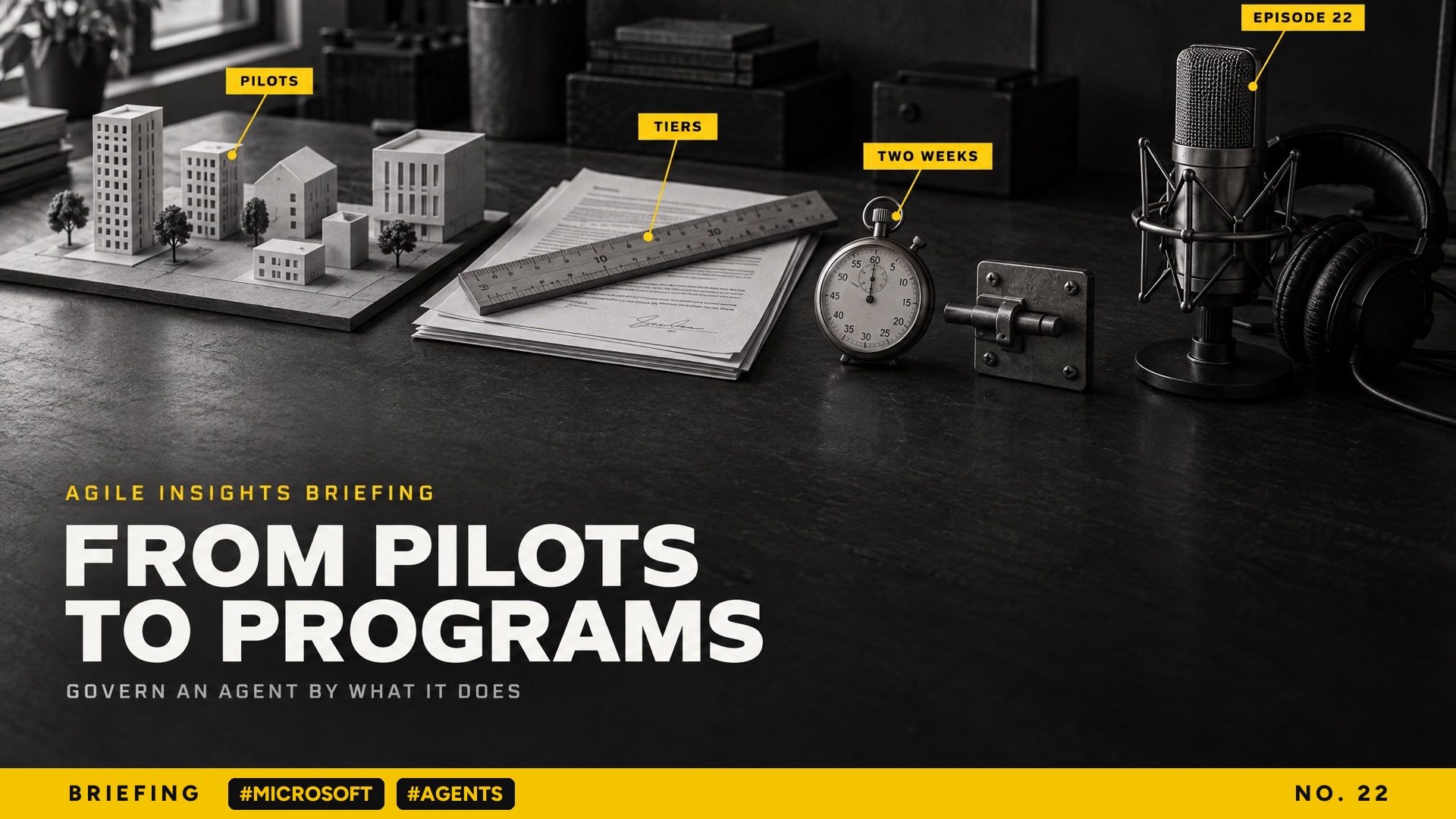
Episode 22 · Primer and discussion · About 14 minutes in two parts
From Pilots to Programs: govern an agent by what it does.
Part 1: Primer · About 7 minutes
Download the MP3 · Linda and Leonard, AI voices, read a script written from the sources below.
Part 2: Discussion · About 8 minutes
Download the MP3 · Linda and Leonard, AI voices, read a script written from the sources below.
In this episode
01The bottleneck is ownershipMicrosoft’s survey finds organisational factors carry about twice the reported AI impact of individual ones, and only 32% strongly agree they have accountable executive sponsors. It is an association, not proof.
02Assist versus executeOnce an agent acts rather than assists, Microsoft’s guidance says four demands appear: a named owner, a risk response, lifecycle care and explicit limits on what it may decide.
03Match oversight to riskLight self-service for agents that assist, expert validation and monitoring for agents that act, and a process owner with an incident plan for the highest risk.
04Guardrail or gate?Microsoft’s test: if a team cannot launch a low-risk use case in under two weeks, you have a gate. Two weeks is its proposal, not a benchmark, and no outcome data is published.
05Take the structure, keep your evidenceRun a small central team on top of existing governance, keep your register and evidence independent of the vendor, and count soft savings as capacity, not cash.
Sources and links (7)
From Pilots to Programs: A Structured Approach to Scaling AI and Agents for Real Business Value · techcommunity.microsoft.com
Microsoft Copilot Blog post by Aamer Kaleem, 23 October 2026. The argument this episode is about.
Microsoft Copilot Blog post by Aamer Kaleem, 23 October 2026. The argument this episode is about.
Adopt agentic AI at scale · learn.microsoft.com
Microsoft Learn overview of the three frameworks and five pillars.
Microsoft Learn overview of the three frameworks and five pillars.
Agentic transformation patterns · learn.microsoft.com
Microsoft Learn on the assist-to-execute line and the four demands once an agent acts.
Microsoft Learn on the assist-to-execute line and the four demands once an agent acts.
Build an agentic Center of Excellence · learn.microsoft.com
Microsoft Learn on the four functions and the failure modes of a central team.
Microsoft Learn on the four functions and the failure modes of a central team.
Govern agents by risk · learn.microsoft.com
Microsoft Learn on the three tiers and the controls each requires.
Microsoft Learn on the three tiers and the controls each requires.
2026 Work Trend Index report · microsoft.com
Microsoft WorkLab survey behind the 67% to 32% organisational versus individual finding.
Microsoft WorkLab survey behind the 67% to 32% organisational versus individual finding.
Agentic Readiness Framework overview (PDF) · adoption.microsoft.com
Microsoft’s Agent Readiness Survey deck: 500 organisations, 31% and 32% strongly agree.
Microsoft’s Agent Readiness Survey deck: 500 organisations, 31% and 32% strongly agree.
Written from Microsoft’s own post, Learn guidance and surveys, checked on 26 October 2026. Every source is Microsoft’s, so the figures are its self-reported findings, not independent evidence that the framework works. Check the originals before quoting.
Our fact check · 9 claims: 4 confirmed, 1 reported, 2 partly right, 2 unverified
Before we record, every claim the hosts make is checked against the sources (this table was last updated 25 October 2026). Confirmed means a primary source or two independent reports; Reported means one party says so; Partly right, Disputed, Unverified and Not yet known mean what they say, and the hosts say so on air. This is the table as we left it.
- ConfirmedWork Trend Index 2026: organisational factors 67% vs individual 32% of reported AI impactMicrosoft survey; ~20,000 AI-using knowledge workers, 10 markets incl. Australia, Feb–Apr 2026, Edelman DXI; correlational and self-reported. Published 5 May 2026.
- ConfirmedAgent Readiness Survey: 31% unified approach, 32% accountable sponsorsMicrosoft survey; Both “strongly agree” averages in the published deck (Agentic Readiness Framework overview, Dec 2025): 500 organisations, 13 countries, 16 industries, self-reported.
- Unverified“Security and governance maturity … generally higher than the other readiness pillars”Not shown in the published deck: its safeguards item averages 29% and compliance 26% “strongly agree”, below the two strategy items.
- ConfirmedOnce an agent executes, four demands: owner, risk response, lifecycle, explicit authorityMicrosoft Learn, Agentic transformation patterns (14 Jul 2026); the post names three.
- Partly rightThree risk tiersThe post and Learn’s Govern agents by risk (22 Oct 2026) cut the tiers differently (post: informational / acting / regulated; Learn: individual productivity / expert-knowledge and internal service / business-critical and external). Same principle.
- ReportedThe two-week “gate, not guardrail” testThe post’s own test; not in the Learn guidance; no evidence for the number.
- ConfirmedLearn’s CoE failure modes: gatekeeper, ghost, perfectionistBuild an agentic Center of Excellence (22 Oct 2026).
- Partly rightPwC $150m time savingsMatches Microsoft’s case study (Feb 2026), no method; time valued, so a soft saving on the post’s own definition.
- UnverifiedAndreou “The new bottleneck is diffusion”; mobilezone, Virgin Money, Quantum, Kantar figuresNot found or not checked.
Want to know more?
Sign up for our podcast at agile-insights.com.au.
Read the transcript · Part 1: Primer
Linda Here is the idea for today. Most organisations do not have an A I problem. They have a pilot problem: plenty of trials, and very few agents in production. Microsoft argues that the cause is how the organisation runs agents, not the technology. The fix is to govern each agent by what it actually does. By the end, you will know the one line that changes the rules, and the three tiers of oversight. You will also have a simple test: is your governance a guardrail, or a gate?
Leonard Some context first. On the twenty third of October, Microsoft published a post on its Copilot blog called From Pilots to Programs. It was written by Aamer Kaleem, whose product engineering team works with customers moving agents into production. Microsoft says the post draws on more than a thousand customer engagements. It sets out three frameworks that Microsoft also publishes on its Learn site. Transformation patterns name what you are building. A maturity model shows how ready you are. And an agentic centre of excellence answers who runs it. Keep in mind that this is a vendor's framework, and its survey figures are Microsoft's own.
Linda Let me build it up in four steps. Step one is the claim that the bottleneck is the operating model. Microsoft's Work Trend Index for 2026 surveyed about twenty thousand knowledge workers in ten countries, including Australia. Organisational factors, such as culture, manager support and talent practices, accounted for about two thirds of the reported A I impact. Individual mindset accounted for about a third. That is an association in a survey, not proof of cause.
Leonard Fair warning, noted.
Linda But Microsoft's readiness survey points the same way. Only thirty one percent of organisations strongly agreed they take a unified approach to A I. Only thirty two percent strongly agreed they have accountable executive sponsors.
Leonard So the gap is ownership more than tooling. That matches what a lot of us have seen. But what does it have to do with how you govern one particular agent?
Linda Step two is the line that changes the rules. It is the line between an agent that assists and an agent that executes. An agent that assists drafts a paragraph, suggests an answer or summarises a document. A person stays in the loop and owns the result. An agent that executes updates a customer record, submits a ticket or moves money...
Leonard Moves money. Right.
Linda Microsoft's guidance says that the moment an agent executes, four new demands appear. Someone must be named as its owner. There must be a plan for when it goes wrong. Someone must improve it over time. And its authority must be explicit: what it may decide alone, and what it may not.
Leonard And the trap runs both ways, as Microsoft puts it. Put assistant level controls on an agent that acts, and you build up hidden risk. Put heavy controls on a simple assistant, and you smother adoption. A lot of review boards fall into the second trap, because one checklist feels fair. A meeting notes summariser and a system that pays invoices go through the same queue...
Linda Same form, same wait.
Leonard Exactly. So people stop asking, and they build around the board instead.
Linda Step three is matching oversight to risk, in three tiers. Tier one covers personal productivity agents that summarise, draft and search. They need a named owner, basic monitoring, a standard release checklist, and self service within published guardrails. Tier two covers agents that answer expert questions or run internal services, where a wrong answer misleads people. They add a domain expert who checks the answers, monitoring for stale content, and a formal release gate. Tier three covers agents in core processes, or agents facing customers. They add a process owner, a security and responsible A I review, decision rights, an incident plan and a quarterly review.
Leonard Microsoft's post has a good example of why tier two matters. Picture thirty agents in production. One tells an employee the wrong parental leave entitlement, because H R changed the policy last week. The agent still has the old version.
Linda We have all read that intranet page.
Leonard Nothing broke in the technology. The content went stale, and nobody owned noticing it. So the post asks three questions. Who notices? Who do they call? And what happens in the first fifteen minutes?
Linda That is step four: someone has to run it. Microsoft calls it an agentic centre of excellence, and says it often starts as two or three people. They govern, with release gates and audit trails. They enable builders, with templates and training, so the easy way to build is also the compliant way. They watch quality, cost and value. And they scale what works. The team sits on top of the governance bodies you already have, rather than beside them. It also comes with a test worth writing down. Can a team launch a low risk use case in under two weeks? If not, Microsoft says, you don't have a guardrail. You have a gate.
Leonard That one will sting a few boards.
Leonard So is the lesson simply that we need less governance, and should get out of the way?
Linda No, and that is the common misunderstanding. The lesson is governance sorted by risk, so a team is judged on two things. What did it stop, and how fast did the safe work ship? That is what this means for A I governance. The question used to be whether a model is safe. Now it is who owns this agent, what it may do alone, and how fast a low risk one can ship. So here is what to do. First, sort every agent you run into assist or execute, and give each one a named person as owner. Second, write down three tiers with their controls, and publish the tier one path. Third, time that path. If it takes longer than two weeks, fix the path before you add a control.
Leonard That's Part 1. In Part 2, we ask whether governance really is the brake on A I, and how much of a vendor's framework you should take. Stay with us.
Read the transcript · Part 2: Discussion
Linda Here is the idea for this part. A I pilots stall because nobody owns the result, and governance becomes the brake only when it treats every agent the same. Govern each agent by what it does, and make the low risk path fast. By the end, you will have three views of where the brake really is. You will know what the evidence shows, and five things to do this quarter.
Leonard A quick recap for anyone joining here. On the twenty third of October, Microsoft published a post called From Pilots to Programs. It sets out three frameworks for scaling agents. Transformation patterns name what an agent is for. A maturity model scores how ready you are. And a small central team, which Microsoft calls an agentic centre of excellence, runs it. The key term is the line between assist and execute. An agent that assists leaves a person in charge of the result. An agent that executes acts in a system on its own, so it needs an owner, limits, and a plan for failure.
Linda So here is the question for this part. Your organisation has a dozen pilots, a review board, and almost nothing in production. Is governance the brake? I want to take three views. The first is that it is, and Leonard is going to make that case. The second is that the real brake is missing ownership. The third is about how much of a vendor's framework you should take, because every step in this one leads to Microsoft's own tools.
Leonard Let me make the case that governance is the brake. Microsoft lists four ways A I programs stall, and one of them is governance as a gatekeeper, where every request queues behind a review board. Its Learn guidance names the same failure, and says teams route around the gatekeeper and build shadow agents. The post puts it neatly. A model run by the security chief can produce zero agents, safely.
Linda Very safe indeed.
Leonard And then there is the two week test. If a team cannot launch a low risk use case in under two weeks, you don't have a guardrail. You have a gate. Plenty of organisations would fail that test today...
Linda I'd push back on where you put the cause, though. A board reviews everything when nobody else owns the risk of each agent. Microsoft's own readiness survey of five hundred organisations is telling here. Only thirty two percent strongly agreed they have accountable executive sponsors. Only thirty one percent strongly agreed they take a unified approach to A I. Two of its other failure modes are about ownership too. A I is run as an I T project with no business owner, and nobody can say what the agent was meant to change. The post's own line is that the fix isn't weaker governance, it's stronger strategy.
Leonard That's fair, and I think the two views meet. The queue is the symptom. If every agent has a named owner and a tier, the board stops being the only place risk gets judged. The tier one path can be self service, because someone is accountable for each agent on it. So the board only sees the agents that act. I'd put it this way. Governance becomes a brake when it is the only owner in the room. Give the agents owners, and governance can afford to be quick.
Linda Agreed. Now the third view, which is how much of this framework to take. A lot of it is sound, and it matches what good governance teams already do. The three tiers come from Microsoft's Learn guidance. Tier one is a named owner, basic monitoring and a release checklist. Tier two adds a domain expert who checks answers, and monitoring for stale content. Tier three adds a process owner, decision rights, an incident plan and a quarterly review. The post itself draws the tiers a little differently, but the principle is the same. Oversight follows what the agent can do, not how impressive it looks.
Leonard Where I'd be careful is the stack. Every phase of the post points to a Microsoft product, for monitoring, for the registry, for publishing skills. That is natural in a vendor's post, and the tools may be good.
Linda They would say so.
Leonard But the structure and the tooling are separate decisions. Your agent register, your tiers and your evidence should outlive any one platform. Microsoft's own registry can already import agents built on Amazon and Google platforms, which tells you organisations run more than one. If your record of who owns what lives only inside one vendor's console, you've handed that vendor your audit trail. Take the structure. Choose the tools on their merits.
Linda And there's one thing the post leaves out. Its controls are design statements: an owner, a plan for failure, limits. It doesn't ask whether a control is actually working. Is the owner real, with time and authority? Has anyone rehearsed the incident plan? Is anyone watching for stale content? Take the parental leave example from the post. An agent gave an employee the wrong entitlement because H R changed the policy last week. A tier two control would have caught that, but only if someone was doing the monitoring. A control on paper is a hope...
Leonard A hope with a signature.
Linda Exactly. What you want is evidence it ran.
Leonard So where does the evidence settle? It is solid on what Microsoft says and recommends. The frameworks are consistent between the post and the Learn guidance, and the survey numbers we quoted are in Microsoft's published results. Its Work Trend Index found organisational factors carried about twice the reported A I impact of individual ones. But all of this is Microsoft's, and the surveys are self reported. One line in the post says security and governance scored higher than the other areas. We could not find that in the survey results Microsoft published, so we've left it aside.
Linda And what it doesn't settle is whether the framework works. There is no published data on organisations that adopted it and did better. The two week threshold is Microsoft's proposed number, not a benchmark. So the fair reading is this. It's a sensible structure from a vendor with a stake in your adoption. It's worth using as a checklist. It's not proof. The value is in the questions it makes you answer. Who owns each agent? What may it do alone? And how fast can the low risk work ship?
Leonard So here is what to do this quarter. First, name a senior business sponsor for the program, and a person, not a team, as owner of each agent. Second, sort every agent into assist or execute, and write three tiers with the controls for each. Third, time your low risk path. If it takes more than two weeks, fix the path before adding controls. Fourth, for every agent that acts, write its decision rights and incident plan before it goes live. Fifth, report value honestly. Hours saved are capacity released, not cash, so lead with savings that reach the budget.
Linda If you'd like to know more, sign up for our podcast at agile-insights.com.au.
Leonard Thanks for listening.
More on #microsoft
Episode 25 · Primer and discussionThe managed loop: what you still own when the vendor runs your agent.Episode 17 · Primer and discussionSwitching on a role pack is a process decision, not an I T toggle.Episode 10 · Primer and discussionMicrosoft now ships the controls for AI agents. The decisions are still yours.Reference 6 · PrimerMicrosoft Agent Governance Toolkit: runtime control for AI agentsEpisode 20 · Primer and discussionUsage is not quality: who reads the feedback?Episode 15 · Primer and discussionMicrosoft governs the access. You still have to govern the answer.
Every episode tagged #microsoft
All of the briefings (38) · Follow Briefing in Apple Podcasts or any podcast app
Everything from Agile Insights: briefings, Making You Think and the reference series