 Briefing
Episode 1 · Discussion · About 9 minutes
Staying in charge of decisions in the age of AI
Download the MP3 · Linda and Leonard, AI voices, read a script written from the sources below.
In this episode
01Why well informed teams still decide badlyDr Chris Stephenson spent three decades as a chief executive across twelve countries. His research suggests poor strategic decisions rarely come from a lack of information. They come from politics: self interest, protecting your patch and avoiding blame.
02Three conditions that keep politics in checkDecision equilibrium means three things in balance: a decision ecosystem where bad news travels as fast as good, governance with one named person accountable, and leadership that asks "tell me why" when challenged.
03AI runs old governance problems fasterThe book argues AI does not create new governance problems. It runs the old ones faster, at a scale nobody can see. Its questions for boards are about accountability, transparency and control, with a ninety day roadmap.
04An off button and enforced limitsFor agents, Stephenson says you need an off button, a named person who can use it and a fast escalation route. Limits must be enforced around the agent, because an instruction in a prompt is a request, not a control.
05What to put in place nowKeep a register of every AI system with one named owner, set clear decision rights, test the stop mechanism and give bad news a route. List automated decisions about people before the Privacy Act change on 10 December 2026.
Sources and links (4)
The original podcast · Listen on Apple Podcasts
Slicing Through The Noise, Ep. 34: Chris Stephenson, 28 September 2026.
Slicing Through The Noise, Ep. 34: Chris Stephenson, 28 September 2026.
The thesis · Read it at the Southern Cross University research portal
Stephenson, C. B. What causes top management teams to make poor strategic decisions? DBA thesis, Southern Cross University, 2012. Open access.
Stephenson, C. B. What causes top management teams to make poor strategic decisions? DBA thesis, Southern Cross University, 2012. Open access.
The book · View on Amazon Australia
Stephenson, C. B. Decision Equilibrium: Staying in Charge in the Age of AI. Boardroom Edge, 2026.
Stephenson, C. B. Decision Equilibrium: Staying in Charge in the Age of AI. Boardroom Edge, 2026.
The December date · Office of the Australian Information Commissioner
Privacy Act transparency for automated decision-making, from 10 December 2026.
Privacy Act transparency for automated decision-making, from 10 December 2026.
Figures and dates were checked against public sources on 10 October 2026. As with any briefing, check the original source before quoting a number in a board paper.
Want to know more?
Sign up for our podcast at agile-insights.com.au.
Read the transcript
Linda G'day, and welcome to the Agile Insights briefing. I'm Linda.
Leonard And I'm Leonard. Today we're looking at the work of Dr Chris Stephenson, whose book Decision Equilibrium asks a question every board now faces. As AI starts making decisions inside an organisation, who is still in charge?
Linda Let's start with who he is. He spent three decades as a chief executive across twelve countries, mostly in technology. Then he went back to study, and finished a doctorate at Southern Cross University in 2012 on a single question. Why do top management teams make poor strategic decisions when they have all the data they need?
Leonard And he's now advising Australian boards on AI. He talked it through on the podcast Slicing Through The Noise, which is where much of today's material comes from, along with the thesis and the book.
Linda His starting point was a frustration. He'd sit in board meetings in Paris or London or Hong Kong, see three options, and be fairly sure option C was right. Then a side group would argue hard for option A, and option A won.
Leonard So he asked whether it was just his meetings, or whether it happens everywhere. His research suggests it happens everywhere, and the cause is rarely a lack of information. It's politics. Self-interest, protecting your patch, avoiding blame.
Linda He's careful to say that isn't villainy. These are smart people reacting to uncertainty. Humans don't like ambiguity, so we pull back to what we can control.
Leonard His research found that executives tend to protect against loss more than they chase gain. Many expect to be in a role for three or four years, and they're paid on short-term results. So a long-term strategy becomes somebody else's problem.
Linda And the behaviour is quite ordinary. Corridor conversations before the meeting that's meant to decide. Or backing both sides, telling you your plan is fabulous but raising concerns about margin, so they can say "I warned you" if it fails.
Leonard He calls that decision politics. And he's clear that politics isn't all bad. A contest of ideas builds a business quickly. What has to go is the undermining and the throwing of shade.
Linda So what holds it in check?
Leonard Three conditions that need to be in balance, which is where the name decision equilibrium comes from. The first is a decision ecosystem. How decisions get made, and how information flows, including bad news. He says in too many organisations the good news reaches the boardroom fast, and the bad news takes its time.
Linda The second is governance. Who is responsible, who is accountable, and is what we're doing legal, proper and ethical? His rule is that accountability belongs to a person. A committee can advise, but one named human has to answer for the decision.
Leonard The third is leadership, and he says it holds the other two together under pressure. His test is simple. What does the chief executive do when someone says, "I think that's a bad idea"? If they shut it down, everyone learns to stay quiet. If they say, "tell me why", the bad news arrives early.
Linda He talks about two failure types in a CEO. The dominant one, who doesn't care what you think, and the reluctant one, who never decides. His advice is to decide, explain the reasoning to the people whose idea lost, and change course if you're wrong. You can always make another decision.
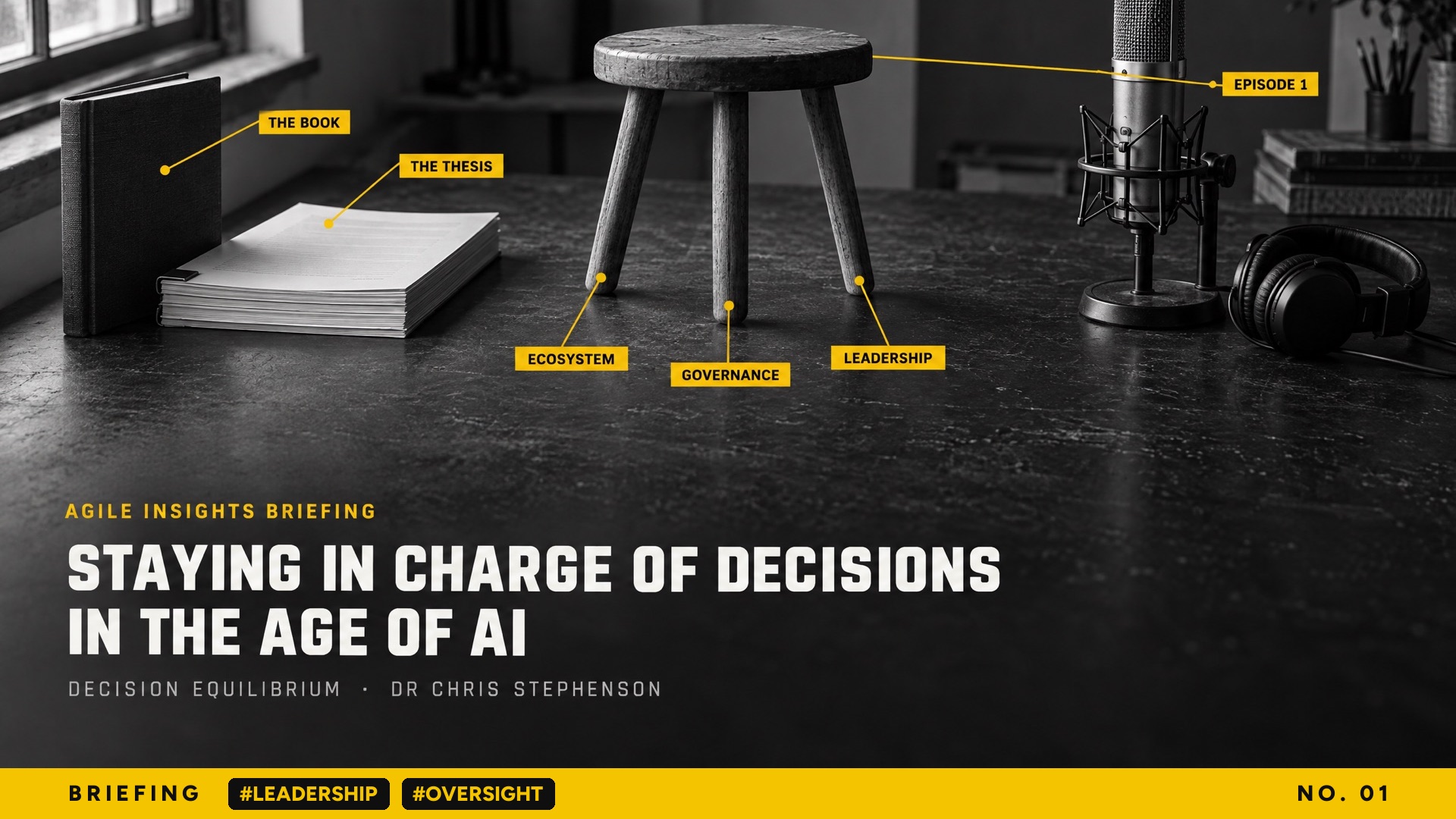
Leonard He also notes that small lapses by the chief executive get copied by the whole team. And he uses an image for all of it: a three-legged stool. If one leg is short, it wobbles. And politics works on each leg in turn. Weaken governance, and the ecosystem weakens, which leaves more room for politics. It compounds.
Linda What about the board's role?
Leonard In his research, boards set the incentives that drive the executive team, so the board shapes the behaviour. Participants thought boards were too sensitive to market expectations, and that incentives rewarded the short term. He also argues for independent validation of big decisions, by people with no stake in the outcome.
Linda And he points out that a company can drift in and out of good decision making. If a founder who held the governance together leaves, you can end up with a vacuum, and politics moves in.
Leonard Which brings us to AI. The book says it draws on more than a thousand hours of interviews with directors and senior executives, and it looks at cases including Robodebt, and failures at Qantas, the Commonwealth Bank and the ASX. His argument is that AI doesn't create new governance problems. It takes the old ones and runs them faster, at a scale where nobody can see what's going on.
Linda And the questions he asks boards are about accountability, transparency and control. Who is responsible when an automated system causes harm? How do you govern a process you can't fully see? How do you keep human oversight when machine decisions outpace your meetings?
Leonard The book finishes with a ninety-day roadmap. Audit your AI maturity, redefine decision rights, and put guardrails in place. On the podcast he got practical about agents. You need an off button, a named person who can use it, and a fast route for escalation.
Linda And he questions the idea that you can simply tell an agent what it may not do. The limits need to be enforced by something around the agent, because instructions written in a prompt are a request, not a control.
Leonard A quick word on the numbers, since some listeners will want to quote them. The eighty-five percent figure for poor decisions traces to a 2006 Bain study of three hundred and sixty-five companies. And his figures on how few firms are ready to govern AI sit close to published McKinsey survey results, though the exact numbers differ. As always, check the original source before using any of them in a board paper.
Linda And one date to know. The tenth of December 2026, when a Privacy Act change starts. Organisations will need to describe, in their privacy policy, the automated decisions that significantly affect people. Chatbots and generative AI are in scope. It's a disclosure duty, and the wider rules for AI still rest on existing law and voluntary standards.
Leonard So what does a company actually need in order to solve all this? Start with visibility. A register of every AI system, agent and vendor feature in use, including ones nobody formally approved, each with one named owner. If nobody claims it, it gets switched off.
Linda Then decision rights. A clear operating model that says who approves what, which risks go to a steering group and which go to the board, and how that changes as an agent is given more freedom to act.
Leonard Then controls that actually run. That's Stephenson's off button made real. A stop mechanism that someone can use without calling a meeting, tested on a schedule. Limits enforced by the platform, not the prompt. And evidence that each control is working, not just written down.
Linda And a route for bad news. A defined path for incidents, and board reporting built on leading indicators instead of a yearly summary. That's his decision ecosystem, in practice.
Leonard For the December deadline, an inventory of the automated decisions you make about people, including those buried in vendor software, and the policy wording to match.
Linda Most organisations start with a short readiness check against the Australian voluntary standard, the NIST framework or ISO 42001, to see where they really are. Then they build in order, with training and support so people use it well. Stephenson's own view is that outside help should coach, not take over, because the organisation has to own the thinking.
Leonard That's the stool. Information, accountability and leadership, with evidence that it all holds. If you'd like to read more, the book is Decision Equilibrium: Staying in Charge in the Age of AI, by Chris Stephenson.
Linda And if you'd like to know more, sign up for our podcast at agile-insights.com.au.
Leonard Thanks for listening.
More on #leadership
Episode 16 · Primer and discussionWhen making something gets cheap, checking it becomes the real work.Making You Think 6 · Primer and discussionThe Unaccountability Machine, by Dan DaviesEpisode 38 · Primer and discussionBudgeted for seats, billed for workEpisode 34 · Primer and discussionWhen the test stops telling you anything: hunger beats tenureEpisode 23 · Primer and discussionWhat FDE means at OpenAI: skills, not custom code.Episode 21 · DiscussionTrust cannot be rushed: how much authority will you give AI?
Every episode tagged #leadership
All of the briefings (38) · Follow Briefing in Apple Podcasts or any podcast app
Everything from Agile Insights: briefings, Making You Think and the reference series