 Briefing
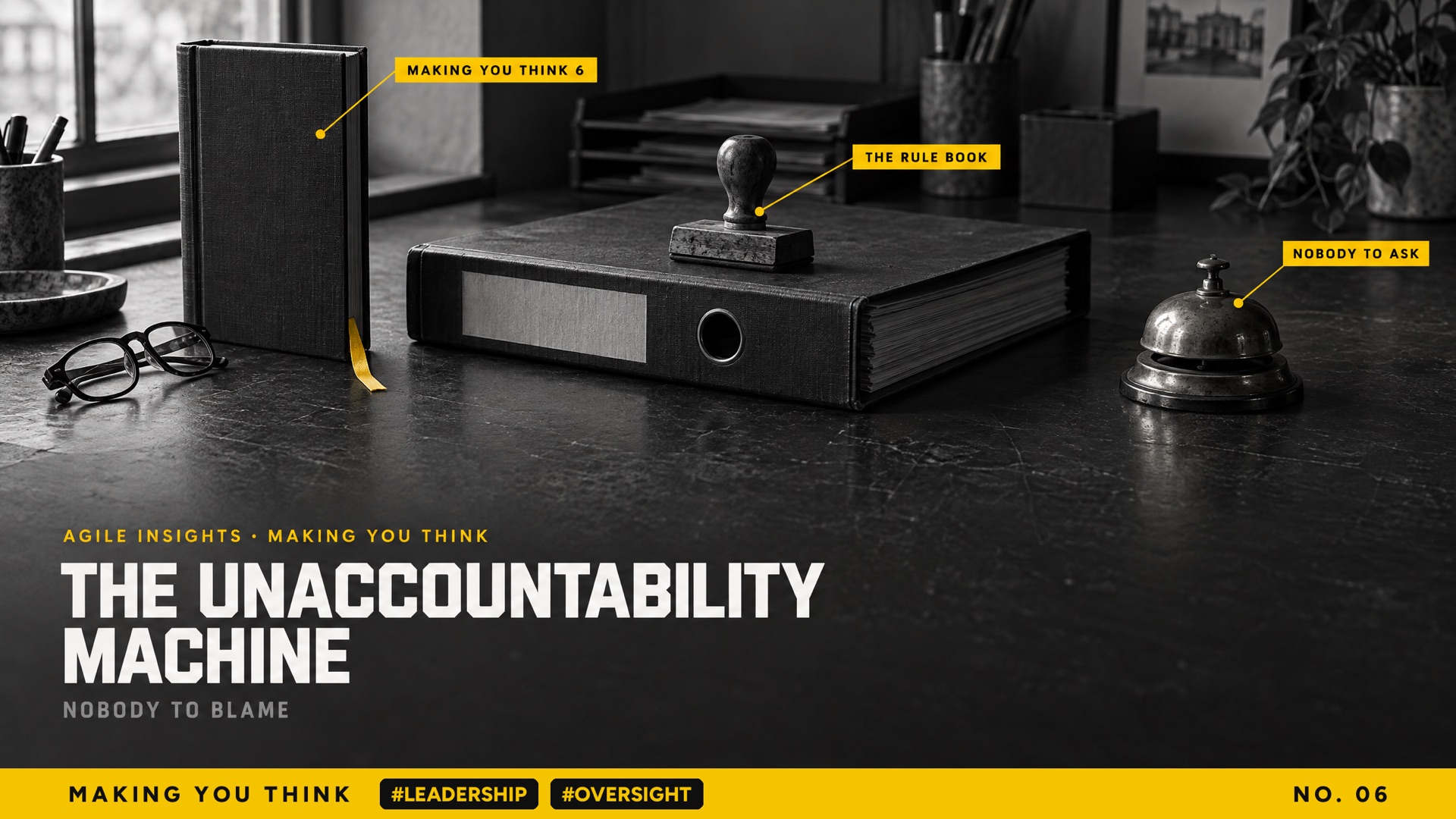
Making You Think 6 · Primer and discussion · About 15 minutes
The Unaccountability Machine, by Dan Davies
Part 1: Primer · About 7 minutes
Download the MP3 · Linda and Leonard, AI voices, read a script written from the sources below.
Part 2: Discussion · About 8 minutes
Download the MP3 · Linda and Leonard, AI voices, read a script written from the sources below.

This episode is about The Unaccountability Machine, by Dan Davies. Find a copy on Amazon Australia, or ask your local bookshop or library.
Based on essays and our own research.
In this episode
01Accountability sinksWhen a decision is handed to a rule book or a system, the link to anyone who could change it breaks. Davies defines a sink as having nobody to blame.
02The fundamental law of accountabilityYou can only be held accountable for a decision as far as you can change it, which is why the gate agent who bumps you cannot really be blamed.
03Organisations as decision makersFollowing Stafford Beer, an organisation is a non-human intelligence. The purpose of a system is what it does, and it needs enough variety to match its world.
04Where the critics push backThe cure is thinner than the diagnosis, Beer may not deserve hero status, power is left out, and, as Tim Harford notes, some sinks are deliberate and legitimate.
05Test every human in the loopCan that person overturn the output, on whose authority, how quickly, and does anyone check that they do? If not, the human is a sink with a name badge.
Your turn
Three questions to ask yourself
Think of the last decision that landed on you and felt wrong. Where, exactly, did the link break?
In your own work, where are you the gate agent, enforcing a rule you cannot change?
Which accountability sinks in your organisation were chosen on purpose, and which just happened?
Two things to try, alone, with a pen
10 minutesFind the sinkTrace one frustrating decision back until the link breaks.
5 minutesThe law testCheck whether anyone can actually change one decision your team now leaves to a system.
About Dan Davies
British economist. A former regulatory economist at the Bank of England, he spent around fifteen years as an analyst covering banks for investment firms, and writes the newsletter Back of Mind.
Other writing (3)
The Unaccountability Machine (2024) · Profile Books
Why big systems make terrible decisions, and how the world lost its mind.
Why big systems make terrible decisions, and how the world lost its mind.
Back of Mind (newsletter) (2026) · Substack
His regular writing on economics, systems and accountability.
His regular writing on economics, systems and accountability.
Sources and links (8)
The publisher's page · Profile Books
Profile Books on the book, with a preview of the opening chapters.
Profile Books on the book, with a preview of the opening chapters.
Taming the unaccountability machine · Back of Mind
Davies, January 2025, on what to do, and on the critique about power.
Davies, January 2025, on what to do, and on the critique about power.
A bad tool always blames the workman · Back of Mind
Davies, September 2026, on agentic AI and keeping a person in the loop.
Davies, September 2026, on agentic AI and keeping a person in the loop.
Who's responsible for our accountability problem? · Tim Harford
Tim Harford's column applying the idea to British public scandals.
Tim Harford's column applying the idea to British public scandals.
The Schiphol squirrels · Animal People
Contemporary 1999 report of the K L M incident the book opens with.
Contemporary 1999 report of the K L M incident the book opens with.
Based on essays and our own research, checked on 21 October 2026. The author's argument is paraphrased, not reproduced. Check the original before quoting.
Our fact check · 21 claims: 13 confirmed, 3 reported, 2 unverified
Before we record, every claim the hosts make is checked against the sources (this table was last updated 21 October 2026). Confirmed means a primary source or two independent reports; Reported means one party says so; Partly right, Disputed, Unverified and Not yet known mean what they say, and the hosts say so on air. This is the table as we left it.
- ConfirmedUK hardback 18 Apr 2024; paperback 13 Mar 2025; US Chicago 2025, 304 ppProfile; preview copyright page; Chicago
- ConfirmedLonglisted, FT/Schroders Business Book of the Year 2024Profile; Talking Biz News; Not shortlisted; Supremacy won
- "Won FT and McKinsey Business Book of the Year"Chicago catalogue; False; Never repeat
- ConfirmedFormer Bank of England regulatory economist; investment bank analystProfile; InkWell; his own account; Employers unverified
- Extreme Economies is his—; False; Richard Davies
- ConfirmedDefinition "nobody to blame" (p. 21); "break a link" (p. 17)Preview
- ConfirmedFundamental law of accountability (p. 17)Preview
- Confirmed440 squirrels, KLM, Schiphol, April 1999, Beijing to Athens, ministry order, "formally correct"Preview pp. 18–21; Animal People 1999; Book says "400" once on p. 21; use 440
- ConfirmedGate agent and Gold Elite example (pp. 15–16)Preview
- ConfirmedThree revolutions; the Chilean coup ended the "debate"Preview pp. 6–7
- ConfirmedPost-2008 voters with "no mechanism to punish individual human beings"Preview p. 15
- ConfirmedBook names algorithmic loan and insurance decisions; "not just a computer"Preview pp. 4–5; Brief
- ReportedPOSIWID coined by Beer, Heart of Enterprise 1979Wikipedia; Check Beer's text
- ReportedVSM five systems as summarisedKallipolis; Fare Forward
- ReportedChapter 10 remedies (LBO liability; beyond shareholder value)Fare Forward; ferd.ca; Two reviewers
- UnverifiedAI replacing middle management as a remedyFare Forward; Single source; don't use
- ConfirmedDavies concedes the power critiqueBack of Mind, Jan 2025
- ConfirmedAgentic AI as an "intelligence amplifier" for a human in the loopBack of Mind, 16 Sep 2026; No "accountability sink" in that post
- "AI is the next accountability sink"Tunguz; A Working Library; Commentators; Not Davies
- ConfirmedHarford's FT column extending the idea; central bank as a legitimate sinkHarford, 14 Jun 2024
- UnverifiedGuardian review—; Blurb only; reviewer unnamed
Want to know more?
Sign up for our podcast at agile-insights.com.au.
Read the transcript · Part 1: Primer
Linda Here is the idea for today. If nobody can change a decision, nobody can be held accountable for it. And big systems are often built, usually without anyone meaning to, so that nobody can. That is the argument of The Unaccountability Machine, by Dan Davies. By the end of this part you will know what an accountability sink is, the simple law underneath it, and why the world started to feel so unaccountable. This is Making You Think, episode six.
Leonard And the author is worth knowing, because he comes at this from the inside. Dan Davies is a British economist. He was a regulatory economist at the Bank of England, then spent around fifteen years as an analyst covering banks for investment firms. His first book, Lying for Money, from 2018, is a history of financial fraud. He has written a blog for twenty years and now writes a newsletter called Back of Mind. The Unaccountability Machine came out from Profile Books in 2024, and it was longlisted for the Financial Times business book of the year.
Linda From the inside, yes.
Linda Davies opens chapter one with a story that is hard to forget. In April 1999, four hundred and forty ground squirrels arrived at Schiphol, the airport in Amsterdam, on a K L M flight from Beijing. They were on their way to a buyer in Athens, and they had no import papers. Following an order from the Dutch agriculture ministry, the staff put them into a shredder. When the story came out, K L M apologised, and said its staff had followed the rules but made a mistake of judgement. Notice what that statement does. Everyone followed the procedure, so nobody in particular did it.
Leonard That is what gets me about it. You want to find the person who decided, and every person you find says they were following an instruction from somewhere else. So is that what Davies means by an accountability sink? A place where the blame just drains away?
Linda Exactly that. An accountability sink is what you get when a decision is handed over to a rule book, a procedure or a system. The link between the person affected and anyone who could change the outcome is broken. In Davies' words, having "nobody to blame" is the definition of one. You have met them. It is the call centre where the person on the phone agrees your problem is unfair. They still cannot do anything, because the system will not let them. Nobody is lying. The decision really was made somewhere else, by something that is not a person.
Leonard So the person on the phone is not dodging me. They genuinely cannot change it. I had always assumed there was someone further up who could, if I only shouted loudly enough.
Linda Most of us have tried. That is the second step, and Davies calls it the fundamental law of accountability. Put simply, you can only be held accountable for a decision as far as you are able to change it. His example is the airline gate agent who bumps you off a full flight so that a frequent flyer gets your seat. You are angry with the agent. But the agent did not write the rule, and has no power to change it, so by this law the agent cannot really be accountable for it. And if nobody who can change the rule is in front of you, the anger has nowhere to go.
Leonard Then where does he think the decisions actually live, if not with people?
Linda This is the third step, and the unusual one. Davies borrows from Stafford Beer, a British management thinker of the 1960s and 1970s. Beer worked in cybernetics, the study of how systems steer themselves with feedback, and he treated an organisation as a kind of intelligence in its own right. It takes in information, makes decisions, and acts, and it is not a human being. Beer had a famous line for judging one: the purpose of a system is what it does. If a system keeps producing an outcome, that outcome is what it is for. And to steer well, a system needs enough variety inside it to match the variety of the world it faces. A rule book with three options will fail a customer with a fourth problem...
Leonard So the rule book at the airport, or the script in the call centre, is part of a decision maker that nobody can see. Is that new, though? There have always been rules.
Linda Davies agrees. He says a decision made by an algorithm, about a loan or an insurance claim, is only the most obvious sign; the rule book came first. His fourth step is about why this got worse. He describes three revolutions. A managerial revolution, which happened and was forgotten. A cybernetic revolution, Beer's way of running organisations as self steering systems, which never arrived. His most famous project, an economic control room for Chile's government, ended with the coup of 1973. And the revolution that won, in which economics reduced the purpose of a company to one goal, value for shareholders. When everything is judged by one number, a great many decisions end up made by no one in particular.
Leonard And the anger has to go somewhere eventually.
Linda That is where the book lands. Davies argues that after the financial crisis of 2008, and the years of austerity that followed, many people started paying attention to politics again. They felt decided upon by systems they could not reach, with no individual they could hold responsible. So, he argues, some of them used their votes against the whole system instead. He calls it a crisis of accountability. You do not have to accept that last step to find the first three useful.
Leonard Before Part 2, a question for you. Think of the last time a decision landed on you that felt wrong, and you could not find anyone who could change it. Where, exactly, did the link break?
Linda In Part 2: where the argument is strong, where the critics push back, and what happens when the decision maker is an A I system. See you there.
Read the transcript · Part 2: Discussion
Linda The idea again, in one sentence. If nobody can change a decision, nobody can be held accountable for it. A quick recap of the terms from Part 1. An accountability sink is a place where a decision has been handed to a rule book or a system, so there is nobody to blame. Dan Davies' fundamental law says you are only accountable for a decision as far as you can change it. And from Stafford Beer, the purpose of a system is what it does. Today, where the argument is strong, where it is weak, and what it means when the system making the decision is an A I.
Leonard Let me start with the strength, because I think it is a real one. Davies gives a name to something almost everyone has felt and nobody could quite describe. Once you have the phrase, you see sinks everywhere. Tim Harford, writing in the Financial Times in 2024, ran the idea through some of Britain's worst public scandals. The infected blood inquiry, the Post Office prosecutions of sub postmasters, Hillsborough, and Windrush. In each one, people were harmed by a system, and for years nobody could be found who owned the decision. That is what a good idea does. It makes old facts readable.
Linda It really does. Harford also adds a correction that I think matters for anyone who designs systems. Not every accountability sink is a failure. Some are put there on purpose. An independent central bank is one. Governments deliberately hand interest rates to a rule-bound body so that politicians cannot fiddle with them before an election. So the useful question is not whether a sink exists. It is whether it was chosen, whether anyone reviews it, and whether the people affected can appeal. A sink that was designed, reviewed and appealable is governance. A sink that just happened is the squirrels.
Leonard The biggest criticism is the one Davies himself half accepts. The diagnosis is far stronger than the cure. Reviewers kept saying the last chapter, called What Is to Be Done?, is thin. The economist Brad DeLong pushed him on it, and Davies replied in his newsletter in January 2025. His advice, roughly, was to keep doing the analysis you were already doing, but with Beer's question about variety in mind. Reviewers report two firmer proposals in the book. Make the buyer of a company stand behind the debts it loads onto that company, and let firms aim at more than shareholder value. Sensible, but modest next to the size of the diagnosis.
Linda The second criticism is about the hero. Ed Smith, reviewing it in the New Statesman, wondered how much Stafford Beer really deserved the role. Beer's best known project, the Chilean control room, was never finished, and his model is hard to test. Smith also prefers the word responsibility, because, as he puts it, it "is not zero sum". The third criticism is about power. The political scientist Margaret Levi argued the theory leaves out who has power and who does not. And to his credit, Davies wrote that he found himself "going hands up on that one".
Leonard I want to push back on Smith a little, though. Responsibility is a lovely word, but it is something you feel. Accountability is something someone can do to you. If a system harms me, I do not much care whether somebody inside it feels responsible. I care whether there is a person with the power to put it right. That is why I think Davies picked the colder word on purpose...
Linda That is fair, and I think the two of them can share it. Responsibility is what you want inside the organisation, in the people running it. Accountability is the test from the outside. Davies' law is useful precisely because it is checkable. Can this person change the outcome, yes or no? You can audit that. You cannot audit a feeling.
Leonard Which brings us to A I. Davies does mention algorithms in the book, deciding loans and insurance claims. But his point there is that rule books came first, and the computer is only the most visible part. In a newsletter post in September 2026, he goes further on agentic A I. He describes an agent as a loop that keeps running without coming back to anyone who has the context to correct it. His preference, borrowing from the cybernetics pioneer Ross Ashby, is A I as an "intelligence amplifier" for a person who stays in the loop. Other writers have gone further and called A I the next accountability sink. That phrase is theirs, and ours today, not his.
Linda And here is where his law earns its keep in any organisation using A I. Almost every A I policy says a human is in the loop. Davies gives you the test for whether that is true. Can that human actually overturn the output? On whose authority? How quickly? And does anyone ever check that they do? A reviewer who approves everything, because the system is usually right and the queue is long, is not accountable for anything. They are a sink with a name badge. So a question for you. In your own work, where are you the gate agent, enforcing a rule you cannot change?
Leonard Two short activities, each about five to ten minutes, with a pen and paper. The first is called Find the sink. Pick one frustrating decision you were on the receiving end of, at work or as a customer. Trace it backwards, step by step. At each step, write down who or what made the call, and whether they could have changed it. Then circle the point where the link breaks. Most people find it is earlier than they expected, and that the person they were angry with was never able to help.
Linda The second is called The law test. Pick one decision in your team that a system, a rule or an A I tool now shapes. Write down three things. Who can change the outcome. How they would do it. And how long it would take. If the honest answer is nobody, you have found a sink. Then decide whether it is one you would have chosen on purpose, like the central bank, or one that just happened. If it just happened, you know where to start.
Leonard So what to carry away. First, accountability follows the power to change a decision, so look for where that power actually sits. Second, sinks are not always bad, but the good ones are chosen, reviewed and open to appeal. Third, a human in the loop only counts if that human can say no and sometimes does. Davies is better at the diagnosis than the cure, and he would probably tell you so himself. But the diagnosis is a very good place to start.
Linda If you'd like to know more, sign up for our podcast at agile-insights.com.au.
Leonard Thanks for listening.
More on #leadership
Episode 16 · Primer and discussionWhen making something gets cheap, checking it becomes the real work.Episode 1 · DiscussionStaying in charge of decisions in the age of AIEpisode 38 · Primer and discussionBudgeted for seats, billed for workEpisode 34 · Primer and discussionWhen the test stops telling you anything: hunger beats tenureEpisode 23 · Primer and discussionWhat FDE means at OpenAI: skills, not custom code.Episode 21 · DiscussionTrust cannot be rushed: how much authority will you give AI?
Every episode tagged #leadership
All of Making You Think (13) · Follow Making You Think in Apple Podcasts or any podcast app
Everything from Agile Insights: briefings, Making You Think and the reference series