 Briefing
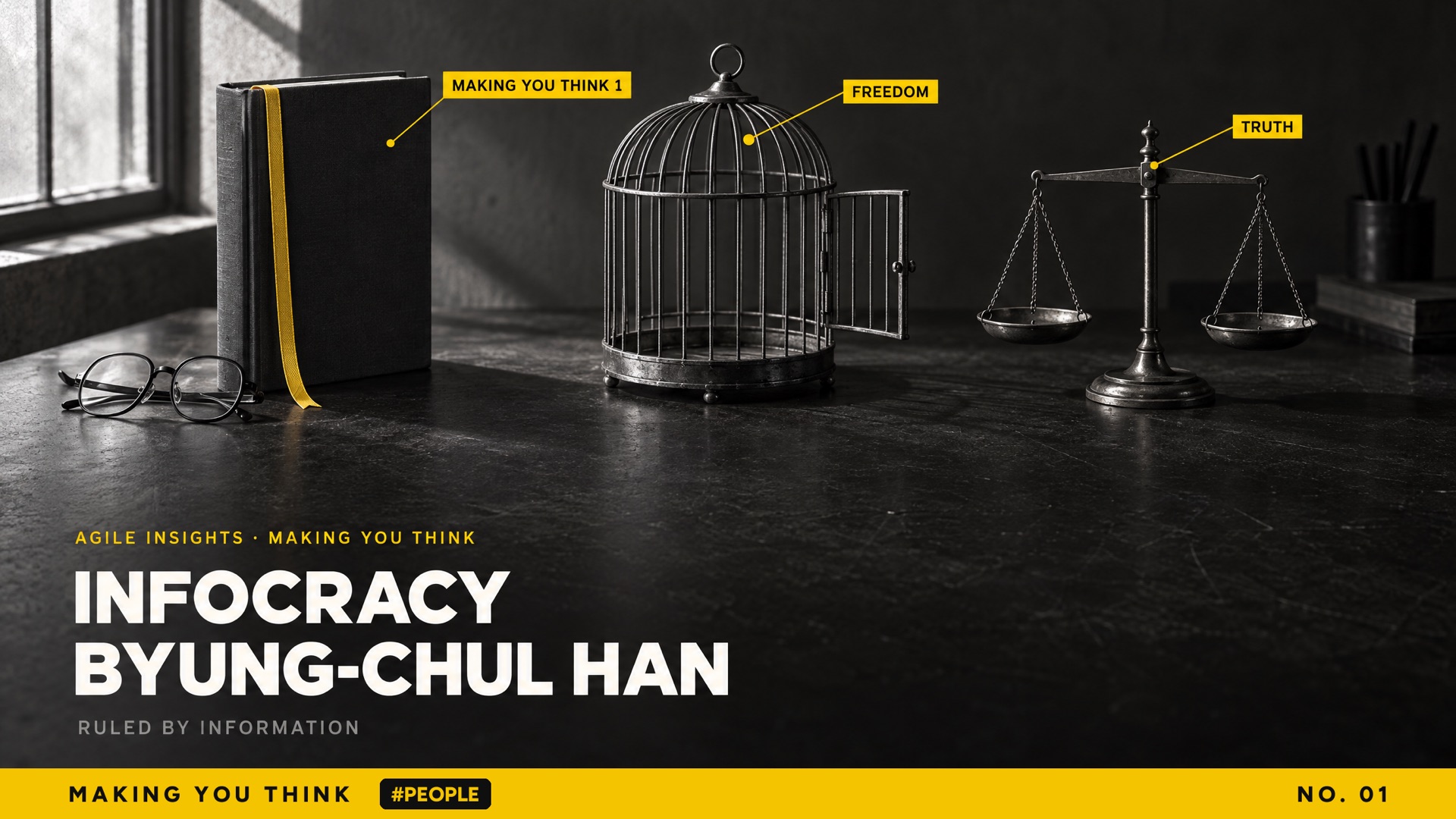
Making You Think 1 · Primer and discussion · About 15 minutes in two parts
Infocracy, by Byung-Chul Han
Part 1: Primer · About 6 minutes
Download the MP3 · Linda and Leonard, AI voices, read a script written from the sources below.
Part 2: Discussion · About 9 minutes
Download the MP3 · Linda and Leonard, AI voices, read a script written from the sources below.

This episode is about Infocracy: Digitalization and the Crisis of Democracy, by Byung-Chul Han. Find a copy on Amazon Australia, or ask your local bookshop or library.
In this episode
01Han and his one ideaByung-Chul Han was born in Seoul and studied philosophy in Germany. His 80 page book argues that we are ruled less by force and more by information, and that it works because we feel free.
02The argument in four stepsFor Han, power now rests on information we hand over freely, and democracy turns into information wars. Argument needs someone who disagrees. The person who does not care about truth is a greater threat than the liar.
03Where the critics push backOne peer reviewed review praises the book's clarity, then says Han gives no empirical evidence, no alternatives and no room for resistance. The hosts settle on this: a hypothesis worth having that he has not tested.
04What other research foundResearch by others, not Han, complicates his claim. A 2022 Reuters Institute review put about six to eight per cent of the UK public in a partisan online news echo chamber, far fewer than people assume.
05AI, three questions, two activitiesThe link to AI tools is the hosts' own, not Han's. Three questions and two activities ask you to check something you accepted as true and argue a view you reject. The point to keep: argument needs someone who disagrees.
Your turn
Three questions to ask yourself
When did you last change your mind about something that mattered, and what changed it? Was it a person, or was it a feed?
Who is the other in your week? I mean someone who disagrees with you on something you care about, and whom you still listen to.
Is there a subject where you have stopped caring whether what you repeat is true, because it suits your side?
Two things to try, alone, with a pen
One day, then ten minutesWhat I took on trustFor one day, note each thing you accept as true without checking. That evening, check one, and ask why you accepted it.
Ten minutesThe strongest versionPick a view you reject. Write its strongest version in five sentences, as someone who holds it would say it.
About Byung-Chul Han
Byung-Chul Han was born in Seoul in 1959 and first studied metallurgy there. He moved to Germany in the early 1980s, studied philosophy at Freiburg and German literature and Catholic theology at Munich, and took his doctorate at Freiburg in 1994 with a thesis on Heidegger. He taught at Basel, at the Karlsruhe University of Arts and Design and at the Berlin University of the Arts. His books include The Burnout Society, Psychopolitics and Infocracy, which runs to 80 pages in English. In 2025 he received the Princess of Asturias Award for Communication and Humanities. The New Yorker reports that he shuns interviews.
Other writing (7)
The Transparency Society (2015) · Stanford University Press
Transparency as a false ideal that erodes trust.
Transparency as a false ideal that erodes trust.
Sources and links (9)
Infocracy · Polity
The publisher's listing for the English edition (Polity, 2022), translated by Daniel Steuer.
The publisher's listing for the English edition (Polity, 2022), translated by Daniel Steuer.
Interview with Byung-Chul Han, October 2021 · Read at El País
Free to read. Han in his own words, speaking about another of his books, Non-things.
Free to read. Han in his own words, speaking about another of his books, Non-things.
Interview with Byung-Chul Han, April 2022 · Read at Noema
Free to read. A long interview published by Noema.
Free to read. A long interview published by Noema.
Interview with Byung-Chul Han, December 2021 · Read at ArtReview
Free to read. An interview published by ArtReview.
Free to read. An interview published by ArtReview.
Review of Infocracy by Uxía Sánchez Lorda · Read at tripleC
Peer-reviewed review in tripleC 24(1), February 2026. The source of the page-cited quotations this episode relies on, and of four objections.
Peer-reviewed review in tripleC 24(1), February 2026. The source of the page-cited quotations this episode relies on, and of four objections.
Review of Infokratie by Adrian Lobe · Read at Spektrum
Spektrum der Wissenschaft, October 2021 (in German). Enjoys the prose; says the claims are not argued enough.
Spektrum der Wissenschaft, October 2021 (in German). Enjoys the prose; says the claims are not argued enough.
German reviews of Infokratie, in digest · Read at Perlentaucher
Perlentaucher's summary of the German press reviews (in German), including Bettina Baltschev for Deutschlandfunk Kultur. A digest, not the reviews themselves.
Perlentaucher's summary of the German press reviews (in German), including Bettina Baltschev for Deutschlandfunk Kultur. A digest, not the reviews themselves.
Echo chambers, filter bubbles and polarisation: a literature review · Read at the Reuters Institute
Reuters Institute, January 2022. Not from Han: finds echo chambers are less common than assumed, about 6 to 8% of the UK public.
Reuters Institute, January 2022. Not from Han: finds echo chambers are less common than assumed, about 6 to 8% of the UK public.
Like-minded sources on Facebook: the 2020 US election study · Read at Nature
Nyhan and colleagues, Nature 620, July 2023. Not from Han: 23,377 users; cutting like-minded content by about a third had no measurable effect on eight attitude measures.
Nyhan and colleagues, Nature 620, July 2023. Not from Han: 23,377 users; cutting like-minded content by about a third had no measurable effect on eight attitude measures.
Written from public sources and checked on 11 October 2026. The script was drafted from the publisher's description and from reviews that quote the book, and reviewed by a person who has read it. The German reviews by Baltschev and Gladic were seen only through a digest, and two of the studies only as abstracts. The link to today's AI tools is the presenters' own, not the author's. Check the book itself before quoting.
Our fact check · 19 claims: 11 confirmed, 3 reported, 1 partly right, 3 disputed, 1 unverified
Before we record, every claim the hosts make is checked against the sources (this table was last updated 11 October 2026). Confirmed means a primary source or two independent reports; Reported means one party says so; Partly right, Disputed, Unverified and Not yet known mean what they say, and the hosts say so on air. This is the table as we left it.
The book
- ConfirmedGerman title Infokratie: Digitalisierung und die Krise der DemokratieMatthes & Seitz; Series Fröhliche Wissenschaft, vol. 184
- ConfirmedGerman publisher Matthes & Seitz Berlin, 2021Matthes & Seitz; Perlentaucher; Die Welt reviewed it 17 Jul 2021
- DisputedGerman page countPublisher: 88; two reviews: 100; Use 88
- ConfirmedEnglish edition: Polity, 2022, translated by Daniel Steuer, 80 pagesPolity; Wiley; title page scan; Notes start p. 60. Month differs between listings: say “2022”
- ConfirmedISBNs: hardback 978-1-5095-5297-9; paperback 978-1-5095-5298-6Polity; Wiley
- DisputedEnglish subtitlePolity and Wiley listings: “Digitization and the Crisis of Democracy”; the scanned title page: “Digitalization”; Check the hard copy
What Han does not say
- ReportedThe book mentions artificial intelligenceSánchez Lorda, quoting p. 39; Inside the dataist vision: decisions “on the basis of big data and artificial intelligence”
- UnverifiedIt discusses generative AI, chatbots or large language modelsNone; Almost certainly no; The German text was out by July 2021; no review mentions them. Every AI mention could not be counted without the full text
- ReportedHis worry is AI and data replacing public argument and political decision, not AI writing or thinking for one personSánchez Lorda; Safe wording: “Han wrote about algorithms and big data deciding in place of debate”
- ConfirmedIn October 2021 Han said big data is only correlation and “Artificial intelligence does not think”El País interview, 15 Oct 2021; His own words; Said about Non-things, not Infocracy
The author
- ConfirmedBorn 1959, SeoulMatthes & Seitz; Princess of Asturias Foundation; New Yorker; German Wikipedia says “near Seoul”
- ConfirmedFirst studied metallurgy in SeoulNew Yorker; Knepper et al.; The university is unverified
- ConfirmedMoved to Germany in the early 1980s, aged 22Knepper et al.; New Yorker; No exact year found
- ConfirmedStudied philosophy at Freiburg, German literature and Catholic theology at MunichFoundation; Matthes & Seitz
- ConfirmedDoctorate 1994, Freiburg, on HeideggerFoundation; New Yorker
- Partly rightTaught at Basel, at the Karlsruhe University of Arts and Design, and at the Berlin University of the ArtsFoundation (no dates for all); Wikipedia for dates; The dates differ between sources: do not state them
- DisputedWhether he holds a post nowPublisher: “was professor”; Knepper et al. (2024): “now writes full time”; one 2026 review: “is a professor”; Best reading: no current chair. Say “taught at”
- ConfirmedPrincess of Asturias Award for Communication and Humanities, 2025Foundation (jury minutes, Oviedo, 7 May 2025)
- ReportedShuns interviews and is not on social mediaNew Yorker, 17 Apr 2024
Want to know more?
Sign up for our podcast at agile-insights.com.au.
Read the transcript · Part 1: Primer
Linda Byung Chul Han argues that we are ruled less by force and more by information, and that it works because we feel free. I'm Linda, and this is the first episode of Making You Think, a series that takes one book or idea at a time. By the end of this part you will know who Han is, his argument in four steps, and what his main terms mean. The book is called Infocracy.
Leonard And I'm Leonard. Before the idea, the man.
Linda Han was born in Seoul in nineteen fifty nine, and he first studied metallurgy there.
Leonard Metallurgy.
Linda Metallurgy. In the early nineteen eighties he moved to Germany. He studied philosophy at Freiburg, and German literature and Catholic theology at Munich. In nineteen ninety four he took his doctorate at Freiburg, on Heidegger. He taught at Basel, at Karlsruhe and in Berlin. This is a short book. The English edition runs to eighty pages. His other books include The Burnout Society and Psychopolitics. In twenty twenty five he received the Princess of Asturias Award for Communication and Humanities. And the New Yorker reports that he shuns interviews.
Leonard Then we will have to speak for him. Carefully. Step one. Linda... what does he mean by a regime?
Linda He starts with where power sits. As the publisher puts it, power no longer rests on owning the means of production. It rests on access to information, used for surveillance, control and predicting behaviour. The older form he calls the disciplinary regime, a term he takes from Foucault. It isolated bodies, drilled them, and forced them to be visible. Picture a factory floor where everyone knows the supervisor is watching.
Leonard We have all had that supervisor.
Linda We have. His new term is the information regime. It rules through openness, incentives, and our own wish to be seen. Imagine an app where you post your morning run because you want to. Nobody ordered it...
Leonard And yet a record of where I go now sits with someone else.
Linda Exactly.
Leonard So the difference is who does the work. In the factory, someone has to watch me, and I know I am not free. With the app, I hand the record over myself... and feel rather pleased about it. Is that his claim, or is it your gloss on him?
Linda It is his. One reviewer quotes him, from page five, saying that when freedom and surveillance coincide, domination becomes complete.
Leonard That is a bleak sentence.
Linda It is. Step two is the title. Infocracy is his name for what democracy turns into under the information regime. As the publishers describe it, election campaigns become information wars, fought with bots, troll armies, fake news and psychometric profiling aimed at how people vote. Imagine a town square where everyone once heard the same speech and argued about it afterwards. Now imagine each person hearing a different speech through headphones.
Leonard The headphones help me. In the square I could tell my neighbour that I thought the speaker was wrong. With headphones, my neighbour never heard the speech, so we have nothing to argue about. Is that step three?
Linda It is. Here Han leans on Habermas and his idea of communicative action. As reviewers report it, communicative action needs a shared public space, and it needs an other, meaning someone who does not already agree with you. Han's chapter is called The End of Communicative Action. His claim is that filter bubbles and echo chambers push the other out. Opinion then loses its footing in reason, and people end up indoctrinating themselves. Think of a book club where everyone chose the same book for the same reasons.
Leonard A very pleasant evening.
Linda Very pleasant. And nobody goes home thinking anything new.
Leonard And the fourth step is about truth. I would have guessed that the great danger to public life is the liar, the person who knows the facts and says the opposite. Does Han agree?
Linda Not quite. The last chapter is called The Crisis of Truth. As one reviewer quotes him, the liar still respects truth, even while distorting it. The greater threat, for Han, is the person who does not care whether a thing is true. The reviewer reports that his example is a recent American president. He calls this condition a new nihilism. Imagine two neighbours. One tells you bin night is Tuesday when he knows it is Thursday. The other names whatever day comes to mind, and is not bothered either way.
Leonard And I can catch the first one out.
Linda You can. With the second, there is nothing to catch.
Leonard Let me say the terms back. The disciplinary regime rules by watching and drilling. The information regime rules through what we hand over freely. Infocracy is what democracy becomes under it. Communicative action is argument in a shared public space, and it needs an other. And the new nihilism is not lying... it is not caring.
Linda That is the argument. So here is one question to take with you. Think of the last thing you posted, shared or logged about yourself. Did you choose that freely... and who else gained from it?
Leonard I am not going to answer that for anyone. Give it a minute before you press play again. In Part Two we ask whether Han is right. We put his case at its strongest, hear from his critics, and look at evidence that complicates the picture. Join us there.
Read the transcript · Part 2: Discussion
Linda Byung Chul Han argues that we are ruled less by force than by information we hand over freely, and that this hollows out democratic argument. I'm Linda, and this is Part Two of the first Making You Think, on his book Infocracy. A quick recap of his terms. The information regime is rule through openness and our own wish to be seen. Infocracy is what democracy becomes under it. The other is the person who does not agree with you. By the end you will have the best case for Han, the best case against, and some thinking to do.
Leonard And I'm Leonard. The book appeared in German in twenty twenty one, and was published in English in twenty twenty two.
Linda So, his case at its strongest. Leonard, you first.
Leonard Its strength is that it explains something the older picture of power cannot. If control means force, then a world where nobody forces you looks free. Han says... look again. My example, not his: nobody makes us carry a device that records where we are, and yet we queue to buy one.
Linda Overnight, sometimes.
Leonard Overnight. As the publisher describes his view, power now rests on access to information used to predict behaviour, and our feeling of freedom is what holds it in place. His second strong point is about the other. An argument only tests a belief if someone in the room does not share it.
Linda I would add his point about indifference. Most of our defences, such as corrections and fact checks, assume the problem is falsehood. Han's claim, as one reviewer quotes it, is that the deeper problem is not caring. A correction does nothing for someone who never minded being wrong.
Leonard No. It does not.
Linda That reviewer is Sánchez Lorda, writing this year in the peer reviewed journal Triple C. The review credits the book with a clear and accessible account linking platforms to democratic decline. A question for you. When did you last change your mind about something that mattered... and what changed it? Was it a person, or was it a feed?
Leonard Keep hold of that while we turn to the critics. The same review that praises the clarity lists four problems. Han never states what model of democracy he is defending. He gives no empirical evidence. He offers no alternatives. And his view of users is deterministic, with no room for resistance. That last one bites. If the regime works because we feel free, what about the people who notice, and switch off, or argue back? In his account, as reported, they barely appear.
Linda Two German reviewers make related points. Adrian Lobe, in the German science magazine Spektrum, found the book a pleasure to read. But the review says its claims are not argued enough and stand, in its phrase, like aphorisms. Bettina Baltschev, on German public radio, found the book persuasive but dark, with no way out. We have her view only through a digest of German reviews. Here I part company with the critics a little, Leonard. A short book of diagnosis does not owe us a cure.
Leonard I disagree, at least in part. A diagnosis with no evidence is closer to a hunch.
Linda Hm. Go on.
Leonard And a diagnosis that leaves no room for resistance can become a reason to do nothing. If I believe my feed has already settled what I think, why would I bother arguing with my neighbour? That is the risk in a book this bleak.
Linda That is fair... and I think we can settle it this way. Han gives us a hypothesis worth having, and the critics are right that he has not tested it. So the testing falls to the reader, which brings us to the first activity. For one day, jot down each thing you accept as true without checking. A headline, a figure in a meeting, something a friend passed on. That evening, pick one and check it yourself. Then ask what made you accept it in the first place. The evening part takes about ten minutes.
Leonard Now the evidence, and none of this comes from Han. It is research by others, and it complicates his third step. A literature review from the Reuters Institute, published in twenty twenty two, found that echo chambers are far less common than people assume. It put about six to eight per cent of the U K public in a partisan online news echo chamber.
Linda Six to eight.
Leonard Six to eight. It also found that algorithms tend to give people slightly more diverse news. If that holds, then for most people the other has not been pushed out.
Linda A second study appeared in the journal Nature in twenty twenty three. It covered twenty three thousand, three hundred and seventy seven Facebook users during the twenty twenty American election. Like minded content was most of what they saw, which sounds like Han's point. But when the researchers cut that content by about a third, they found no measurable effect on eight measures of attitude. So the bubble was real... and thinning it changed little. I do not think that sinks Han, but it does weaken his third step.
Leonard Which brings me to a question I would rather you answered than us. Who is the other in your week? I mean someone who disagrees with you on something you care about, and whom you still listen to. If a name comes easily, the research may be describing you. If no name comes... Han may be.
Linda I will leave that with you and turn to AI, with a warning label. The book appeared in German in twenty twenty one, before today's chatbots, so they are not its subject. Where artificial intelligence does appear, as the reviewer quotes page thirty nine, it sits inside a view he opposes. He describes people he calls dataists, and their outlook he calls digital rationality. They hold that there is now too much information for public debate to cope with. So algorithms, big data and AI can replace argument, and experts can replace politicians. He reports that view in order to oppose it.
Leonard So his worry was data and machines deciding in place of public debate. It was not a tool writing or thinking for one person. What follows is our extension, and ours alone. A tool that answers every question agreeably could become a private version of the same thing, a conversation with no other in it. There is early research that points that way, again not from Han. A Microsoft Research study of three hundred and nineteen knowledge workers found that higher confidence in generative AI went with less critical thinking. Higher confidence in oneself went with more. It rests on what people reported about themselves, so treat it as a pointer.
Linda I would push back there. Moving from the public square to one person's desk is a big jump, and Han did not make it. The same tool can be asked to argue against you, so it comes down to how it is used.
Leonard That is true. I will take the correction.
Linda It leads to the second activity, and it needs no tool at all. Pick a view you reject. Write the strongest version of it in five sentences, as someone who holds it would say it. No sneering.
Leonard The hard part.
Linda The hard part. If you cannot do it, you may not yet know what you disagree with.
Leonard A third question, from Han's last step. Is there a subject where you have stopped caring whether what you repeat is true, because it suits your side? That one stings, which is why it is worth asking.
Linda So, what to carry away. One, feeling free and being free are separate questions, and Han is right to pull them apart. Two, his critics are right that he asserts more than he shows, and the evidence on echo chambers is kinder than he is. Three, an argument needs an other, and finding one is something you can do this week. Read the book if you can. It is eighty pages.
Linda If you'd like to know more, sign up for our podcast at agile-insights.com.au.
Leonard Thanks for listening.
More on #people
Episode 34 · Primer and discussionWhen the test stops telling you anything: hunger beats tenureEpisode 32 · Primer and discussionAgentic video is real: what to try, and what to checkEpisode 31 · Primer and discussionSpeeding up planning decisions with AI: who checks the checker?Making You Think 12 · Primer and discussionThe Game Changer, by Jason FoxEpisode 13 · Primer and discussionFairness under pressure: a fair AI decision has to hold when someone leans on itMaking You Think 9 · Primer and discussionArtificial Intimacy, by Sherry Turkle
All of Making You Think (13) · Follow Making You Think in Apple Podcasts or any podcast app
Everything from Agile Insights: briefings, Making You Think and the reference series