 Briefing
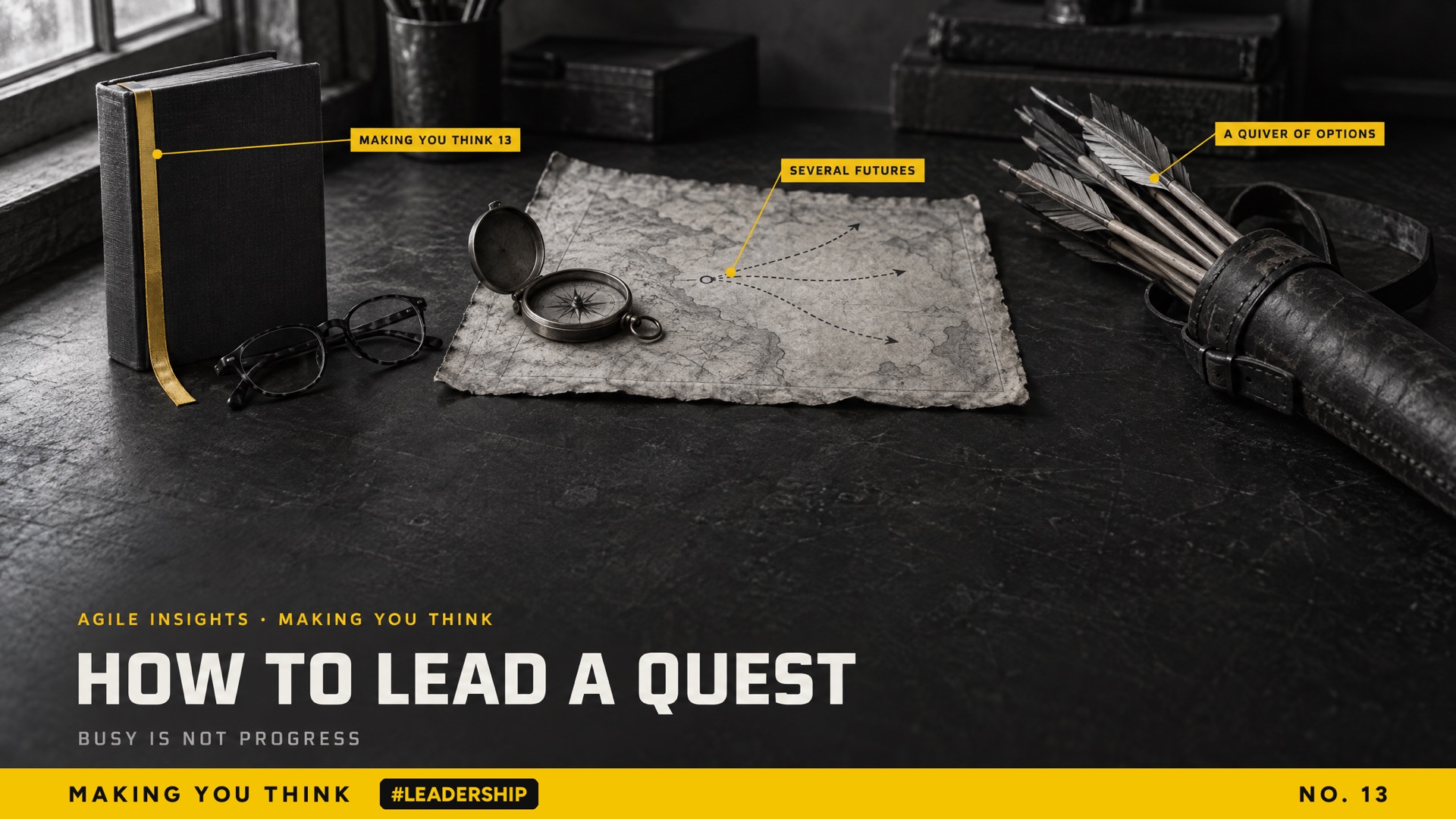
Making You Think 13 · Primer and discussion · About 15 minutes
How to Lead a Quest, by Jason Fox
Part 1: Primer · About 7 minutes
Download the MP3 · Linda and Leonard, AI voices, read a script written from the sources below.
Part 2: Discussion · About 8 minutes
Download the MP3 · Linda and Leonard, AI voices, read a script written from the sources below.

This episode is about How to Lead a Quest, by Jason Fox. Find a copy on Amazon Australia, or ask your local bookshop or library.
Based on essays and our own research.
In this episode
01Defaults are useful, then dangerousFox defines a default as the option chosen automatically unless a real alternative is offered; defaults suit formulaic work, and he admits his own eighty twenty split is a guess.
02The delusion of progressEfficient systems free up time that fills with busy work; in his words it is perpetuating productivity rather than progress, and it satisfies because progress motivates us.
03The growth arc and the KrakenA startup finds a formula, optimises it, plateaus and wakes up irrelevant. Fox's answer is pioneering leadership beside operational excellence, not instead of it.
04Where the critics pushThe book argues by story and metaphor; innovation tales suffer from hindsight; exploration is costly, as March noted; and clear goals still work for well defined tasks.
05What to doKeep defaults for the work you understand, ask what each week moved toward a new future, and run small experiments with the result that would prove you wrong written first.
Your turn
Three questions to ask yourself
What did you do this week that felt like progress, but only kept yesterday's work running?
If the main thing your organisation does stopped mattering in five years, what would the most likely reason be, and who is paid to notice?
Where is your team's use of A I just making the default faster, and where is it opening a path you could not take before?
Two things to try, alone, with a pen
10 minutesProgress or busy?Sort last week's time into keeping things running and moving toward a new future, then claim one hour.
10 minutesThree futures and a hunchTest one hunch against three possible futures and design one small experiment that could prove you wrong.
About Jason Fox
Dr Jason Fox is a Melbourne-based leadership adviser, speaker and writer who holds a PhD. His first book, The Game Changer (Wiley, 2014), was on motivation and game design; How to Lead a Quest (Wiley, 2016), illustrated by his partner Kim Lam, turned to pioneering leadership. In 2016 he described himself as a motivation design specialist; he now calls himself a complexity practitioner and leadership adviser, and writes at foxwizard.com.
Other writing (4)
The Game Changer (2014) · Wiley (Australia)
motivation science plus game design at work; Making You Think 12
motivation science plus game design at work; Making You Think 12
Why I'm 'helping' executive teams with agentic AI (2026) · foxwizard.com
his 2026 essay linking the quest book to how organisations are adopting A I
his 2026 essay linking the quest book to how organisations are adopting A I
Books, on the author's own site (2026) · Jason Fox
both books and the small independent magazine The Cleverness Biannual
both books and the small independent magazine The Cleverness Biannual
Sources and links (10)
Wiley Australia, publisher page for the book · wiley.com
Wiley, look-inside excerpt: chapter 1, The Anatomy of Default Thinking · media.wiley.com
Wiley, look-inside excerpt: table of contents · media.wiley.com
"Three things leaders should seek to avoid", HRD Canada, 28 Mar 2016 · hcamag.com
Fox on the curse of efficiency and the delusion of progress
Fox on the curse of efficiency and the delusion of progress
Fox, "Why I'm 'helping' executive teams with agentic AI", 31 May 2026 · foxwizard.com
March, "Exploration and Exploitation in Organizational Learning", Organization Science, 1991 · ideas.repec.org
our connection, not cited by Fox
our connection, not cited by Fox
"The motivating power of progress", Canadian Government Executive (Amabile and Kramer) · canadiangovernmentexecutive.ca
Humble, "The Flaw at the Heart of Bimodal IT", Apr 2016 · continuousdelivery.com
Ordóñez, Schweitzer, Galinsky and Bazerman, "Goals Gone Wild: The Systematic Side Effects of Overprescribing Goal Setting", 2009 · hks.harvard.edu
Based on essays and our own research, checked on 26 October 2026. The publisher's copy, the book's introduction and chapter 1 in the look-inside previews, the contents and index, Fox's 2016 interview and his 2026 essay were read in full; the later chapters were not, and are described from the contents, the author's overview and readers' summaries. The author's argument is paraphrased, not reproduced. Check the original before quoting.
Our fact check · 49 claims: 39 confirmed, 7 reported, 1 partly right
Before we record, every claim the hosts make is checked against the sources (this table was last updated 26 October 2026). Confirmed means a primary source or two independent reports; Reported means one party says so; Partly right, Disputed, Unverified and Not yet known mean what they say, and the hosts say so on air. This is the table as we left it.
The author
- ConfirmedDr Jason Fox, born 1983NLA Cataloguing-in-Publication data, book's copyright page (e-bookshelf preview); Say "in his early thirties when he wrote it" if needed; not essential
- ConfirmedLives in Melbourne, AustraliaFoxwizard.com/about; 2016 book bio; Wiley 2014 bio
- ConfirmedHolds a PhD ("a doctorate in philosophy", i.e. a PhD)Book ch. 1 (Wiley excerpt); Wiley 2014 bio ("PhD in record time"); Self-described; Institution, field and thesis title: Not yet known. One Goodreads reviewer doubts his credentials for this reason. On air: "who has a PhD" only
- ReportedLectured at three universities (complexity science, living systems, eco-philosophy)Foxwizard.com/about; ACEL 2026 bio; Self-described; Universities not named
- ConfirmedLeadership adviser and keynote speaker; in 2016 described as a "motivation design specialist"; now "wizard-philosopher, complexity practitioner and leadership advisor"Book's About the Author (2016); foxwizard.com/about; ACEL 2026; Self-described; The self-description shifted between 2016 and 2026; worth one line
- ConfirmedPartner Dr Kim Lam ("dangerlam"), veterinarian and illustrator, did the cover and internal illustrationsCopyright page; About the Author; foxwizard.com
- ConfirmedNow writing as foxwizard.com (sunsetting drjasonfox.com); newsletter "museletter"; podcast Wyrd Work launched Sep 2026Foxwizard.com /now and RSS
- ConfirmedDistances himself from his pre-2016 behavioural-science work and is "reluctant to promote" The Game ChangerFoxwizard.com/books; agentic-ai essay, 31 May 2026; Useful bridge to MYT 12, said lightly
- ConfirmedFox has two books; the quest book is How to Lead a QuestFoxwizard.com/books; Wiley; No later edition
- ConfirmedPublished by Wiley (John Wiley & Sons Australia, Milton Qld), 2016Copyright page; Wiley (Jan 2016); E-books 29 Dec 2015 (e-bookshelf); Goodreads gives 4 Mar 2016 for one edition. Say "2016"
- ConfirmedSubtitle A handbook for pioneering executivesCover and title page (preview); Wiley's store now: A Guidebook for Pioneering Leaders
- Confirmed278 pages (+ xix); Wiley says 304Library records; index ends p. 278; Wiley; Both are right; different counts
- ConfirmedPaperback ISBN 9780730324713; ISBN-10 0730324710Wiley; CiP; computed (weighted sum 154, divisible by 11, check digit 0); Wiley's own excerpt files are named 0730324710
- ConfirmedEPUB 9780730324720; PDF 9780730324737; hardback 9780730324744E-bookshelf (EPUB, PDF); CiP (all three); Hbk: CiP only; All check digits valid
- ConfirmedMain idea (default thinking, busyness as false progress, quests that explore futures and test options)Publisher copy; Introduction; Carries the episode
- ConfirmedDefault defined as the option chosen automatically unless a viable alternative is offeredCh. 1 (read in full); The one book quotation
- ConfirmedDefault thinking linked to Kahneman's system 1; "slow" renamed "thorough"Ch. 1
- ConfirmedDefault thinking is great for formulaic work; 80 per cent figure not from researchCh. 1 and footnote 4; Strong honest beat
- ConfirmedCurse of efficiency: too busy for strategy and new ideasPublisher copy; HRD 2016; contents
- ConfirmedDelusion of progress: emails and KPIs feel like progress but only maintain yesterdayHRD Canada interview, 28 Mar 2016; Quote: "perpetuating productivity rather than progress"
- ConfirmedProgress is what most motivates people; managers ranked it lastAmabile and Kramer (669 managers; 238 diarists, 26 teams, ~12,000 days); Fox cites them pp. 16–17; his figure reportedly 600 (Partly right)
- ConfirmedGrowth arc: startup, growth, plateau, irrelevance; the KrakenIndex; figure 3.1 title; Part I opener
- ReportedKodak and Nokia appear as cautionary talesIndex (Kodak 110–111; Nokia 47–48); What he says about them not read
- ConfirmedKodak built the first digital camera in 1975 and went bankrupt in Jan 2012Standard history (Sasson; AP Feb 2012); Ours if used; 19 Jan 2012 Reported
- ConfirmedPioneering leadership complements operational excellence, not an alternativeIntroduction
- ConfirmedQuests explore multiple possible futures instead of one goal; output is viable alternative optionsIntroduction; getAbstract
- Partly rightQuest-Augmented Strategy is a quadrant model; axes operational/pioneering and thinking/doingIntroduction ("each quadrant"); index pp. 61–66; Inferred; not yet checked against the book
- ConfirmedParts III–VI walk the quadrants: options, experiments, augmenting strategy, progressIntroduction; Sequence; Fig. 11.1 says the flow is non-linear
- ReportedExperiments designed to disprove a hypothesisContents ("Forming a hypothesis"); index; a reader's notes (p. 130)
- ReportedNine layers of Fell: three to celebrate, three to change, three not to celebrateContents; index; a reader's notes; Layer names Reported
- ConfirmedBimodal working borrowed from GartnerIndex (Gartner 207–208); ch. 16 title
- ConfirmedRituals at yearly, quarterly, monthly, weekly and daily rhythm; choose "one word"Contents ch. 21
- ConfirmedInfinite game, Carse 1986Index; Carse
- ConfirmedMarch 1991: exploitation crowds out exploration; short-run effective, long-run self-destructiveOrganization Science 2(1): 71–87, abstract; Ours, not Fox's
- ReportedExploration's returns less certain, more remote, organisationally distantMarch 1991 body; Paraphrase only
- ConfirmedO'Reilly and Tushman 2004, ambidextrous organisationHBR Apr 2004; Citation; Ours
- ConfirmedFox, PhD; Melbourne; born 1983Ch. 1; site; CiP; Institution Not yet known
- ReportedPhD by 25, lectured at three universitiesTEDx 2013; site
- ConfirmedFox wrote before generative AI; the book has no AI index entryIndex; Fox 2026; Say it plainly
- ConfirmedFox (2026): executives going "all in" on AI; "decision-based evidence making"; QAS would mean a quiver of optionsFoxwizard.com, 31 May 2026; Read in full; Attribute to the 2026 essay, not the book
- ConfirmedTwo thirds of his client work now involves committed AI integrationSame essay; His figure; Optional
- ReportedThe book mentions Jevons paradox and an AI-tracking law firmFox 2026; Not in index; not yet checked against the book
- AI adoption as default-driven exploitation and a new delusion of progressHosts' extension; Ours; Said so on air
- LLMs as default machines (most likely continuation)Hosts' analogy; Ours; Said so; not Fox's
- ConfirmedNo independent press review; Goodreads 3.94 from 90 ratingsSearch; Goodreads 26 Oct 2026
- ConfirmedRosenzweig, The Halo Effect, 2007Search results (publisher, reviews); Bibliographic
- ConfirmedLepore, "The Disruption Machine", New Yorker, 23 Jun 2014Search results; Bibliographic
- ConfirmedBimodal critique (Humble 2016; Forrester 2016)Continuousdelivery.com; search; Humble); Reported (Forrester
- ConfirmedGoal-setting theory well replicated; Goals Gone Wild 2009Locke and Latham; 2026-10-goals-gone-wild; Concept
Want to know more?
Sign up for our podcast at agile-insights.com.au.
Read the transcript · Part 1: Primer
Linda The idea for today is that organisations drift into irrelevance by running on default thinking and mistaking busyness for progress, so leaders need to add a quest: exploring several possible futures, testing alternatives, and folding the ones that work back into strategy. That is the argument of How to Lead a Quest, the second book by the Melbourne writer Doctor Jason Fox. By the end of this part you will know what Fox means by a default, why being busy can be the enemy of progress, and what a quest actually involves. This is Making You Think, episode thirteen.
Leonard If you heard episode twelve, you have met him already. Jason Fox is a leadership adviser based in Melbourne who holds a PhD, and his first book, The Game Changer, was about motivation and game design. How to Lead a Quest came out from Wiley in Australia in 2016, subtitled A handbook for pioneering executives. The illustrations are by his partner, Kim Lam. Since then his description of himself has shifted, from motivation design specialist to what he now calls a complexity practitioner and leadership adviser. He still teaches the framework from this book. It is a playful read, full of dragons and sea monsters, but the argument underneath is serious.
Linda Step one is the default. Fox defines a default as "an option that is selected automatically unless a viable alternative is specified". Think of driving home on autopilot and arriving with no memory of the trip. Default thinking is fast pattern matching, and Fox links it to what the psychologist Daniel Kahneman called system one. He renames the slow, careful kind thorough thinking, because, he says, slow never sells...
Leonard Fair enough.
Linda In an organisation, defaults take four forms: systems, templates, norms and precedents. And Fox is clear that they are good. They let us do formulaic work quickly and well. He reckons most work should run this way, and he admits in a footnote that his eighty twenty split is not from research.
Leonard So if defaults are good, where is the trap?
Linda Step two, which Fox calls the curse of efficiency. Because default systems are efficient, they free up time. But the time does not go to strategy or new ideas. It fills straight back up with more busy work. Then comes what he calls the delusion of progress. Clearing the inbox, ticking off key performance indicators, finishing the to do list: it all feels like progress. In a 2016 interview he called it "perpetuating productivity rather than progress". It keeps yesterday's business running, and asks nothing of tomorrow. The twist is that people are motivated by a sense of progress, so busy work is genuinely satisfying. That is exactly why it traps us.
Leonard Guilty.
Linda Same.
Leonard Listeners to episode twelve will know that research. Teresa Amabile and Steven Kramer found that progress in meaningful work lifts people's day more than anything else. Yet in their survey of six hundred and sixty nine managers, progress came last of the five motivators the managers ranked. Fox uses the same finding to make a darker point. If progress feels that good, we will happily accept a counterfeit. A full day of email gives us the feeling without the substance. So here is a question for you... What did you do this week that felt like progress, but only kept yesterday's work running?
Linda Step three is the arc that busy organisations follow. Fox draws what he calls the default growth arc. A startup explores, finds a formula that works, and grows fast. Then it does the sensible thing and optimises that formula. Growth flattens into a plateau of maturity. And because nobody has had time to look for what comes next, it wakes up one day irrelevant. Fox gives the danger a name from the old sea stories: the Inevitable Kraken of Doom, a beast that feeds on irrelevance. Among the cautionary tales the book draws on are Kodak and Nokia. The shape will be familiar to anyone who has watched a market leader fade.
Leonard So is the answer to stop being efficient?
Linda No, and this is step four. Fox calls his answer pioneering leadership, and he is explicit that it complements operational excellence rather than replacing it. You keep running the business well. Alongside it, you lead a quest. A quest, in his sense, has no fixed destination. Instead of one crystal clear goal, you explore several possible futures. You look for what he calls intriguing incoherence: the places where today's business would stop making sense if one of those futures arrived. From that you build a quiver of alternative options. You test them with small, science style experiments, each built around a hypothesis...
Leonard And when they fail?
Linda The ones that survive are folded back into strategy. He calls the framework quest augmented strategy.
Leonard And he takes failure seriously. The book has a chapter on planning to fail, built around what he calls the nine layers of Fell, a nod to Dante. As readers describe it, some kinds of failure are worth celebrating, like a well run experiment that did not work, and some are not, like apathy. He also borrows the word bimodal, from the research firm Gartner, for working in two modes at once: running today's business and exploring tomorrow's. And he ends with culture. A quest only lasts if it has rituals, at a yearly, quarterly, monthly, weekly and daily rhythm. The prize, he says, is not a goal reached. It is enduring relevance.
Linda Before Part 2, a question for you. If the main thing your organisation does stopped mattering in five years, what would the most likely reason be, and who is paid to notice?
Leonard In Part 2: where the idea is strong, what the critics say about evidence, hindsight and cost, an argument about clear goals, and what Fox himself now says about A I. See you there.
Read the transcript · Part 2: Discussion
Linda The idea again, in one sentence: organisations drift into irrelevance by running on default thinking and mistaking busyness for progress, so leaders should add a quest that explores possible futures and tests alternatives alongside the day job. A quick recap. A default is what happens automatically unless someone offers a real alternative. The delusion of progress is mistaking busy work for movement. And a quest is a disciplined search for new options, run beside operational excellence, not instead of it. Today: the strengths, the critics, what Fox himself now says about A I, and two activities.
Leonard Strength first. Fox names a trap that serious research also describes, though he does not cite it. In 1991 the organisational theorist James March wrote a famous paper on exploration and exploitation. Exploitation is refining what you already do. Exploration is searching for something new. March argued that organisations tend to get better at exploitation faster than at exploration, and that this is "effective in the short run but self destructive in the long run". That is Fox's growth arc and his Kraken, in the language of a scholar. The connection is ours, not his, but it gives his intuition a firm academic footing.
Linda The second strength is honesty about defaults. Fox does not sneer at efficiency. He says most work should run on defaults, and he admits in print that his own split is a guess. The third strength is that the book is practical. It ends with rituals at every rhythm from the year to the day, and it separates good failures from bad ones. Too many books about innovation stop at inspiration. This one at least tries to say what to do on Monday morning.
Leonard Now the critics. We found no newspaper review of the book, so the fairest test is the standard case against books of this kind. The first objection is evidence. The book argues by story, metaphor and borrowed frameworks: krakens, dragons, Dante and the hero's journey. Some readers love the playfulness. Others find it light for experienced leaders...
Linda Krakens will do that.
Leonard Fox would say it is a handbook, not a study. The second objection is hindsight. Innovation books tend to tell the stories of fallen giants backwards, from the known ending. In The Halo Effect, in 2007, Phil Rosenzweig argued that observers infer good strategy from good results, after the fact.
Linda The third objection is cost. Exploration is expensive, and March said so himself. As his paper is usually summarised, the rewards of exploring are uncertain and slow to arrive, and an organisation that explores too much ends up with many half developed ideas and little real skill at anything. So pioneering needs a budget and a rule for stopping. Fox partly answers this, because his quests are small experiments, options rather than big bets. The fourth objection is about the word bimodal. When Gartner promoted bimodal I T, critics such as the software writer Jez Humble argued that the best teams improve speed and safety together, not in separate lanes. A separate innovation mode can become a sideshow.
Leonard I want to push on one of his opening moves, though. Fox says that leading from a crystal clear goal is a flawed position. But goal setting is one of the best replicated findings in work psychology. People with specific, hard goals usually do better than people told to do their best. Isn't throwing out the clear goal throwing out one of the few things we know works?
Linda For a well defined task, yes. Edwin Locke and Gary Latham's research on goals is solid, and Fox himself says an enterprise needs goals. But a 2009 paper called Goals Gone Wild, by Lisa Ordóñez and colleagues, showed what goes wrong when specific goals are imposed on complex, changing work: narrow focus, more risk taking, more cheating and less learning. Their advice for that kind of work was learning goals, which is close to a quest. So I would put it this way. Clear goals for the work you understand. Questions and options for the work you don't.
Leonard That I can live with. Goals for the eighty, quests for the twenty. Now A I. Fox wrote this book in 2015, before generative A I, and he says himself that it predates the leap made by large language models. But he has written about it since. In an essay in May 2026, he said most of his client work now comes from organisations committing to integrate A I. He described chief executives going all in on A I, and called the pattern "decision based evidence making": deciding first, and finding the evidence afterwards. Quest augmented strategy, he wrote, would have meant cultivating a quiver of options through experiments, instead of one big bet.
Linda Now our own extension, which is ours and not his. A lot of A I adoption is run as default thinking. Buy the tool, make existing work faster, and count licences and prompts. In March's terms that is exploitation, and it is legitimate, because much of the early value sits there. But if it is all an organisation does, it is a fresh case of the delusion of progress. A quest would ask a different question. What could we do with this that we could not do before, and what small test would show us we are wrong? So a question for you. Where is your team's use of A I just making the default faster, and where is it opening a path you could not take before?
Leonard Two short activities, each about ten minutes, with a pen and paper. The first is called Progress or busy. List the ten biggest uses of your time last week. For each one, tick whether it kept things running, or moved you toward a future you are not yet in. Count the ticks in each column. Then choose one hour next week for the second column, and write what you will do with it. Fox would call the first column productivity and the second progress. Both matter, but only one keeps you relevant.
Linda The second is called Three futures and a hunch. Write down one nagging hunch about your work. Then sketch three futures, five years out: one where the hunch is right, one where it is wrong, and one that is just strange. For each future, write one thing you do today that would stop making sense there. Pick one small, cheap experiment that would tell you something within a month. Finally, write the result that would prove you wrong. If you cannot write that last line, it is not yet an experiment.
Leonard So what to carry away. First, defaults are good for the work you understand, and dangerous when they are all you have. Second, busy is not the same as progress, so ask what each week moved toward a future you are not yet in. Third, a quest is not a leap of faith. It is a set of small, honest experiments run beside the day job, with the result that would prove you wrong written down first. That matters more, not less, as A I makes the default faster than ever.
Linda If you'd like to know more, sign up for our podcast at agile-insights.com.au.
Leonard Thanks for listening.
More on #leadership
Episode 38 · Primer and discussionBudgeted for seats, billed for workEpisode 34 · Primer and discussionWhen the test stops telling you anything: hunger beats tenureEpisode 23 · Primer and discussionWhat FDE means at OpenAI: skills, not custom code.Episode 21 · DiscussionTrust cannot be rushed: how much authority will you give AI?Making You Think 12 · Primer and discussionThe Game Changer, by Jason FoxEpisode 16 · Primer and discussionWhen making something gets cheap, checking it becomes the real work.
Every episode tagged #leadership
All of Making You Think (13) · Follow Making You Think in Apple Podcasts or any podcast app
Everything from Agile Insights: briefings, Making You Think and the reference series