 Briefing
Episode 6 · Discussion · About 10 minutes
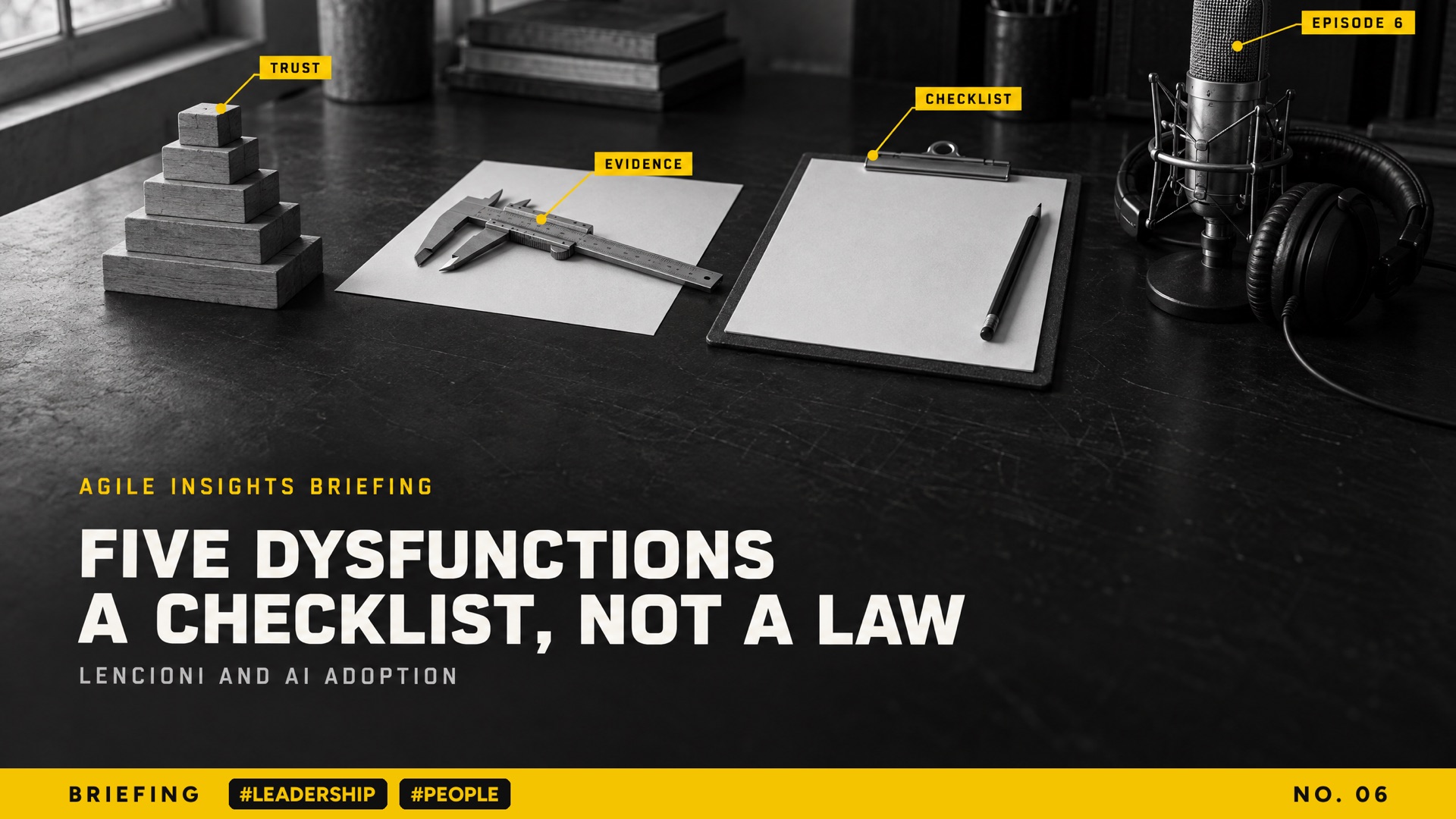
The Five Dysfunctions of a Team: a checklist for AI adoption, not a law
Download the MP3 · Linda and Leonard, AI voices, read a script written from the sources below.
In this episode
01What the five dysfunctions model saysLencioni draws five team failures as a pyramid: absence of trust, fear of conflict, lack of commitment, avoidance of accountability and inattention to results. Each layer rests on the one below, so his advice is to fix from the bottom.
02Trust is supported, the order is notA pooled analysis of 112 studies found trust and team performance correlated at about 0.3, though its authors say that does not prove cause. The hosts found no study testing whether the layers must be fixed in order.
03What builds trust in a teamThe sceptics and the research point the same way: trust comes from real shared work and a leader who coaches, not disclosure exercises. For AI, that means a joint pilot with a real outcome, not an away day.
04What each layer looks like with AIOn the hosts' own reading, staff stop reporting AI mistakes, approval forums wave proposals through, nobody knows who owns an agent, reviewing output becomes nobody's job, and the organisation counts tool usage instead of team outcomes.
05A five question checklist to testAsk one question per layer and treat a vague answer as the finding. Start at the lowest weak layer, pick a measure such as AI mistakes reported each month, try one fix and check whether anything changed.
Sources and links (5)
The Five Dysfunctions of a Team · Wiley
The publisher's listing for Lencioni's 2002 leadership fable and model.
The publisher's listing for Lencioni's 2002 leadership fable and model.
Psychological Safety and Learning Behavior in Work Teams · SAGE Journals
Amy Edmondson's 1999 study of 51 work teams (Administrative Science Quarterly). Abstract.
Amy Edmondson's 1999 study of 51 work teams (Administrative Science Quarterly). Abstract.
Trust and team performance: a meta-analysis · Science for Work
De Jong, Dirks and Gillespie (2016, Journal of Applied Psychology), 112 studies. Plain-language summary of the findings.
De Jong, Dirks and Gillespie (2016, Journal of Applied Psychology), 112 studies. Plain-language summary of the findings.
Understand team effectiveness · Google re:Work
Google's re:Work guide to its team research on psychological safety and four other dynamics.
Google's re:Work guide to its team research on psychological safety and four other dynamics.
Four models of team performance · Hogan Assessments
Hogan Assessments on Lencioni and other team models. The firm sells a rival model, so read it as a critique with an interest.
Hogan Assessments on Lencioni and other team models. The firm sells a rival model, so read it as a critique with an interest.
Written from public sources and checked on 10 October 2026. The research is summarised from abstracts and secondary reports, and some sources could not be opened in full. The AI readings of each layer are the presenters' own interpretation, not Lencioni's. Check the original before quoting.
Our fact check · 8 claims: 3 confirmed, 3 reported, 1 disputed, 1 unverified
Before we record, every claim the hosts make is checked against the sources (this table was last updated 10 October 2026). Confirmed means a primary source or two independent reports; Reported means one party says so; Partly right, Disputed, Unverified and Not yet known mean what they say, and the hosts say so on air. This is the table as we left it.
- Confirmed2002, Jossey-Bass/Wiley; fable plus model, assessment and action stepsWiley-VCH listing
- DisputedPage countWiley 256, Wikipedia 229; Edition
- ReportedPyramid, fix from the bottomSecondary summaries
- ReportedModel from consulting experience, not researchCurphy and Hogan via Wikipedia and Hogan blog
- UnverifiedNo peer-reviewed validation of the assessment; no test of the orderingExtended search; Absence
- ConfirmedEdmondson 1999, ASQ 44(2): safety → learning behaviour → performanceSAGE abstract; Abstract
- ConfirmedDe Jong et al. 2016, JAP 101(8): ρ = .30, 112 studiesAbstract plus summary; Headline
- ReportedGoogle Project Aristotle: reportedly 180 teams, safety ranked firstSearch summaries
Want to know more?
Sign up for our podcast at agile-insights.com.au.
Read the transcript
Linda Hello, I'm Linda, and this is the Agile Insights discussion series. Patrick Lencioni's five dysfunctions model is a useful checklist for the human side of AI adoption. But it is a hypothesis, not a finding. By the end you will know what the model says, what the research does and does not support, and how to use it when you roll out or govern AI.
Leonard And I'm Leonard. A quick recap for anyone who has not read it. The book came out in two thousand and two. It is a fable about a chief executive called Kathryn Petersen, who inherits a struggling company's leadership team. Alongside the story, Lencioni sets out a model of five dysfunctions, drawn as a pyramid, where each layer rests on the one below.
Leonard The base is absence of trust, meaning people will not admit mistakes or ask for help. Next is fear of conflict, which gives you polite meetings and private grumbling. Then lack of commitment, where decisions stay vague and people hedge. Then avoidance of accountability, where nobody calls out a peer. At the top is inattention to results, where personal status beats the team's outcome. His advice is to fix it from the bottom up.
Linda So why does an AI governance podcast care? Because almost every AI programme is a team effort, and most of the failures people describe are not about the model. They are about whether people tell the truth, challenge each other, and own the result. That is exactly the territory this pyramid covers. The question is whether it is a sound way to think about it, or just a tidy story.
Leonard Let me take the sceptic's seat, because the evidence deserves a hearing. The model came from Lencioni's consulting experience, presented as a fable. Two organisational psychologists, Gordon Curphy and Robert Hogan, say in their book The Rocket Model that it is not based on research and that its recommendations lack empirical support. They do credit it with good insights, like the cost of avoiding conflict. One caution: Hogan's firm sells a competing model.
Linda I would add that I searched for peer reviewed validation of the book's team assessment and found none. That is absence of evidence in my search, not proof that none exists. And I found no study that tests the claim at the heart of the pyramid, that the layers must be fixed in that order. So treat the sequence as a hypothesis. Where I would push back is on the bottom layer, because that part has real research behind it.
Linda In nineteen ninety nine, Amy Edmondson studied fifty one work teams in a manufacturing company. She found that psychological safety, a shared belief that it is safe to take interpersonal risks, was associated with learning behaviour. Learning behaviour, in turn, connected safety to team performance. Later, a meta analysis by De Jong, Dirks and Gillespie pooled one hundred and twelve studies covering more than seven thousand teams. Trust and team performance correlated at about point three.
Leonard Fair, but let me keep us honest. That is a correlation, and the authors of that meta analysis are clear that it does not prove trust causes performance. Google's Project Aristotle is often quoted too, reportedly across one hundred and eighty teams, with psychological safety ranked first among five dynamics. I could only confirm that through summaries, not Google's own page. So the base of the pyramid is well supported. The staircase above it is not.
Linda Agreed, and that is a useful place to land. The model is a vocabulary and a diagnostic prompt, and the trust layer stands on firm ground. Curphy and Hogan are right that disclosure exercises and trust falls may not build trust in a team that is already struggling. Their suggestion, from earlier research on teams, is that real shared work does it better. For AI, that points to a joint pilot with a real outcome, not an away day.
Leonard Let me press that, because it is the sceptic's best case. If disclosure exercises do not build trust, what does? Curphy and Hogan lean on earlier team research, which argues that teams build trust by doing real work together. Edmondson's abstract points the same way. She found that team structures, such as context support and leader coaching, mattered alongside shared beliefs. So trust looks less like a feeling you can schedule, and more like a result of how the work is set up and led.
Linda That fits what you would expect in an AI programme. A workshop about openness changes little. A shared pilot with a real deadline shows people each other's judgement under pressure. The meta analysis adds a caution. One plain language summary says trust mattered more where team members depend heavily on each other, and less where tasks are loosely linked. I could not confirm that from the paper itself, so hold it lightly. But it suggests that for tightly linked AI work, trust is worth the effort.
Leonard So here is the honest position. Skip the trust falls. Build the conditions instead: real shared work, a leader who coaches rather than polices, and clear support for the team. And be wary of any tidy programme for it, including the book's own assessment, since I found no validation of that instrument. Use the model to ask better questions, not to score your people.
Leonard Then let me ask what each layer looks like with AI in the room. This is my own reading, not Lencioni's. Trust: staff quietly stop reporting AI mistakes and near misses, because it feels risky to admit them. Conflict: the approval forum waves through proposals because nobody wants to be the person who blocks the shiny thing. Commitment: nobody is sure who owns an agent or what was decided about it, so every team hedges.
Linda And the top two layers. Accountability: reviewing AI output becomes nobody's job, so work that looks finished needs redoing by a colleague later. Results: the organisation measures how often individuals use the tool, instead of whether the team's outcome improved. Notice how these stack. If people will not report problems, challenge in the forum becomes theatre, and then ownership and review have nothing solid to rest on. That dependency idea is the most useful thing in the model.
Linda Let me make that concrete with an illustration. This is a made up example, not a real organisation. Picture a finance team that has rolled out an AI assistant for drafting reports. After three months, usage looks healthy. But a manager notices that corrections to the assistant's output are never logged. She starts at the bottom of the pyramid, with trust. In a team meeting she asks one question: what is one thing the assistant got wrong this month that you caught? Nobody answers.
Leonard That silence is the diagnostic. Nobody is lazy. Admitting a mistake can feel like admitting you relied on the tool, or that you missed something earlier. So she does what the model suggests, and goes first. She describes an error she nearly sent to the executive team. Then she sets up a simple, no blame channel for corrections, and thanks the first person who uses it, in front of the others.
Linda Two weeks later the log has entries. Now the second layer becomes visible. Several errors cluster around one report template, yet nobody raised it, because the template's owner is senior. That is fear of conflict, sitting on top of the trust fix. So she asks each reviewer to write down one objection before the next review. The template gets changed. Only then does it make sense to ask who owns the assistant's output, and what the team is judged on.
Leonard Notice what the example does and does not show. It shows the layers being worked in order, which is a sensible way to approach it. It does not prove that the order is necessary. Another team might fix ownership first and find that trust follows. The real value is the habit. Ask the lowest question first, make one change, and look for evidence that it worked.
Linda Now the checklist version. Five questions, one for each layer, that you can ask of your own team. Trust: when did someone last tell us about an AI mistake without being asked? Conflict: when did a review last change a decision, or stop a piece of work? Commitment: can everyone name the owner of each AI system, and say what was decided about it?
Leonard Four, accountability: who checks the AI's work before it leaves the team, and would a colleague say so if the check was skipped? Five, results: what shared outcome would tell us the AI is helping, apart from how often people use it? If you cannot answer a question with a recent, specific example, that layer is your starting point. Treat a vague answer as the finding.
Leonard Once the checklist shows a weak layer, what should a leader do on Monday? Four things, in this order. One, make it safe and easy to report an AI mistake or near miss, with a simple route and no blame for honest reports. Two, build real challenge into approvals, for example by asking every reviewer to write down one objection before the meeting. Three, name one owner for each AI system and write down what was decided.
Linda Four, judge shared outcomes before individual tool use. And one rule for the whole list: treat Lencioni as a hypothesis. Pick the lowest layer where your team looks weak, try one fix, and check whether anything changed. If you cannot see a change, do not assume the model is right. The honest use of a popular framework is to test it against your own evidence.
Leonard A quick word on how to test it, since I keep saying hypothesis. Pick a measure before you change anything. For trust, count the AI mistakes and near misses reported each month. For conflict, count the reviews that changed a decision. Then make your change, wait a few weeks, and look again. A rising count of reports usually means safety is improving, not that quality is getting worse. Secondary accounts of Edmondson's hospital work describe something similar, where better led teams reported more errors. I have not confirmed that from her paper.
Linda And be honest about what you cannot know. A before and after comparison in one team cannot rule out other changes, such as a new tool version or a busy quarter. If the change matters, try it in two teams, or stagger the start. None of this needs a statistician. It needs the discipline to write down what you expect, and to accept a result that disagrees with the book.
Linda If you'd like to know more, sign up for our podcast at agile-insights.com.au.
Leonard Thanks for listening.
More on #leadership
Episode 34 · Primer and discussionWhen the test stops telling you anything: hunger beats tenureMaking You Think 12 · Primer and discussionThe Game Changer, by Jason FoxMaking You Think 5 · Primer and discussionSeeing Systems, by Barry OshryEpisode 38 · Primer and discussionBudgeted for seats, billed for workEpisode 23 · Primer and discussionWhat FDE means at OpenAI: skills, not custom code.Episode 21 · DiscussionTrust cannot be rushed: how much authority will you give AI?
Every episode tagged #leadership
All of the briefings (38) · Follow Briefing in Apple Podcasts or any podcast app
Everything from Agile Insights: briefings, Making You Think and the reference series