 Briefing
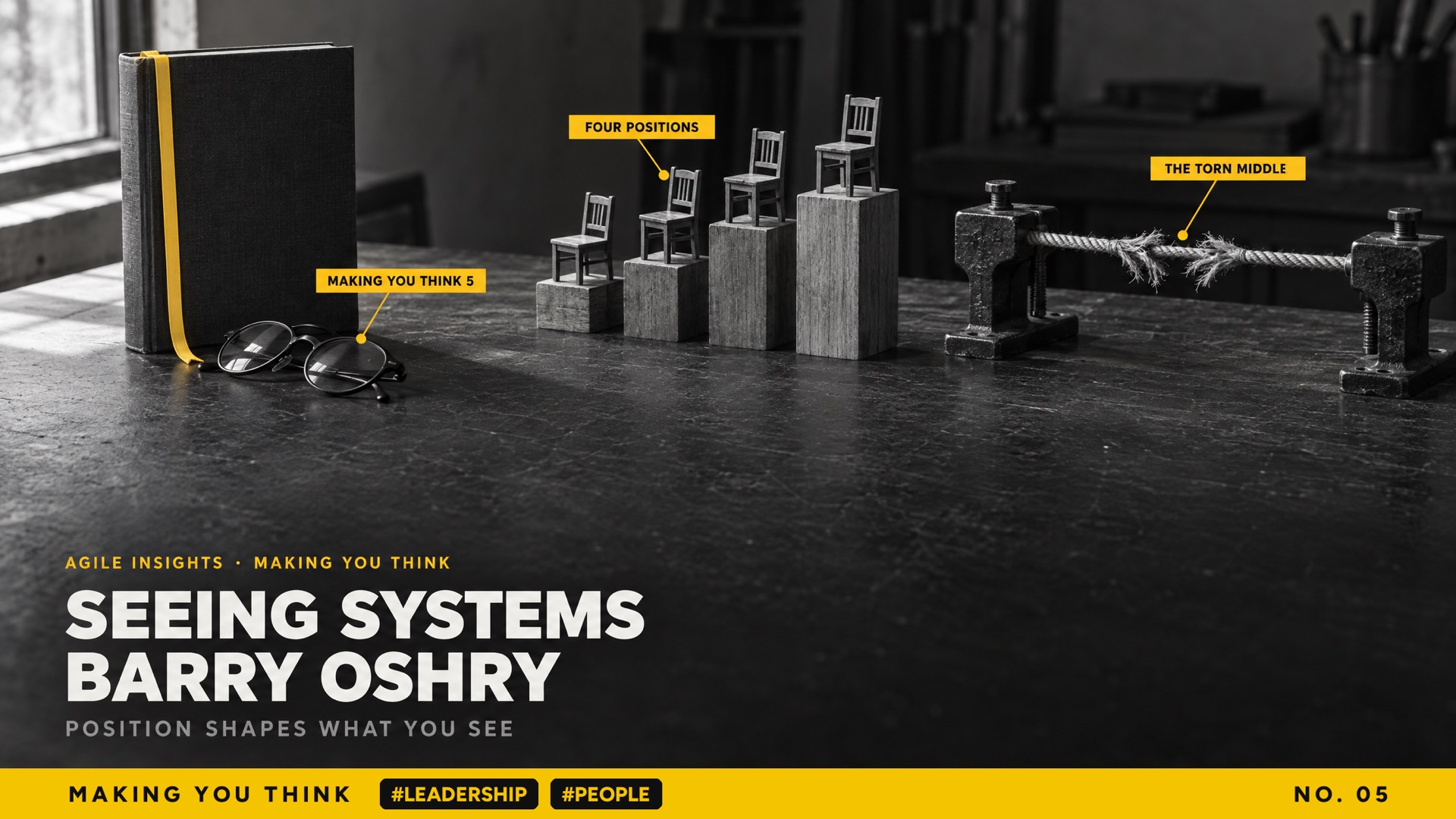
Making You Think 5 · Primer and discussion · About 16 minutes in two parts
Seeing Systems, by Barry Oshry
Part 1: Primer · About 7 minutes
Download the MP3 · Linda and Leonard, AI voices, read a script written from the sources below.
Part 2: Discussion · About 9 minutes
Download the MP3 · Linda and Leonard, AI voices, read a script written from the sources below.

This episode is about Seeing Systems: Unlocking the Mysteries of Organizational Life, by Barry Oshry. Find a copy on Amazon Australia, or ask your local bookshop or library.
In this episode
01Who Barry Oshry isAn educator and playwright who taught at Boston University, created the Power Lab around 1970 and founded Power and Systems with Karen Ellis Oshry in 1975. The book's second edition came out in 2007.
02Four positions, not four peopleTop means complexity and accountability, Middle means tearing, Bottom means vulnerability, and Customer means neglect. They are conditions we move in and out of, so one person can be all four in a day.
03Reflexes that lock into dancesTops pull responsibility up, Bottoms hold those above responsible, Middles slide into other people's conflicts, and Customers blame delivery. Oshry calls the result a dance of blind reflex, and the book names five kinds of blindness.
04A strong lens, a weak proofKott (2023) notes the theory grew from watching simulations, not from testing a hypothesis. The participant figures are self reports from his own firm, and we found no study comparing cultures.
05Take a stand, pay its priceSee your position and theirs. Tops create responsibility in others, Bottoms take responsibility for their own condition, Middles meet with other Middles, and Customers get in early, as partners.
Our summary of Oshry's four positions in our plain words, drawn from his 2010 articles and his 1999 workshop guide, not a diagram from the book.
Your turn
Three questions to ask yourself
In the last month, when did you feel burdened, torn, ignored or short-changed at work? And which position were you standing in at that moment?
Who at work have you explained by their personality, when their position might explain them better?
The last time a change landed on you without your involvement, did you hold them responsible, or take some responsibility for the condition yourself?
Two things to try, alone, with a pen
Five to ten minutesRewrite the villainOne person you have labelled, rewritten through the position they are standing in.
About ten minutesFour chairs, one weekFive interactions from your week, each placed in a position, with the reflex that cost something and the stand you could take.
About Barry Oshry
Barry Oshry is an educator and playwright. He took part in the National Training Laboratories' first applied behavioural science intern programme in 1960 and taught at Boston University, where in the 1960s he built large organisational simulations for business students. Around 1970 he created the Power Lab, a multi-day immersion in a society of Elites, Managers and Immigrants. In 1975 he and his wife and partner, Karen Ellis Oshry, founded Power + Systems, which runs the Organization Workshop through a worldwide network of trainers. They retired from the firm in 2018. He received the OD Network's Lifetime Achievement Award in 2015, and his plays include Hierarchy and Peace.
Other writing (6)
Seeing Systems: Unlocking the Mysteries of Organizational Life (2007) · Berrett-Koehler
This episode's book, in its second edition: four positions, five blindnesses, the dances of blind reflex, and a new section on uncertainty.
This episode's book, in its second edition: four positions, five blindnesses, the dances of blind reflex, and a new section on uncertainty.
Context, Context, Context (2018) · Triarchy Press
A short restatement of the ideas, written as a conversation between two consultants.
A short restatement of the ideas, written as a conversation between two consultants.
The Organic Systems Framework (2019) · Triarchy Press
A sixty-page booklet proposing a paradigm for organisation development.
A sixty-page booklet proposing a paradigm for organisation development.
Leading Systems: Lessons from the Power Lab (1999) · Berrett-Koehler
One Power Lab told as a story, with its Elites, Managers and Immigrants. Now out of the publisher's catalogue.
One Power Lab told as a story, with its Elites, Managers and Immigrants. Now out of the publisher's catalogue.
The Organization Workshop (with Tom Devane) (1999) · Power + Systems (from Collaborating for Change, Berrett-Koehler)
A short, free guide to the workshop: the positions, the reflexes and the shifts it aims for.
A short, free guide to the workshop: the positions, the reflexes and the shifts it aims for.
People in Context, Parts I and II (2010) · The Systems Thinker
The best free introduction: the four contexts, the reflexes, the stands, and the Rigid Manager case. Free to read.
The best free introduction: the four contexts, the reflexes, the stands, and the Rigid Manager case. Free to read.
Sources and links (10)
People in Context, Part I · The Systems Thinker (PDF)
Oshry's 2010 article: the four contexts, the misreadings, the reflexes and the stands with their prices.
Oshry's 2010 article: the four contexts, the misreadings, the reflexes and the stands with their prices.
People in Context, Part II · The Systems Thinker (PDF)
Peer groups at the Top, Middle and Bottom, Middle integration, and the Rigid Manager case.
Peer groups at the Top, Middle and Bottom, Middle integration, and the Rigid Manager case.
Seeing Systems, second edition · Berrett-Koehler
The publisher's page for the book (Berrett-Koehler, 2007).
The publisher's page for the book (Berrett-Koehler, 2007).
The Organization Workshop · Power + Systems (PDF)
Oshry and Tom Devane's 1999 guide: overload, disregard, crunch and neglect, and the shifts the workshop aims for.
Oshry and Tom Devane's 1999 guide: overload, disregard, crunch and neglect, and the shifts the workshop aims for.
Total System Power · GovLeaders.org
Oshry's essay on Tops as developers, Bottoms as fixers, Middles as integrators and Customers as validators.
Oshry's essay on Tops as developers, Bottoms as fixers, Middles as integrators and Customers as validators.
Two Theorists on Work Systems: Murray Bowen and Barry Oshry · MDPI (open access)
Katherine Kott, Systems, 2023. A sympathetic review that notes the theory was never tested and proposes studying a real workplace.
Katherine Kott, Systems, 2023. A sympathetic review that notes the theory was never tested and proposes studying a real workplace.
Laboratory Training in Human Relations and Organizational Behavior · ERIC
Harrison and Oshry, 1967: 357 middle managers, little change in workplace behaviour after training, and behaviour that looked strongly situational.
Harrison and Oshry, 1967: 357 middle managers, little change in workplace behaviour after training, and behaviour that looked strongly situational.
Our Leadership · Power + Systems
Power + Systems' page on Barry and Karen Oshry: Boston University, the Power Lab and their retirement in 2018.
Power + Systems' page on Barry and Karen Oshry: Boston University, the Power Lab and their retirement in 2018.
Is Barry Oshry's Systems Thinking Still Relevant at the Teal Level? · Enlivening Edge
Enlivening Edge, 2015, where Frederic Laloux argues the positions survive as relational spaces.
Enlivening Edge, 2015, where Frederic Laloux argues the positions survive as relational spaces.
AI at Work 2025: Momentum Builds, but Gaps Remain · BCG
Boston Consulting Group, June 2025: frontline regular use stalled at 51 percent, and about a quarter of frontline staff report strong leadership support.
Boston Consulting Group, June 2025: frontline regular use stalled at 51 percent, and about a quarter of frontline staff report strong leadership support.
Written from public sources and checked on 20 and 21 October 2026. We have not read the full book. Oshry's two 2010 articles, his 1999 workshop guide with Tom Devane, his Total System Power essay, the book's contents page and Kott (2023) were read in full; Harrison and Oshry (1967) as a summary; the BCG report in part. How each dance unfolds rests on reviews of the book. None of Oshry's writing we read mentions AI, and no source applies his ideas to it: the AI passage is the presenters' own. Check the book itself before quoting.
Our fact check · 45 claims: 27 confirmed, 13 reported, 1 partly right, 2 disputed, 2 unverified
Before we record, every claim the hosts make is checked against the sources (this table was last updated 20 October 2026). Confirmed means a primary source or two independent reports; Reported means one party says so; Partly right, Disputed, Unverified and Not yet known mean what they say, and the hosts say so on air. This is the table as we left it.
The author
- ReportedBorn 1932Library of Congress heading in the archive.org MARC record
- ReportedPhDOshry and Devane 1999, author note; Field and institution not found
- ConfirmedNTL intern programme, 1960; BU College of Business Administration; 1960s simulationsOshry and Devane 1999; Power + Systems “Our Leadership”; Kott 2023 quoting the book, p. 271
- ReportedFormer chair, BU Department of Human RelationsB-K author page (via search; page now 404)
- DisputedPower Lab created 1970Power + Systems; Kott gives 1970 and 1972
- ConfirmedPower + Systems founded 1975 with Karen Ellis OshryTriarchy Press; SCiO 2020 bio
- Partly rightRetired 2018Power + Systems; Triarchy (2017 in SCiO bio)
- ReportedWorldwide Week of Partnership 2013; OD Network award 2015Triarchy Press
- ConfirmedPlaysTriarchy; SCiO; TST 2010 author box
- UnverifiedAlive or deadNo obituary found; Avoid tense traps
The book
- Confirmed1st ed. ©1996 (catalogued 1995), xix + 208 pp.; 2nd ed. August 2007, paperback 9781576754559MARC record; Open Library; B-K product records
- Disputed2nd-ed. length 272 vs 304 pp.O’Reilly and Open Library vs Goodreads; Don’t quote a page count
- ConfirmedStaged as a play: Prologue (“Overcoming System Blindness”), Act I Seeing the Big Picture, Act II Seeing Patterns of Relationship, Act III Seeing Patterns of Process, Act IV Seeing Uncertainty, “The Next Act”, Epilogue; 72 numbered piecesContents page
- ConfirmedNew in the 2nd ed.: an extensive section on facing uncertainty; a new epilogue on theatre, blogs and podcastsPublisher description
- Confirmed“Tunnel of Limited Options” (scene 67)Contents page; publisher; As a term; meaning only via one review
- ReportedOshry thanks “many thousands” of participants he observed and interviewed (p. xxvi)Kott 2023, quoting the book
- ReportedHow the dances run: Tops more overwhelmed, Bottoms more disempowered; Ends less responsible, Middles more stretchedVandenbroeck review (Goodreads, 2019)
- ReportedSpatial blindness = seeing your part, not the whole; temporal = not seeing the history of the momentGetAbstract
- ReportedBook wording for the conditions: Tops overwhelmed, Bottoms “invisible and vulnerable”, Middles torn, Customers “shortchanged”Vandenbroeck review
The argument (Oshry’s own words, outside the book)
- ConfirmedThe four are “not just hierarchical positions”; they are conditions we move in and out of from event to eventOshry 2010 I, p. 2; Oshry and Devane 1999; “Total System Power”
- ConfirmedContexts: Top = complexity and accountability; Middle = tearing; Bottom = vulnerability; Customer = neglectOshry 2010 I, pp. 2–3
- ConfirmedOshry 2010 I p. 5; II conclusion
- ConfirmedContext blindness produces “arrogant” Tops, “resistant” Bottoms, “weak” Middles, “nasty” CustomersOshry 2010 I, pp. 2–3
- ConfirmedReflexes: Tops suck responsibility up and away from others; Bottoms hold others responsible; Middles slide in between others’ conflicts; Customers stay aloof and hold delivery responsible. “Not all of us, not every time, but with great regularity”Oshry 2010 I, p. 5; “Total System Power”
- ConfirmedStands and prices: Tops create responsibility in others (give up some control); Bottoms take responsibility for their condition and the system’s (give up dependency and blame); Middles keep independent thought and action in service of the system (give up pleasing everyone); Customers share responsibility for delivery (give up entitlement)Oshry 2010 I, pp. 5–6
- ConfirmedCustomers enter the delivery process “early as a partner, instead of late as a judge”Oshry and Devane 1999, Table 5
- ConfirmedTotal System Power: Developers, Fixers, Integrators, ValidatorsOshry 2010 II box; “Total System Power”
- ConfirmedPeer groups: “mine” (Top territoriality), “I” (Middle alienation), “we” (Bottom groupthink)Oshry 2010 I p. 4, II pp. 2–3
- ConfirmedRobust System: differentiates, homogenises, individuates, integrates. Middle alienation = individuation without integration; fix: “Integration strengthens individuation”Oshry 2010 II, pp. 3–4; II misprints the Top formula
- ConfirmedRigid Manager case: six department managers face an initiative alone; the Middle peer group is “the key leverage point”; its job is an agreed strategy, which may be not to implementOshry 2010 II, pp. 4–5
- ConfirmedTOOT (“Time Out Of Time”): the action stops and each group says what life is like in its positionOshry 2010 I, p. 4
- Confirmed“Seeing context is an unnatural act”Oshry 2010 II, p. 5
- ConfirmedOshry does not want front-line staff called “Bottoms”; the workshop is not role playOshry and Devane 1999, pp. 23–24
- ConfirmedEight levels of Middle integration, each needing more Top supportSales, TST 17(9), Nov 2006; As Sales’ account of Oshry
Evidence and critiques
- ConfirmedAn emergent theory from watching simulations, not a tested hypothesis; it “lacks the typical methodological data associated with an academic study”Kott 2023
- ReportedNo academic article on the theory until 2020; Kott proposes testing it in a real work system such as a start-upKott 2023; / Confirmed
- ConfirmedKott: his remedies “might require attention from a consultant or coach”Kott 2023
- ConfirmedOshry often observed his own labs as the “anthropologist”Oshry 2010 I, p. 4
- Confirmed“Hundreds” of simulations, ~40,000 participants who “overwhelmingly report” the theory fitsSales 2006 (a P+S senior associate for 20 years); As Sales’ claim; self-report, not independent
- ReportedPower Lab graduate survey 1983–2007: 92% significant impact, 97% good use of time, 100% significant learningPower + Systems Power Lab page; Firm’s own survey
- ConfirmedLab training changed little in managers’ workplace behaviour (357 managers)Harrison and Oshry 1967; (summary): supports “it’s the situation” and raises the transfer question for workshops
- ReportedSame exercise run in Central America, Australia, Germany, UK, South Africa, Hong Kong, SingaporeOshry and Devane 1999, p. 23; (authors’ claim); no cross-cultural study found
- ReportedPositions persist in self-managing organisations as “relational spaces”Laloux, via Enlivening Edge 2015
- ReportedReaders find the writing repetitive or “touchy-feely”Goodreads reader reviews; Informal
- UnverifiedNo controlled test, replication or published critique beyond KottSearches: journals, Semantic Scholar, OpenAlex, DOAJ, ERIC (21 Oct); Absence
Want to know more?
Sign up for our podcast at agile-insights.com.au.
Read the transcript · Part 1: Primer
Linda Seeing Systems says that where you stand in an organisation shapes what you see, feel and do. So much of what we blame on people's personalities is really their position. I'm Linda, and this is the fifth episode of Making You Think. The book is Seeing Systems, Unlocking the Mysteries of Organizational Life, by Barry Oshry. The second edition came out in two thousand and seven. By the end of this part you will know who he is, his argument in four steps, and his key words.
Leonard And I'm Leonard. First, the author. Barry Oshry is an educator and a playwright. In nineteen sixty he joined the first intern programme in applied behavioural science at the National Training Laboratories. He then taught at Boston University, where he built large simulations of organisations for business students. Around nineteen seventy he created the Power Lab. It is a live in society that runs for several days, with an elite, managers and new arrivals. In nineteen seventy five he and his wife, Karen Ellis Oshry, founded a firm called Power and Systems. They retired from it in two thousand and eighteen.
Linda Quite a classroom.
Linda A word on our sources. We haven't read the full book. This episode rests on Oshry's own articles, the book's contents page, and reviews. His ideas grew from decades of watching his simulations. People are put into positions at random, given no instructions, and left to cope. Again and again he saw the same patterns, whoever happened to be in the role. That is where step one begins.
Leonard So what is step one?
Linda There are four positions, Top, Middle, Bottom and Customer, and they are conditions, not people. In his words, they are conditions we move in and out of from event to event. You are Top when you are responsible for a system or a piece of one. That world is complexity and accountability...
Leonard Oh, that sounds familiar.
Linda You are Middle when two parties pull you in different directions. He calls that tearing. You are Bottom when decisions land on you without your involvement. That is vulnerability. And you are Customer when you wait on someone else for what you need. That is neglect.
Leonard So one person can be all four in one day. At breakfast you're Top, in charge of getting the kids out the door. At ten you're Middle, between your team and your boss. At noon the restructure email arrives, and you're Bottom. At three you're on hold to the help desk, a Customer. Oshry tells of a junior engineer who ran a small project and felt overwhelmed and responsible for everything. He was low on the ladder, but on that project his condition was a Top's.
Linda We've all had that day.
Linda Step two. We see people, not their positions. Oshry calls this system blindness, and the book names five kinds. Spatial blindness is seeing your own part and not the whole. Temporal blindness is missing the history that led to this moment. Relational blindness misses the patterns between positions. Process blindness misses what groups do over time. Uncertainty blindness, added in the second edition, is about how we run from not knowing. The result is that we invent villains: the arrogant Top, the resistant Bottom, the weak Middle and the nasty Customer.
Leonard His own example is a good one. You send your manager a good idea. A week goes by, then two, and nothing. You decide your manager is arrogant, and you stop offering ideas. From where your manager sits, though, your idea was one more complication in a day already full of them. Nobody meant any harm. You each read the other through your own position.
Linda I've done that.
Linda Step three. Each position comes with a reflex. Tops pull responsibility up to themselves and away from others. Bottoms hold the people above them responsible. Middles slide in between other people's conflicts and make them their own. Customers stand back and blame whoever is delivering. He says this happens not to everyone, and not every time, but with great regularity...
Leonard So they feed each other?
Linda And the reflexes fit together. He calls the result a dance of blind reflex. The book names three: Top and Bottom, the Middle between two Ends, and Provider and Customer.
Leonard Here is how a dance looks from the inside. A manager fixes every problem herself, because it is so clearly her job. Her team, never asked, stops bringing solutions and starts bringing complaints. So she takes on even more, and feels more burdened. They feel more ignored. Each side now has proof that the other is the problem. Inside groups the same thing happens: turf wars among Tops, Middles who drift apart, and Bottoms who close ranks.
Linda Oh, I know that one.
Linda Step four is the way out. First, see the position, yours and theirs. Then take what Oshry calls a stand instead of the reflex, knowing that each stand has a price. Tops create responsibility in others, and give up some control. Bottoms take responsibility for their own condition and the system's, and give up blame. Middles keep their own independent judgement in service of the whole, and give up trying to please everyone. Customers get into the delivery process early, as partners, and give up the sense of being owed.
Leonard And for Middles there is one more move. Meet with the other Middles. Share what each of you sees, work out together what is going on, and agree a common approach. Oshry also heads off a misunderstanding. This is not only about hierarchy. He says the same patterns turn up in flat organisations, and he doesn't want anyone called a Bottom at work. The labels describe a condition you are in, not a rank you hold.
Linda So here is a question for you. In the last month, when did you feel burdened, torn, ignored or short-changed at work? And which position were you standing in at that moment?
Leonard Hold on to your answer. In Part Two we weigh the case for Oshry and against him, and look at what happens when AI lands in an organisation. See you there.
Read the transcript · Part 2: Discussion
Linda Seeing Systems says that where you stand in an organisation shapes what you see, feel and do. So much of what we blame on personality is really position. I'm Linda, and this is Part Two of Making You Think, episode five, on the book by Barry Oshry. A quick recap. Tops live with complexity and accountability, Middles are torn, Bottoms are vulnerable, and Customers are neglected. Each position has a reflex, and the reflexes lock into what he calls dances. The way out is to see the position and take a stand. As before, we haven't read the full book. This rests on his articles, the contents and reviews.
Leonard And I'm Leonard. The case at its strongest first. Oshry takes the most common move at work, blaming the person, and offers an explanation people recognise at once. It also gives everyone, at every level, something to do on Monday that costs nothing. And it fits a finding from his own early research. In nineteen sixty seven he and Roger Harrison studied three hundred and fifty seven middle managers who had been through human relations training. Back at work, their behaviour showed no significant change overall. The authors wrote that what drives behaviour at work seems strongly situational. Position, in other words, and not only the person.
Linda Now that's a striking result.
Linda His best worked example shows why that matters. A change programme arrives in a division. Six department managers each face it alone, caught between the new initiative and the daily demands of their boss. One of them, Charles, ignores the initiative and keeps his boss happy. The consultants decide Charles is the problem and set out to develop him. Oshry says the real leverage is the six managers as a group. Suppose they meet, share what they see and agree one strategy, even a strategy of not going ahead. Then the boss gets a more consistent story, and nobody is torn alone. So, a question for you. Who at work have you explained by their personality, when their position might explain them better?
Leonard Which leads to our first activity. It takes five to ten minutes, alone, on paper. Write down the name or initials of someone at work you have given a label to, and write the label. Arrogant, resistant, weak, difficult. Underneath, write their context. What lands on them, from whom, and what they can't see from where they sit. Then write one thing you could do that makes it easier for them to do what you need. That last step is Oshry's own first piece of advice: take other people's contexts into account.
Linda Now the pushback, and the first is about evidence. In twenty twenty three, Katherine Kott of Fielding Graduate University reviewed Oshry's theory in the journal Systems. She is sympathetic, but plain. The theory emerged from watching simulations rather than from testing a hypothesis, so it lacks the usual data of an academic study. Oshry also often watched his own labs as their observer...
Leonard Which is fair.
Linda She suggests testing it in a real workplace, perhaps a new start up, to see whether the same positions and tensions appear. As far as we could find, nobody has yet run that test.
Leonard The numbers people quote don't settle it either. A senior associate of Oshry's firm wrote in two thousand and six that about forty thousand people had taken part in these programmes. He said they overwhelmingly report that the theory matches their experience. The firm's own survey of Power Lab graduates reports very high satisfaction. Those are counts and self reports from inside the work, not outcomes measured independently. And there is a twist. His nineteen sixty seven study found that training changed little back at work. That supports his view of the situation, but it also asks hard questions of any workshop, his own included.
Linda There's always a twist.
Linda The second worry is reach. The model was built in American organisations with clear hierarchies. Oshry and his co author Tom Devane wrote that the same exercise had been run in Australia, Germany, South Africa, Singapore and elsewhere. That is their claim of use, and we found no study comparing cultures. On flat organisations, the writer Frederic Laloux, not Oshry, has argued that the positions survive as relational spaces rather than boxes on a chart. Kott adds one more limit. His remedies, she writes, might require attention from a consultant or coach. And readers split on the style, a play with poems and fables. Several call it repetitive.
Leonard I'll push on that limit about needing a coach, because I think it matters most. If the fix needs a facilitator, most people will only ever get the diagnosis. And the people who most need it, the managers stuck alone in a tearing middle, are the least likely to be sent to a workshop. So I'd call it a lens, not a method, until someone shows it working in a real organisation over time.
Linda I partly disagree. The stands need no facilitator. A Top can hand a problem back. A Middle can ring two other Middles and compare notes. A Customer can turn up early. Those cost a conversation, not a contract. But I accept your test, so let's settle it this way. It is a strong lens and a weak proof. Use it to explain why a situation feels the way it does, and to find cheap moves. Don't use it to predict how much or how fast. That is where last episode's book, Donella Meadows on systems, is stronger.
Leonard Agreed, and that is our verdict, which you are welcome to argue with. Now, AI, and carefully...
Linda Carefully is right.
Leonard Oshry's book came out in two thousand and seven, and none of his writing that we read mentions AI. We found no source that applies his ideas to it. So what follows is ours. Picture a company that switches on an AI assistant for everyone on the same day. From the Top chair, it is a strategy, a board question, and accountability for the risks. From the Middle chair, it is a mandate from above and an anxious or sceptical team below. His framework suggests Middles will align up, align down, or try to carry it alone.
Linda And from the Bottom chair, it is one more thing done to us. Oshry's own example of so called resistant Bottoms is a new initiative that people simply expect to wait out. The Customers are the people affected by what the AI produces, and they are often brought in late, as judges, not early, as partners. One survey fits the picture. Boston Consulting Group's AI at Work report in twenty twenty five found frontline regular use stuck at about half. Leaders and managers ran far higher. Only about a quarter of frontline staff felt strong support from their leaders. That gap is what position would predict. It isn't proof of the theory.
Leonard So the moves for an AI rollout follow his stands. Put the Middles together, as a group that owns adoption and agrees its own approach. Let the Tops create responsibility rather than collect it. Bring the affected people in early, as partners. And a question for you. The last time a change landed on you without your involvement, did you hold them responsible, or take some responsibility for the condition yourself?
Linda The second activity follows from that, and it takes about ten minutes. List five interactions from the past week. Next to each, write whether you were Top, Middle, Bottom or Customer. Write the feeling, burdened, torn, oppressed or short-changed, and what you did. Then circle one where your reflex cost something. Perhaps you took it all on, blamed upward, got caught in the middle, or stood back and waited. Write the stand you could take next time, and what it would cost you.
Leonard So, what to carry away. One, before you judge a person, ask which position they are standing in, and which one you are in. Two, every position has a reflex, and the reflexes lock together, so changing your half changes the dance. Three, take a stand and pay its price. For Middles, that starts with finding the other Middles. It is a lens, not a proof, and that is how we would use it.
Linda If you'd like to know more, sign up for our podcast at agile-insights.com.au.
Leonard Thanks for listening.
More on #leadership
Episode 34 · Primer and discussionWhen the test stops telling you anything: hunger beats tenureMaking You Think 12 · Primer and discussionThe Game Changer, by Jason FoxEpisode 6 · DiscussionThe Five Dysfunctions of a Team: a checklist for AI adoption, not a lawEpisode 38 · Primer and discussionBudgeted for seats, billed for workEpisode 23 · Primer and discussionWhat FDE means at OpenAI: skills, not custom code.Episode 21 · DiscussionTrust cannot be rushed: how much authority will you give AI?
Every episode tagged #leadership
All of Making You Think (13) · Follow Making You Think in Apple Podcasts or any podcast app
Everything from Agile Insights: briefings, Making You Think and the reference series