 Briefing
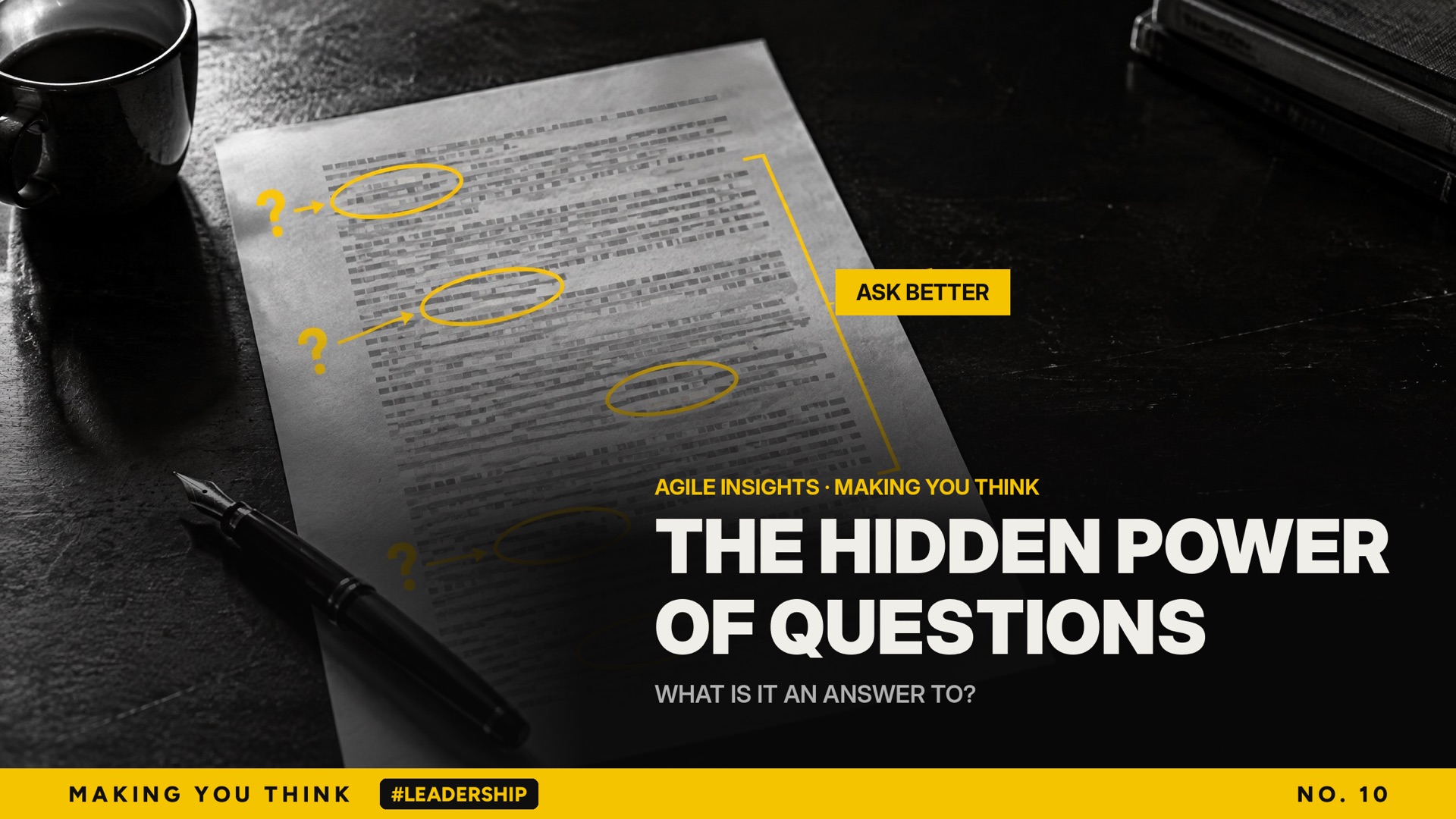
Making You Think 10 · Primer and discussion · About 15 minutes
Q: The Hidden Power of Questions, by Lani Watson
Part 1: Primer · About 7 minutes
Download the MP3 · Linda and Leonard, AI voices, read a script written from the sources below.
Part 2: Discussion · About 9 minutes
Download the MP3 · Linda and Leonard, AI voices, read a script written from the sources below.

This episode is about Q: The Hidden Power of Questions in a World That Wants Answers, by Lani Watson. Find a copy on Amazon Australia, or ask your local bookshop or library.
Based on essays and our own research.
In this episode
01What is ChatGPT an answer toOne of Watson's favourite questions at the moment, from a Philosophy Bites interview: it answers a million questions, but what problem was it built to solve? We rush to answers without checking the question.
02A question is an actWatson defines a question as an information seeking act, judged by what it does, not by a question mark. Looking both ways counts; a rhetorical question does not. Her book has no question marks.
03We are taught to stopOne study she draws on, as the Spectator reports, found young children ask about 107 questions an hour. Questioning declines once school starts, where teachers ask and students answer.
04Who gets to ask whatQuestions are power that can be misused and is unevenly shared, as in courtrooms. Reviewer Ian James Kidd warns the deeper risk may be ceasing to care about answers or questions.
05Ask what it answersBefore adopting any tool or A I system, write the question it answers, who asked it and who never got to ask. If nobody can name the problem, start there.
Your turn
Three questions to ask yourself
In the last meeting you were in, who asked the questions, and who was only expected to answer?
What is the last tool your organisation adopted, and what was it an answer to?
Which question have you not asked at work, and what stopped you?
Two things to try, alone, with a pen
10 minutesCount the questionsWrite out the last hour of your working day, then count every question in it, spoken or not.
5–10 minutesWhat is it an answer toPick one tool or A I system your team relies on and find the question it answers.
About Lani Watson
Philosopher and honorary fellow at the University of Edinburgh, formerly a research fellow at the University of Oxford. Her Edinburgh doctorate (2015) was Why Ask: The Epistemology of Questioning; as a Leverhulme Early Career Fellow she organised OPEN-Scotland, a philosophy-in-schools network launched in 2019. She runs Philosophy of Questions and is known online as the Questions Doctor. Q is her first book.
Other writing (3)
Q: The Hidden Power of Questions in a World That Wants Answers (2026) · The Bodley Head
Her first book, on why questions matter more than answers.
Her first book, on why questions matter more than answers.
Philosophy of Questions (2026) · philosophyofquestions.com
Her project site: a questioning strengths assessment and a collection of questions.
Her project site: a questioning strengths assessment and a collection of questions.
Why Ask: The Epistemology of Questioning (2015) · University of Edinburgh
Her doctoral thesis on the philosophy of questioning.
Her doctoral thesis on the philosophy of questioning.
Sources and links (8)
Penguin UK, Q publisher page with "Look inside" sample · penguin.co.uk
Philosophy Bites, "Lani Watson on the Power of Questions", 22 Aug 2026 · philosophybites.libsyn.com
Choose to Be Curious, ep. 335, "The Hidden Power of Questions, with Lani Watson", 5 Aug 2026 · soundcloud.com
Lani Watson, "In a World Full of Answers, Ask Better Questions", Next Big Idea Club · nextbigideaclub.com
Ian James Kidd, "Questioning Questions", Daily Philosophy, 12 Sep 2026 · daily-philosophy.com
Joe Dolce, "Why we should never be afraid to ask questions", The Spectator Australia, 5 Sep 2026 · spectator.com.au
Philosophy of Questions (her site: assessment, questionnaire) · philosophyofquestions.com
Based on essays and our own research, checked on 21 October 2026. The author's argument is paraphrased, not reproduced. Check the original before quoting.
Our fact check · 54 claims: 44 confirmed, 7 reported
Before we record, every claim the hosts make is checked against the sources (this table was last updated 21 October 2026). Confirmed means a primary source or two independent reports; Reported means one party says so; Partly right, Disputed, Unverified and Not yet known mean what they say, and the hosts say so on air. This is the table as we left it.
- ConfirmedUK Bodley Head 2026, 320 pp; HB 9781847927842, TPB 9781847927859Sample PDF copyright page; Penguin AU; Penguin AU: TPB 1 Sep 2026
- ConfirmedUS Viking, 4 Aug 2026, ISBN 9780593830987; audiobook read by author 8 h 48 mPRH US
- ConfirmedScript says "came out in August 2026"PRH US; Penguin UK ebook/audio 27 Aug
- ConfirmedHonorary fellow, Edinburgh; formerly research fellow, OxfordJacket; Penguin AU; NBI
- ReportedEdinburgh PhD Why Ask, 2015ERA record via search index; Page 403; title and date from the index
- ReportedLeverhulme ECF; organised OPEN-Scotland, launched 2019Edinburgh PPLS news via search index; Two snippets agree
- ConfirmedRuns Philosophy of Questions; "the Questions Doctor"Philosophyofquestions.com; Dolce
- ConfirmedFirst bookA. M. Heath
- Confirmed"What is ChatGPT an answer to" is "one of my favorite questions at the moment"; "a million questions" it answers; "what was the actual problem … I'm not sure"Philosophy Bites, 22 Aug 2026, 14:00; Interviewer is Nigel Warburton
- ConfirmedBook warns of "finding brilliant solutions to problems that don't exist"Sample p. 12
- Confirmed"Answer-oriented world"Sample p. 9; Dolce
- ConfirmedA question is "an information-seeking act"Philosophy Bites 02:55; Choose to Be Curious 03:54; Kidd
- ConfirmedSurvey: most count looking both ways, and a dictionary look-up, as questionsPhilosophy Bites 03:02; "a very high percentage"
- ConfirmedRhetorical questions are not questionsPhilosophy Bites 04:16
- ConfirmedNo question marks in the bookSample p. 6 note; Dolce
- ConfirmedDropped question marks from her own writing; "nobody really mentioned it"Choose to Be Curious 05:12–06:19
- ConfirmedBook opens with "Where are you." and its effect on attentionSample pp. 1–2
- ConfirmedMagician / doctor / headline examples of attentionNext Big Idea Book Bite
- ConfirmedCuriosity gives a dopamine hit; we remember answers to our own questions betterSample pp. 3–4; NBI; Dolce; Her report of research
- ConfirmedAsking "How are you" and listening shows careNBI insight 3
- ReportedYoung children ask about 107 questions an hour with adults ("one study")Dolce, Spectator, reporting the book; Attributed on air to "one study she draws on, as the Spectator's review reports". Likely Chouinard (2007) CHILDES monograph; a secondary summary gives ~108/hour; Frontiers gives 76 information-seeking/hour. Primary not opened
- Confirmed"One to three questions a minute"NBI Book Bite; Her words
- ConfirmedQuestioning declines on entering school, "drops off a cliff" by secondaryPhilosophy Bites 14:45
- ConfirmedGold star for spelling MONDAY; "rarely gold stars for asking the right questions"Sample p. 10; Paraphrased
- ConfirmedAdult life (exams, interviews, meetings) rewards certaintyNBI
- ConfirmedChapter 7 is "Who gets to ask what"Sample contents
- ReportedCourtroom: lawyers ask, witnesses answer; traced to AristotleDolce; Reviewer's account
- ConfirmedBook covers hospitals, politics, mediaSample p. 6
- ConfirmedQuestions can expose falsehoods, ensure justice, and be "a means of dominance and control"Sample p. 2
- ConfirmedPower can be misused and is unevenly distributed; questions we feel we can't askChoose to Be Curious (~19:00)
- ConfirmedAporia definition; "a precursor to curiosity"Sample p. 20
- ConfirmedQuestioning mindset comfortable with uncertaintySample p. 13
- ConfirmedKidd: Q "at its best on the power of questions"Kidd review
- ConfirmedWarburton's sceptic challenge and Watson's replyPhilosophy Bites 13:04
- Confirmed"Search for answers should [not] be abandoned"Sample p. 12
- ConfirmedDefinition unchanged ~15 years, open to being wrongChoose to Be Curious 04:01–04:14
- ConfirmedDolce: "immensely entertaining"Spectator
- ReportedGuardian: "deceptive simplicity"Penguin UK blurb; Blurb only
- ConfirmedKidd: epistemic insouciance (Cassam); conspiracy theorists as skilled questioners; "ceasing to care enough about either"Kidd review
- ReportedWatson warns against "just asking questions"Kidd, reporting the book
- ReportedAristotelian slogan (right question, person, time, way, reasons)Kidd, reporting the book
- Confirmed"Knowing how to question includes knowing when to stop"Kidd; Kidd's summary, attributed to him on air
- ConfirmedHer questioning strengths: philosopher top, inquirer bottom; overuses philosopherChoose to Be Curious (~11:00–13:00)
- ConfirmedInstant answers weaken the habit of asking and questioning skills; better questions for devices, harder ones for buildersNBI insight 5
- Confirmed"We stop asking each other"; "our questioning muscles … quietly they start to waste"; AI generates follow-up questions for usNBI Daily, 10 Aug 2026, ~14:20–15:40 (her reading of the Book Bite); Script paraphrases
- ConfirmedJob interview: as a young woman she would not ask about parental leave; the absent question revealed the power dynamicChoose to Be Curious (~20:00)
- ConfirmedYoung children ask "between one and three questions every minute" with familiar adultsNBI Daily ~11:40; Same as the essay
- ConfirmedBook examines why machines may never ask questions for themselvesSample p. 6; Chapter content unread
- ConfirmedEmpty appendix for the reader's questionsSample contents and p. 14; Dolce
- ConfirmedCount-the-questions exercise (her morning; her count sixteen)Sample pp. 16–17; Adapted for Activity 1
- ConfirmedTen Q Tools at the end of the bookSample p. 13; Names unknown; not listed on air
- "You might disagree with half of it…" as Dolce's verdictSpectator page; False; It is the magazine's strapline
- AI use-case intake test; who can question an AI system; training people to ask as a controlHosts; Ours; Marked on air as our extension
- "Questions can be a way to avoid deciding"Hosts; Ours; Marked on air
Want to know more?
Sign up for our podcast at agile-insights.com.au.
Read the transcript · Part 1: Primer
Linda Here is the idea for today. We are trained and rewarded for our answers, but asking a question is the more powerful act. Questions steer our attention, show what we care about, and shape what happens next. That is the argument of Q, by the philosopher Lani Watson. By the end of this part you will know what she thinks a question actually is, why we stop asking them, and who gets to ask. This is Making You Think, episode ten.
Leonard And she has spent a long time on this one subject. Lani Watson is a philosopher, an honorary fellow at the University of Edinburgh, and formerly a research fellow at the University of Oxford. Her Edinburgh doctorate, finished in 2015, was called Why Ask, on the philosophy of questioning. As a Leverhulme early career fellow she organised OPEN Scotland, a network for people who teach philosophy, in schools and beyond, launched in 2019. She runs a website called Philosophy of Questions, and is known online as the Questions Doctor. Q is her first book. It came out in August 2026, from the Bodley Head in the U K and Viking in America.
Linda Let me start with the question she says is one of her favourites at the moment. In an interview on the Philosophy Bites podcast in August 2026, she put it like this... what is Chat G P T an answer to? Her point was careful. It answers a million questions, she said. But when the technology was being built, what was the actual problem it was meant to solve? She was not sure. That is the book in miniature. In what she calls an answer oriented world, we rush towards solutions without checking the questions first. In the book she warns about brilliant solutions to problems that do not exist.
Leonard We have all sat through one.
Linda We have.
Leonard So her complaint is not really with Chat G P T. It is with skipping the step before the answer. But if questions matter that much, surely we already know what one is? It is the thing with a question mark on the end.
Linda That is her first step, and she says no. Watson defines a question as an information seeking act. What makes something a question is what it does, not what it looks like. So a question does not need to be spoken at all. In that same interview she mentions a survey she has run for years, where most people count looking both ways before crossing the road as a question. Looking up a word in a dictionary counts too. A rhetorical question, on the other hand, is not a question, because it is not seeking anything. And to prove the point, the book itself contains no question marks. Every question ends in a full stop. She dropped them from her own writing years ago, and she says almost nobody noticed.
Leonard I like that the book argues by doing. So the first step is that a question is defined by what it does. What does it actually do to us, then?
Linda Step two is that questions steer attention. The book opens with two words, where are you, and asks you to notice what just happened. Your eyes shifted. A thought appeared. In a short essay for the Next Big Idea Club, she compares this to a magician, who asks the audience a question so that nobody watches the hand...
Leonard Oh, that is exactly how it works.
Linda A doctor's questions decide what gets noticed in a consultation. And the brain rewards it. Watson reports research showing that curiosity triggers a small hit of dopamine, and that we remember information better when it answers a question we asked. Questions also show care. Asking someone how they are, and really listening, gives them your attention.
Leonard Then why are we so bad at it? Most of the adults I know would rather be seen to know than be seen to ask.
Linda That is her third step. We are taught to stop. One study she draws on, as the Spectator's review reports, found that young children ask about one hundred and seven questions an hour in conversation with adults. In the Next Big Idea essay she puts it as one to three questions a minute. Then they start school. On Philosophy Bites she said that questioning declines quickly once children enter school, and has more or less dropped off a cliff by secondary school. Teachers ask and students answer. She remembers winning a gold star for spelling the word Monday. There are rarely gold stars, she writes, for asking the right question. And adult life keeps the same scoring system, in exams, interviews and meetings.
Leonard That many.
Linda Exhausting, if you are the parent.
Leonard And the fourth step, I gather, is about power.
Linda It is. One chapter is called Who gets to ask what. In a courtroom, as the Spectator's review describes it, lawyers ask the questions and witnesses may only answer, a lopsided arrangement she traces back to Aristotle. The book follows the same question into hospitals, politics and the media. Watson is clear that this power cuts both ways. Questions can expose falsehoods and help deliver justice. They can also be used for dominance and control. Two more of her terms are worth having. Aporia is an ancient Greek word for the bafflement of realising you do not know what you thought you knew. She calls it a precursor to curiosity. And a questioning mindset, the goal of the book, is one that is comfortable with that uncertainty.
Leonard Before Part 2, a question for you. Think of the last meeting you were in. Who asked the questions, and who was only expected to answer?
Linda In Part 2: where the argument is strong, the reviewer who thinks the real problem is something else, and what all this means when the answers come from a machine. See you there.
Read the transcript · Part 2: Discussion
Linda The idea again, in one sentence. We are rewarded for answers, but asking is the more powerful act, and Lani Watson thinks that matters more now that machines supply answers on demand. A quick recap of the terms from Part 1. A question, for Watson, is an information seeking act, defined by what it does rather than how it looks. An answer oriented world rushes to solutions without checking the questions. Aporia is the useful bafflement of finding you do not know. And a questioning mindset is comfortable with that. Today, where the argument is strong, where a reviewer pushes back, and what it means for anyone governing A I.
Leonard Let me start with the strength. The book is at its best on power, according to the philosopher Ian James Kidd. Kidd reviewed it for Daily Philosophy in September 2026. He says Q is at its best on who gets to ask, who is expected to answer, and how institutions build that in. In an interview on the Choose to Be Curious podcast, Watson put it simply. Once you see questions as power, two things follow. The power can be misused, and it can be unevenly shared. Her own example is a job interview. As a young woman, she wanted to ask about parental leave, and knew she could not. That absent question told her a lot about the power in the room.
Linda That one lands.
Linda The second strength is that she is fair to answers. On Philosophy Bites, Nigel Warburton played the sceptic. Questions are all right, he said, but I want the answers. Watson's reply was that she has no quarrel with answers in themselves. Her worry is pursuing answers without due regard for the questions. The book says the same thing in its introduction: the search for answers should not be abandoned. And she holds her own answer loosely. She told Choose to Be Curious that her definition of a question has not changed in about fifteen years, and that she is still open to it being wrong. That is a writer practising what she recommends.
Leonard Now the critics. Most reviews have been warm. Joe Dolce, in the Spectator, called it immensely entertaining, and the publisher quotes the Guardian praising its deceptive simplicity. The sharpest pushback comes from Kidd himself, and it is a good one. He asks what happens when people simply stop caring whether they know. He borrows the philosopher Quassim Cassam's term, epistemic insouciance, a shrugging lack of concern for evidence and truth. Kidd also notes that plenty of questions are asked in bad faith. A conspiracy theorist can be a superb questioner...
Linda Just asking questions.
Leonard So asking lots of questions is no proof of a serious mind. Watson agrees on that last point. As Kidd notes, the book warns that someone who is just asking questions may be planting an idea.
Linda And Kidd's conclusion is worth sitting with. The deeper problem, he suggests, may not be that we care too much about answers and too little about questions. It may be that we risk ceasing to care enough about either. I think that is a real correction, but not a refutation. Watson's cure is not more questions for their own sake. In Kidd's own summary, her ideal is the right question, of the right person, at the right time, in the right way, for the right reasons. A questioner like that already cares about the truth. So the two of them end up closer than the review first sounds.
Leonard I want to add an objection of our own, and this one is ours, not a reviewer's. Questions can also be a way to avoid deciding. Every organisation has someone who meets each proposal with one more question, and the decision never comes. In a world that rewards answers, endless questioning can look like rigour while it quietly blocks the work. A board needs a decision on Thursday, not a beautiful state of aporia.
Linda Every organisation has one.
Linda That is fair, and I think the book has room for it. Kidd reports that, for Watson, knowing how to question includes knowing when to stop. And on Choose to Be Curious she described her own questioning strengths. Her strongest style is the philosopher. Her weakest is the inquirer, the one that just gets to the point and solves the problem. She admitted overusing the philosopher in the wrong place. So the answer to your objection is hers already. Good questioning includes choosing the question that lets you decide.
Leonard Which brings us to A I. Here is what is Watson's. One of her favourite questions, what is Chat G P T an answer to, came from that Philosophy Bites interview. In her Next Big Idea essay she argues that instant answers mean we stop asking each other. Our questioning muscles, the ones we relied on as children, quietly start to waste. Technology still depends on our questions, she writes, so we need better questions for our devices and harder ones for the people building them. And the book's introduction says it looks at why machines may never ask questions for themselves. Now here is what is ours. For anyone governing A I, that question is a ready made intake test.
Linda So here is our extension, and we are not putting it in her mouth. First, every proposed A I use case should be able to say what it is an answer to, and who asked. If nobody can name the problem, you may have a solution looking for one. Second, her chapter title, who gets to ask what, is a governance question. Who can question an A I system's output?... The staff using it, the customers affected, an auditor? Third, if answer machines do weaken our questioning, as she argues, then training people to ask is part of the control. So a question for you. What is the last tool your organisation adopted, and what was it an answer to?
Leonard Two short activities, each five to ten minutes, with a pen and paper. The first is called Count the questions, and it borrows an exercise from the book. Write down, in plain sentences, the last hour of your working day. Then go back and count the questions. Include the ones you asked without words, like checking a screen or a face. Next to each one, write who or what you asked: a person, a search box, or an A I tool. Then add one line at the bottom for a question you wanted to ask and did not. Ask yourself why.
Linda The second is called What is it an answer to. Pick one tool, process or A I system your team now relies on. Write the question it answers, in one sentence. Then write who asked that question in the first place. Then write who never got to ask anything about it. Finally, write one question you would put to the people who built it or chose it. If you cannot fill in the first line, that is your finding. Watson's book closes with an empty appendix for the reader's own questions, so you are in good company.
Leonard Good company indeed.
Leonard So what to carry away. First, a question is an act, and it steers attention before any answer arrives. Second, who gets to ask is a form of power, and it is rarely shared evenly. Third, before you adopt an answer, find the question it answers, and the person who asked it. And as Ian James Kidd reminds us, none of this works unless we still care about the truth.
Linda If you'd like to know more, sign up for our podcast at agile-insights.com.au.
Leonard Thanks for listening.
More on #leadership
Episode 38 · Primer and discussionBudgeted for seats, billed for workEpisode 34 · Primer and discussionWhen the test stops telling you anything: hunger beats tenureEpisode 23 · Primer and discussionWhat FDE means at OpenAI: skills, not custom code.Episode 21 · DiscussionTrust cannot be rushed: how much authority will you give AI?Making You Think 13 · Primer and discussionHow to Lead a Quest, by Jason FoxMaking You Think 12 · Primer and discussionThe Game Changer, by Jason Fox
Every episode tagged #leadership
All of Making You Think (13) · Follow Making You Think in Apple Podcasts or any podcast app
Everything from Agile Insights: briefings, Making You Think and the reference series